Launched: 9 December 2006. Last updated: 1 March 2015
I have plunged into a new documentary called "Ice Eagles: An Account of American Aviation in Antarctica." It is obviously not a book; however, it will make extensive use of many historical books on the subject as well as many personal interviews. I have been working on this film since early 2014, collecting research material and interviewing 21 people in Norfolk, VA and Pensacola, FL. I am planning at least five more trips and at least 40 more interviews. I hope to release the film in the Spring of 2016. So far, this has all been at my expense but now I will need funding to finish the project. I am using Kickstarter.com to hopefully accomplish this. You can view my Kickstarter project at: https://www.kickstarter.com/projects/1688326180/ice-eagles-an-account-of-american-aviation-in-anta For those not familiar with Kickstarter, it is a crowd-funding website that gives creative people an opportunity to seek community support for their projects. The person submitting a project gets a project page on the website which describes what they are creating, lists rewards for those who contribute, and provides other information on the project. A funding goal is set and the time period for supporters to pledge funds is also set, in my case 45 days. At the end of 45 days, if the funding goal is met, I will receive all of the monies pledged including anything pledged beyond the goal. If the goal is not met, I get zero. In other words, ALL OR NOTHING. Kickstarter requires that pledges be made online by credit card so that the pledge can be held pending the outcome and cancelled if the goal is not reached. I know that some people are not comfortable using a credit card online. In this case, you could just give funds to a friend who is willing to pledge and have them do it on your behalf. Be sure to let me know if this is the case so that I can credit you properly. By the way, there are a number of rewards for pledging which you can see on the project page. This is the fifth Antarctica-related film that I have made (you can see excerpts from the others at www.gwillow.com) and I am committed to making it as complete and truthful as I can. I will appreciate your consideration. If nothing else, take a look at the Kickstarter page and see what this is all about. Thanks in advance! Best regards,—28 February 2015
Tom Henderson
Graceful Willow Productions
www.gwillow.com
websmaster@gwillow.com
(518) 209-4298
German South Polar Expedition [1901 - 1903]
Captive balloonNational Antarctic Expedition [1901 - 1904]
British Army captive balloon EvaAustralasian Antarctic Expedition [1912 - 1914]
Second British Army captive balloon
Vickers No. 1 monoplane
8,500 cubic feet volumeBritish Army captive balloon
First of two balloons taken south in 1901 on the Discovery. Made first ascent on February 4, 1902, carrying Robert Falcon Scott. This was the first flight in Antarctica by any type of aircraft. A second ascent was then made the same day, carrying Ernest Shackleton. Location was a small bay in the Ross Ice Barrier, near the future location of the Bay of Whales.
[volume not known]German captive balloon
Second of two balloons taken south in 1901 on the Discovery. Apparently this balloon was not flown in the Antarctic.
[volume not known]Vickers No. 1 monoplane
Balloon taken south in 1901 on the German vessel Gauss. Made ascent on Saturday, March 29, 1902, carrying Erich Dagobert von Drygalski, the leader of the Gauss expedition. A second ascent was made later the same day, carrying Captain Hans Ruser, who was the captain of the Gauss, and Dr. Emil Philippi, the chemist and geologist of the expedition.
1 R.E.P. 60 HP five-cylinder air-cooled semi-radial engine The very first airplane to be built by Vickers, this was a license-built French machine, designed by Robert Esnault-Pelterie. The fuselage was built in France while the wings were made in England. After being tested at Vickers' new airfield at Joyce Green, Dartford, and then at Brooklands, it was crated and shipped to Australia for use by the Australasian Antarctic Expedition. However, the wings were damaged beyond repair on October 5, 1911, during a practice flight at Cheltenham Racecourse, Adelaide, Australia, before the expedition left for the Antarctic. Minus its wings, the machine was converted into an air-tractor, and taken south, but it did not fly in the Antarctic. The first tests of the machine as an air-tractor were made on November 15, 1912. After a short trial trip on November 20, 1912, the vehicle made a successful depot-laying trip with a load of 700 pounds on December 2, 1912. At 3 PM on December 3rd, three men and the air-tractor left the expedition's base at Commonwealth Bay on a major trip. On December 4, 1912, while towing four sledges loaded with fuel and supplies, several of the pistons seized and the engine broke down. The air-tractor was left at this point, about ten miles from the base. Later another party of men recovered the air-tractor, which was taken back to Commonwealth Bay and abandoned there.
British Aircraft Before the Great War, by Michael H. Goodall and Albert E. Tagg
Schiffer Publishing Limited, Atglen, Pennsylvania, ©2001, ISBN 0-7643-1207-3
Page 318
The Home of the Blizzard; Being the Story of the Australasian Antarctic
Expedition, 1911-1914, by Sir Douglas Mawson
J. B. Lippincott Company, Philadelphia; William Heinemann, London
Volume One, page 24; Volume Two, pages 6-11, 37.
Moments of Terror: The Story of Antarctic Aviation, by David Burke
New South Wales University Press, ©1994, ISBN 0 86840 157 9
Pages 9-11, 79, 190, 210-211, 303
Pioneer Aircraft 1903-1914, by Kenneth Munson
The Macmillan Company, New York, 1969; first published in Great Britain by Blandford Press Limited, London, ©1969, Library of Congress Catalog Card Number 69-11070
Pages 65, 168-169
Shorter Oxford English Dictionary Oxford University Press, Oxford, England, 5th edition, ©2002
ISBN 0-19-860457-2
The Southern Ice-Continent; The German South Polar Expedition aboard the Gauss 1901- 1903, by Erich von Drygalski; translated by M. M. Raraty
Bluntisham Books, Erskine Press, ©1989, ISBN 1 85297 031 6
(Originally published in German as Zum Kontinent des eisigen Südens: Deutsche Südpolarexpedition fahrten und forschung das 'Gauss' 1901-1903, by
George Reiner, Berlin, 1904)
Pages 157-159
The Voyage of the 'Discovery,' by Captain Robert F. Scott, R.N.
Charles Scribner's Sons, New York; Smith, Elder, & Co., London, 1907
Pages 145-148
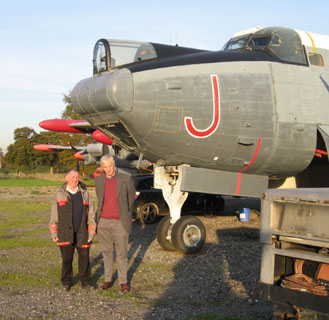
Earlier this year, Jonathan Shackleton and I were flying from Dublin to Gatwick and decided to drop in at the Gatwick Aviation Museum which is in Charlwood, right on the edge of the airport. This is quite an establishment, created and maintained by Peter Vallance, an extraordinary man.
The Museum has two Shackletons in its collection. The aircraft were used for maritime reconnaissance and anti-submarine work in the 1950s and 60s. They carried a crew of 10, have a wingspan of 120 feet and are 87 feet long. If you go to the Museum's website www.gatwick-aviation-museum.co.uk you can learn much more.
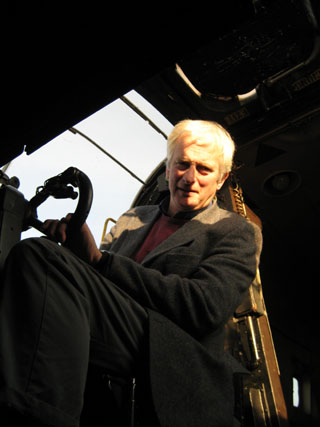
In any event, Peter showed us around and we crawled about inside. Here are some photos. The one on the left shows Jonathan with Peter Vallance. On the right is Jonathan at the controls.