"Tekeli-li" or Hollow Earth Lives:
A Bibliography of Antarctic Fiction
by
Fauno Lancaster Cordes
355 Arballo Drive
San Francisco, California 94132-2156, USA
July 1993
Accessed at least
 times
since 3 December 2006.
times
since 3 December 2006.
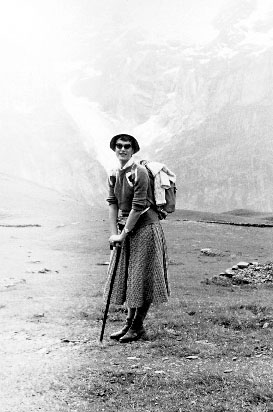
Click here to see Fauno preparing to 'cross the Alps' in 1954.
Click here for a talk Fauno gave at the University of San Francisco on March 12, 1995.
Based in part on a thesis entitled Winter Survival in the Antarctic as
described by James Fenimore Cooper and submitted to the faculty of San Francisco State University in partial fulfillment of the requirements for the
degree Master of Arts in Geography, August 1991. Much of the Annotated Bibliography originated as Appendix 2 of the thesis.
Thesis copyrighted through University Microfilms International.
Updated: February 1999; 22 March 2000; 11 August 2000; 1 September 2000; 1 April 2001; 4 April 2001; 9 July 2001, 11 October 2001, 16 March 2002, 16 April 2002; 23 October 2002; 17 November 2002; 17 March 2003; 2 September 2003; 20 February 2004; 30 October 2004; 9 March 2005; 30 July 2005; 25 February 2006; 27 August 2006; 11 February 2007; 26 November 2007; 16 February 2008; 26 May 2008; 13 October 2008; 21 August 2009; and 11 January 2010 (Final, other than corrections).
Sadly, Fauno Cordes died on Christmas Day, 2009. Her obituary from the San Francisco Chronicle (10 January 2010) appears below. Tekeli-li will cease to be updated (other than corrections) but it will remain on this site indefinitely. A supplement may be created to include new entries. Anyone wishing to take on this task should contact Robert Stephenson (contact details on homepage). Suggestions for listings in a possible supplement may also be sent to him.
FAUNO LANCASTER CORDES passed away on Christmas day in her San Francisco home at the age of 82. Fauno was born in San Francisco to Faun Hope Lancaster and Frederick Carl Cordes, M.D. She graduated from Miss Burke's School, the University of California, and later obtained a Masters degree from San Francisco State University. Her career included technical positions at the City of Hope, Oakridge National Laboratory, and University of California San Francisco. She retired as a nuclear medicine technologist from Mt. Zion Hospital. Fauno's interests included astronomy, model rocketry, and geography. She created and maintained an extensive, annotated bibliography of Antarctic fiction. This bibliography, known as Tekeli-li, is recognized worldwide as an authoritative source and has been cited by numerous published and online works. Fauno was a member of the Century Club of San Francisco, Society of Women Geographers, Explorers Club, Sigma Xi, and Alpha Phi. Fauno is survived by her sister Virginia Stout and nephew Frederick Gregory Stout of Marin County. Friends are invited to attend a memorial service on Tuesday, January 12, 2010 at 11:30 am at St Dominic's Catholic Church, 2390 Bush Street, San Francisco. A reception will follow in the church parish hall. Donations are suggested to Holy Name of Jesus Christ, 1559 39th Avenue, San Francisco.
Since I learned of Fauno's death today (from Jeff Rubin, and later from Billy-Ace Baker) I've thought back to when I first asked her about her bibliography and whether she'd like to have it on my antarctic-circle.org website which was in its infancy at that time. I'm pretty sure this is when we were both at a polar conference at the Byrd Polar Research Institute at The Ohio State University. She had told me that she would get inquiries about 'Tekeli-li' from around the world and each time one came in, she would take the typescript down to the copy shop and have yet another copy made, pay for it, go off to the post office and pay again. "Why do this?" I asked. "Put it on the web and people can copy or download it at no cost to you or to me." So that began a long relationship—two or three times a year I would receive typed sheets with new additions or corrections clearly indicated. (Fauno had some sight difficulties and as far as I know she never had e-mail. I'm assuming she must have seen 'Tekeli-li' on my website, but she never said so.) Her entries were typed up by Margaret Smith, and to start things off she sent me the bibliography in some sort of electronic form which became the basis for its appearance on my site. But it wasn't that easy! A lot of re-formatting and manual coding were necessary before it made its debut.
Looking through my files I find that I first communicated with Fauno on 30 December 1988 saying that I had enjoyed her article in the 21 November issue of the Antiquarian Bookman. That began a sporadic correspondence culminating in the appearance of her bibliography on the Antarctic Circle website, apparently in early 1999. My last note to her went off sometime during the holidays so I guess she just missed it. I was sending on a suggested entry from an interested reader.
It was a great pleasure to know her and to make her work more accessible. All in the Antarctic community mourn her passing.
—R. Stephenson
(11 January 2010)
PREFACE
I had been interested in Antarctic exploration for several years and had slowly accumulated a modest library of Antarcticana. Then my interest turned to Antarctic fiction. It really did all begin on a dark, foggy day in San Francisco in 1978 as I was down on my hands and knees browsing a low, dark shelf of the Melody Lane Bookshop. I found a copy of We Were There with Byrd at the South Pole by Charles S. Strong (1956), which was obviously juvenile fiction. It was only 50 cents, so I bought it even though it did not fit into my cataloging system. The book sat on my shelf virtually unnoticed until I remembered that I owned a set of works by Edgar Allan Poe (1946) which included "The Narrative of Arthur Gordon Pym of Nantucket" (1837). If there were two works of Antarctic fiction, then there must be more. It was with that thought that I began my search.
I had read Edge of the World: Ross Island, Antarctica by Charles Neider (1974) about three times because it appealed to me. On an impulse I wrote to him asking if he had ever considered writing an Antarctic novel. It seems that on the very day that he had received my letter he had been discussing an Antarctic novel that he had set aside several years before. It was he who suggested that I write an annotated bibliography which later became part of an Antarctican Society newsletter (Cordes 1983).
After several false starts, I finally decided to write the bibliography in chronological order because I could detect a pattern that I titled "The Emerging Face of a Continent". I received many letters in response with names of novels or short stories to help in my search for Antarctic fiction.
About four years later, I received a phone call from Jacob Chernofsky, editor and publisher of AB Bookman's Weekly, asking me to write an article for him, which was published the next year. I, then, received more helpful letters with names of novels and science fiction short stories. One of the letters was from Elizabeth Chipman, author and Antarctican, of Australia. She has sent me many books and suggestions and is a delightful correspondent.
About six years ago Barry Lopez, author and naturalist, gave a lecture at Indiana University, and Elena Glasberg stopped to talk to him afterwards and obtained my name and address. The result is that she and I still correspond and exchange information. I benefited enormously from her research for her thesis in progress, The Antarctic of the Imagination: American Authors' Exploration for the Last Continent, and I am grateful for her help.
I am deeply indebted to the University of San Francisco for special permission to use the Richard A. Gleeson Library after the Loma Prieta earthquake of October 1989 destroyed the interiors of my two primary resource libraries. Video cameras placed on the upper floors of the J. Paul Leonard Library of San Francisco State University revealed that the books were dumped on the floor and the metal shelves were twisted into trash. The Main San Francisco Public Library reported that about 300,000 books were tossed on the floor and the rest of the million plus volumes were put into storage until repairs were completed.
Without the interlibrary loan system network, this bibliography would not be possible. I am grateful for the diligence of the many librarians whose names I will never know.
In compiling the bibliography of Antarctic fiction, I decided to follow some personal ground rules:
- I must read all the tales myself. That, unfortunately, almost limited the items to those written in English or translated into English. I was fluent in French 40 years ago, so I have been able to manage an occasional book in French.
- I include the sub-Antarctic islands in my definition of "Antarctic".
- I exclude historical novels, autobiographical poetry, and children's
penguin stories. These are really different fields and should be treated separately.
This monograph is an updated version of my original bibliography, "Appendix 2" of my thesis.
Margaret Smith of "The Last Word" has done my word processing since 1983.
ACKNOWLEDGEMENTS
I wish to thank those who have been kind enough to give me titles to track down, translate passages and provide reference material. Without them, this project would have been quite a bit smaller.
Peter Anderson
Margaret Andrew
Billy-Ace Baker
Maurice Bassan
Joan Boothe
Russell Bright
Gabriel and Carol Campagnet
Barbara Carlson
Camille Cazedesus II
Richard Champion
Paul Chaplin
Elizabeth Chipman
Jeremy and Geraldine Cole
Louis Collins
Bard Cosman
Lawrence Currie
Paul Dalrymple
Richard Dehmel
Malcolm Ferguson
Robert Flint, Jr.
Elena Glasberg
Guy Guthridge
Robert Headland
Kwan Ho
Rupert Jernigan
Ruth Kamena
Crawford Kilian
Yoshiko Kimura
Mary Krier
Valmar Kurol
Edward Lefkowicz
John Lenkey III
David and Cathy Lilburne
Barry Lopez
Frank Manasek
William Manhire
Robert Mattila
Elizabeth Mitchum
Marion Morris
Sam Moskowitz
Charles Neider
Luella Nysven
Hiromitsu and Betty Ogawa
Jerome and Jean Marie Parmer
Stephanie Pfennigwerth
Jay Platt
Edith Ronne
Jeff Rubin
Emanuel and Ann Rudolph
Ruth Siple
David and Deirdre Stam
Robert B. Stephenson
Graham Stone
Virginia Stout
Susan Stryker
John Stutesman
Erik Svensson
Robert A. Swan
Brian Taves
Bayard Teigan
Margaret Thompson
Howard Walter
Shirley Watkins
Michele Wellck
John Westfall
Nancy Weston
Valerie Wheat
TABLE OF CONTENTS
INTRODUCTION
Antarctic fiction began in 1605 with publication of Mundus Alter Et Idem by Bishop Joseph Hall under the name of Mercurio Brittanico.[1] The genre of creating a southern continent inhabited by unknown peoples with what the author considered to be proper moral and political persuasions is a popular format which has lasted four hundred years.
With the discovery of the South Shetland Islands in 1819 by William Smith in the British brig "Williams", the authors of Antarctic fiction introduced a new genre: hollow earth, an idea which has lasted almost two hundred years.
At this point, I do not know the origin of the idea that Earth is hollow. I recently purchased a map which I later learned is page 170 from Mundus Subterraneus by Athanasius Kircher. There is a collection of books by Kircher in the Donohue Rare Book room of the Gleeson Library of the University of San Francisco, and I was able to examine a copy of the 1678 edition. There are two maps on page 170. The upper one is of the Arctic regions, and shows the water spiraling past Tartaria, Spitzberga, Groenlandia and America Borealis into a hole at the North Pole. The lower map of the Antarctic region shows the waters emerging from the South Pole and diffusing evenly throughout a landless Antarctic circle. Ben Watson, curator of the Donohue Rare Book Room, stated that Kircher was not known as a man of original ideas, but as a man who collected other people's ideas.
In 1692 Edmond Halley spoke before the Royal Society about "the change of the variation of the magnetical needle" and then published his ideas in the Society "Transactions". He proposed that the earth was hollow and contained subterranean waters and orbs that were habitable. At this point the trail of hollow earth fades and reappears 126 years later.
In April of 1818, former Captain U.S. Infantry John Cleves Symmes wrote: "The earth is hollow, habitable within; containing a number of concentrick spheres; one within the other, and that it is open at the pole twelve or sixteen degrees". This statement was sent to 500 institutions of higher learning and important government officials both in theUnited States and in Europe. This was the beginning of the Hollow Earth Theory which eventually lead to the presence of the United States government in the Antarctic (Mitterling 1959).[2]
In 1820 Symzonia, written by Captain Adam Seaborn in the tradition of Mundus, was published. However, the best was yet to come after Jeremiah N. Reynolds usurped the lecture circuits from Symmes who was becoming ill. Reynolds had a forceful enough personality to win a speaking engagement before the United States Hall of Representatives in 1836, and thereby attracted even greater public attention, including that of Edgar Allen Poe.
"The Narrative of Arthur Gordon Pym of Nantucket" was published in the January-February edition of the Southern Literary Messenger by Edgar Allen Poe in 1837. The cry "Tekeli-li" and the visions of a hollow earth became firmly implanted in the minds of fantasy fiction writers. Jules Verne and H.P. Lovecraft were among the many authors who responded to "Pym". Verne became obsessed with the idea of writing a sequel which he finally did in 1899 under the title Le Sphinx des Glâces.
The fascination with "Pym" continues. In 1979, Paul Theroux wrote a book about his journey from Boston to Patagonia by rail. He took several books, including "Pym", with him when he went to visit Jorge Luis Borges in Buenos Aires. Borges asked Theroux to read the last two chapters to him and clapped with delight at the end of the recitation.
Most of the books written in the nineteenth century are fantastic
high adventures. The only realistic work during this period is The Sea
Lions (1849) by James Fenimore Cooper which deals with fur sealing in the
South Shetland Islands area.
In The Sea Lions, Cooper drew on his own personal experience as an American naval officer and a major owner of the whaler "Union" of Sag Harbor to tell a story of sealing in the Antarctic. His early interest in the polar regions is shown in his review of William Scoresby's books on "whale-fishery" and William Edward Parry's Arctic journal of 1819-1820 published in the Literary and Scientific Repository and Critical Review of January 1822. His friendship with the family of the American naval Antarctic explorer Charles Wilkes and the publicity of the British Franklin polar disaster kept that interest kindled throughout the rest of his life.
Towards the end of that life, Cooper finally drew upon his knowledge to produce what Fredericka Martin (1946) describes as "The most definitive and coherent description of a seal hunt". Unfortunately the merits of this novel have been overlooked because it was written as a romance of religious conversion.
For the reading public, the Antarctic "heroic age" begins with publication in 1900 of Frederick Cook's book Through the First Antarctic Night 1898-1899 and continues to the International Geophysical Year of 1958. Novels based on occurrences during historic expeditions and whaling adventures appear during this time, and there is a small series of excellent science fiction stories dealing with the Antarctic. John Martin Leahy wrote "In Amundsen's Tent" (1930) in which three explorers find a living horror in Amundsen's south polar tent. A. Hyatt Veril prefers to populate his region "Beyond the Pole" (1926) with lobster-like humanoids. H. P. Lovecraft introduces a two-million-year-old Palaeogean Megalopolis which lies at an altitude of 23,570 feet in At the Mountain of Madness (1936). But ask
any sci-fi fan about a monster from outer space, that can change configuration at will, being loose on an Antarctic station and he or she will respond immediately: "The Thing!" This movie was based on the story "Who Goes There?" (1938) by John W. Campbell, Jr. and has become a classic horror film.
On February 9, 1947, Admiral Richard Byrd and his crew took off from Little America and flew the first airplane flight over the South Pole (Rose 1980). This was the highlight of Operation Highjump as far as the general public was concerned. In 1969, Raymond Bernard wrote The Hollow Earth, and the legend of "Admiral Byrd's discovery" took flight. With complete disregard to Operation Highjump, Bernard wrote:
February, 1947: "I'd like to see that land beyond the (North) Pole. That area beyond the Pole is the center of the Great Unknown".
— Rear Admiral Richard E. Byrd (United States Navy), before his seven-hour flight of 1,700 miles beyond the North Pole.
Admiral Byrd was in Antarctica at that time. I assume that this quote refers to the Antarctic continent beyond the South Pole. It certainly was the "Great Unknown" at that time.
The last part of the twentieth century brought a dramatic change in Antarctic fiction: an increase in stories of worldwide catastrophe and tourism. The causes of worldwide catastrophe or alarm are many, from x-ray impulses from a deep space quasar (Airship Nine by Thomas Block, 1984) to a volcanic plume under the Ross Ice Shelf (Cold Sea Rising by Richard Moran, 1986). The effects vary from war to problems of ice. James Follett (Ice, 1977) envisions an 8,000 cubic mile portion of the ice cap breaking off from the continent, and traveling to the north Atlantic area. Crawford Kilian (Icequake, 1979) describes a massive surge of the ice cap.
The Antarctic as the cause of global disaster is not a new one. Peter Bishop (1989) speaks of The Abode of Snow written by Andrew Wilson in 1875.
The true 'Abode of Snow', he wrote, was not the Himalayas, nor even the Arctic, but the Antarctic. Wilson argued that as the ice accumulates around the South Pole, a point must be reached when:
the balance of the earth must be suddenly destroyed, and this orb shall almost instantaneously turn traversely to its axis, moving the great oceans, and so producing one of those cyclical catastrophes which ... have before now interfered with the development and the civilization of the human race.
Charles McCarry would probably be startled to learn that his book The Better Angels (1979) is listed on a bibliography of Antarctic fiction. It is a novel of Near East intrigue, but there are a few sentences devoted to noting the fact that the hero's children are touring the Antarctic on their stepfather's yacht. This is a rare mention of tourism by private means.
Cruise ships are part of Hungry As The Sea (Wilbur Smith, 1978) and
Storehouses of the Snow (Edwin Woodard and Heather Woodard Bischoff,
1980). John Gordon Davis uses a helium-filled airship to attempt to rescue
tourists from a DC-10 crash on the Beardmore Glacier (Seize The Wind,
1985). Charles Neider has drawn upon his own experience of survival from a
helicopter crash on Mt. Erebus in a novel about a tourist plane crash and
helicopter crash on the volcano (Overflight, 1986).
It is Crispin Kitto who has drawn the curtain on Antarctica as a land of mystery. In The Antarctica Cookbook (1984), an East Hollywood chef
obtains permission to build a summer home on Ross Island between the historic
huts of Robert Scott and Ernest Shackleton.
As the century comes to a close, the cry "Tekili-li" is once more heard. After Richard Lupoff (1984) sent Charles Lindbergh, Amelia Earhart, and Howard Hughes on a circumpolar air race through the southern Symmes' Hole, Rudy Rucker (1990) took up his pen and sent Mason Reynolds, Jeremiah Reynolds and Edgar Allan Poe into the hollow Earth from the south polar regions.
Most of us are like Ian Wedde (1986), author of the novel Symmes Hole, who is content to dream about southern adventures from the safe distance of New Zealand. Perhaps there are one or two of us who occasionally shout "Tekili-li" in the privacy of our own homes.
AN ANNOTATED BIBLIOGRAPHY OF ANTARCTIC FICTION
A.F.M. "An Interview With An Emperor". Aurora Australis.
Published at the Winter Quarters of the British Antarctic Expedition, 1907, during the winter months of April, May, June, July, 1908.
Two men go for a walk on a perfect Antarctic night. They meet a six-foot emperor penguin dressed in a velveteen coat, a white moleskin waistcoat with brass buttons, and baggy trousers. The presumed gamekeeper leads the men back to the march and sends them away.
Abbey, Lloyd. The Last Whales. New York: Grove
Weidenfeld, 1989.
This is a story of whales, dolphins, and nuclear winter.
Abramov, Aleksander and Sergei Abramov. Horsemen From Nowhere. Moscow: Mir Publications, 1969. Translated from the Russian by George Yankovsky.
A Russian tractor crew in the Antarctic comes upon rose-colored clouds that can duplicate people and places. The clouds are removing the ice shields of the Arctic and Antarctic.
Adams, Eustace L. Over The Polar Ice (Andy Lane Series).
Racine: Whitman Publishing Co., 1928.
A teenage aviator flies from New York to the South Pole and back.
Anderson, Edna. The Ice-Bound Treasures. Minneapolis: T. S. Denison & Company, Inc., 1968. Originally published 1961.
Gold is discovered on Petrel Island and two men vanish from a nearby weather station. Merdith Ashley and his twin sons, Stan and Eric, fly to the area to investigate.
Andreae, Johann Valentin. Christianopolis. Translated
by Felix Emil Held, Ph.D. New York: Oxford University Press, 1916. An authorized reprint by University Microfilms, Inc., Ann Arbor, Michigan, 1966. Originally published: Amsterdam: 1619.
The hero leaves port on the ship "Phantasy" which sinks during a violent storm on the Mare Aethiopicum. Clinging to debris, he comes ashore on an idyllic island in the Antarctic Zone, 10 degrees of the south pole, 20 degrees of the equinoctial circle and 12 degrees under the point of the bull. He discovers a large, utopian, inhabited city named Christianopolis.
Andrew, Margaret. Flight To Antarctica. Cambridge: The Burlington
Press, 1985.
Two children wish themselves to Antarctica. Their adventures take them from the home of the Marwans in Victoria Land, Gondwana, to the Gonds and Guardians inside Mt. Tyree.
Andrews, John Williams. Triptych For The Atomic Age.
"Antarctica: A Narrative of the Bubble Nothing". Boston: Branden Press, 1970.
"'Antarctica' was written on commission for Columbia Broadcasting System for production by Columbia Workshop. It appeared first in print in POET LORE, A
National Quarterly of World Poetry and the Drama".
A group of men fly to the South Pole and find its meaning.
Andrews, Sarah. In Cold Pursuit.
New York: St. Martin's Minotaur, 2007.
Valena arrives at McMurdo Station and discovers that the professor in charge of her research has been arrested for murder.
Anonymous. Documents relating to the Federal State of the Dougerthy [sic] and Hesperies [sic] Islands, Stapol, 15 June, 1965. Received at the Australian Consulate-General and other embassies in Madrid, Spain, on 21 July, 1965.
Anonymous. Voyage de Robertson, Aux Terres Australes. Amsterdam: 1767. Translated from English.
Robertson sails due west from Chili [sic] for a month. He finds a land which le Chevalier Drake thought was a continent. This land is inhabited by what Le Seigneur Taumelli calls "Australiens".
Note: Australia was known as New Holland in 1767 (Buache Map 1763).
Anonymous. Le Pôle Sud. Tours: Alfred Mame et
Fils, 1898. Traduit de L'Anglais Par Harold.
The crew of a whaler spends a winter in the Antarctic with the native
population of Esquimaux and polar bears.
Appleton, Victor II. Tom Swift and His Atomic Earth Blaster. New York: Grosset & Dunlop, 1954.
Tom Swift leads an expedition to the South Pole to mine the iron at the center of the Earth.
Armstrong, Richard. The Secret Sea. New York: David McKay Company,
Inc., 1966.
The whaler "Orion" and its catchers penetrate the Antarctic ice pack to a secret sea. Disaster strikes.
Arthur, Elizabeth. Antarctic Navigation. New York: Alfred
A. Knopf, 1995.
A young woman recreates Robert Falcon Scott's last polar journey.
Bagley, Desmond. The Snow Tiger. Garden City: Doubleday & Company, Inc., 1975.
Mike McGill does some avalanche protection studies in New Zealand and before going to his assigned duties at the South Pole.
Bailey, Auden. Drifting at the Bottom of the World. Ferndale: Bella Books, 2002.
Miss Angus MacNeill Jones went to work in the Antarctic where she met Jubilee Oval, a creator of Antarctic myths.
Baldwin, Bee. The Red Dust. London: Robert Hale Limited,
1965.
Seismic sounding creates a great fissure near Mt. Erebus. Great clouds of red loess explode from the fissure covering Earth with a lethal Allergy. A passenger ship from England, with a few surviving Immunes on board, arrives in New Zealand and confronts a group of mad scientists.
Banks, Iain. The Business. New York, London, Toronto, Sydney, Singapore: Simon & Schuster, 1999).
The Business is the only non-govermental organization to own a base in Antarctica. It is located in Kronprinsesse Euphemia Land. Kathryn Telman knows it exists but she is too busy to go there.
Banks, David. Iceberg. London: Doctor Who Books, 1993.
Ruby Duval boards S.S. Elysium for a cruise to the Antarctic. During her adventures she meets The Doctor and Cybermen.
Barjavel, Rene. The Ice
People (La Nuit Des Temps). New York: William Morrow and Company,
Inc., 1971. Originally published: Les Presses de la Cité in 1968.
A French Antarctic expedition finds the remains of a 900,000 year
old civilization under the south polar ice cap. A woman, Elea, is awakened.
Barker, Nicholas and Anthony Marter. Red Ice. New York:
St. Martin's Press, 1986.
The death of James Maxwell, captain of the British naval ship
"Mercatos", is essential for the success of the plans of the terrorist
organization, Ola Roja, in the Antarctic. They stalk him from Uruguay to the
Antarctic Peninsula.
Barrett, Michael. Antarctic Secret. New York: Roy Publications Inc., 1965.
An American manned spacecraft, with the British Project Javelin secret space weapon aboard, crash lands in Antarctica. A British Intelligence officer is sent to retrieve Javelin.
Bartram, George. Under the Freeze. London: Arrow Books Limited, 1986.
The search for missing Russian plutonium leads an American agent to a sunken ship in the Antarctic.
Batchelor, John
Calvin. The Birth of the People's Republic of Antarctica. New York: The
Dial Press, 1983.
Skullagrim Fiddle, driven from Sweden, the Falklands and South Georgia Island during the Age of Exile, becomes the warlord of Anvers Island. His final flight is to Elephant Island where he is a prisoner for 29 years.
Bauer, E. "The Forgotten World". Amazing Stories: pp. 436-444, August 1931.
An oceanographer returns to Discovery Bay after 30 years and learns that an old school mate, who was supposedly lost flying over the South Pole, has survived in a warm inhabited valley near the active volcano Mt. Noen.
Baxter, Stephen. Anti-ice. New York: Harper Prism, 1994.
Originally published: Britain: Harper Collins Publishers, 1993.
Four Englishmen reach the moon in 1870 in a spacecraft powered by
anti-ice, a super fuel discovered by Captain Ross during his dog-team journey
south of Cape Adare.
Bayle, Luc Marie. Le Voyage de la Nouvelle Incomprise. Paris: la Sociétè "l'OFFSET' à Levalloise, 1953. Exemplaire No. 123 Imprimé spécialment pour Monsieur le Vice-Amiral de Toulouse-Lautrec-Montfa.
The polar voyage of "Nouvelle Incomprise" is printed in handwritten script. There are many pen-and-ink drawings of people, places and penguins.
Beale, Charles Willing. The Secret of the Earth. New York: Arno Press, 1975. Originally published: 1899.
Two brothers fly into the hollow earth on a homemade airship. They enter through the North Pole and exit from the South Pole. The temperature in the Antarctic at 11,280 feet is -91°.
Note: The average altitude for the south polar plateau is about 10,000 feet. A temperature of approximately 129° below zero, Fahrenheit, was recorded in July, 1983, at Russia's Vostok Base (78° 28'S, 106° 48'E) (Chipman 1990).
Beck, Christopher. The People of the Chasm. London: C. Arthur Pearson, Limited, 1923.
Dick and Monty Vince put their plane aboard M. Javelot's ship "Penguin" and sail to Antarctica. They locate Anton Javelot in a green valley populated by small people, apes and an assortment of monsters.
Becker, Hyam Yona. The Temple of Ha Shem. Jerusalem: Gafen Publishing House, Ltd., 1997.
Shlomo Tzabok leads an Israeli expedition to the Sinai mountain chain of Antarctica. His prime companion is the Eskimo Enki. They discover a 4,000 year-old culture based on the Nfm Skoog's space ship.
Beliayev, Aleksander. The Struggle in Space: Red Dreams Soviet-American War. Translated by Albert Perry. Washington, D.C.: Arfor Publishers, 1965. Originally published in 1928.
A Russian finds himself transported into the future in a city called Radiopolis. A war against America begins and ends in a submarine town in the area of the South Pole.
Bellow, Saul. More Die of Heartbreak. New York: William Morrow and Company, Inc., 1987.
Uncle Benn spent a season in Antarctica. He made a helicopter expedition to collect lichens.
Benjamin, Philip. Quick, Before It Melts. New York: Random House, 1964.
A journalist from Sage Magazine is sent to the Antarctic to report on the International Geophysical Year. Wending his way through raucous adventures, he engineers a spectacular "scoop".
Bennett, C. H. Surprising, Unheard of and Never-To-Be Surpassed Adventures of Young Munchausen. London: Routledge, Warne, and Routledge, 1865. The fifth story.
Munchausen is traveling on a high-pressure engine in Pennsylvania when it explodes. He is hurled across the Pacific Ocean and hits his forehead in the South Pole. He lives with the South Polacks for several weeks.
Berry, Steve. The Charlemagne Pursuit. New York: Ballentine Books, 2005.
Cotton Malone's father died in submarine NR-IA beneath the Antarctic ice pack near the remnants of an ancient people.
Billing, Graham. Forbush and the Penguins. New York, Chicago,
San Francisco: Holt, Rinehart and Winston, 1965.
A scientist lives alone in an historic hut to study penguins.
Binder, Eando.
Lords of Creation. Philadelphia: The Prime Press, 1949. Originally
published: The Frank A. Munsey Co., 1939.
Homer Ellory of 1950 A.D. is revived in a time-capsule crypt in 5000 A.D.
The Outlanders of the Kaatskills are held in bondage by the Antarkans.
Humrelly (Homer) rummages through the ruins of New York to find the means of conquering Antarka.
Note: This is one of the rare pre-WW II stories that mention atomic bombs. The United States government ignored these science fiction prophesies so that the "Manhattan Project" could continue in secrecy.
(Bird, Robert Montgomery). "The Ice Island". Philadelphia
Monthly Magazine, vol. 1, pp. 109-114, 1827.
A man is marooned on an iceberg with a pine tree imbedded in it.
Note: In 1820, John Miers declared that Norwegian pines had been spotted on one of the South Shetland Islands (Miers 1820).
Bisbee, Eugene. The Treasure of the Ice. London, New York: F. Tennyson Neely, 1898.
Six explorers leave New York aboard the whaler "Polaris". They survive a shipwreck near the South Pole in a volcanic region inhabited by descendants of ancient Greece.
Bledsoe, Lucy Jane. The Antarctic Scoop. New York: Holiday House, 2003.
Victoria Von Woolf, age 12, wins the science test sponsored by the "Wild X-plorer" online magazine. Her prize: a trip to Antarctica.
Bledsoe, Lucy Jane. "the breath of seals". Best Lesbian Love Stories, 2004, pp. 1-14. Los Angeles: Alyson Books, 2004.
Roz Frick, a McMurdo Station worker, thinks about a Christmas card she has received.
Bonehill, Captain Ralph. Lost in the Land of Ice. New York: Grosset and Dunlap, 1902.
A young yacht owner and his friend have many adventures on their way to the Sout Pole seeking a treasure ship.
Bisbee, Eugene. The Treasure of the Ice. London, New York: F. Tennyson Neely, 1898.
Six explorers leave New York aboard the whaler "Polaris". They survive a shipwreck near the South Pole in a volcanic region inhabited by descendants of ancient Greece.
Bonnell, Captain Ralph. Lost in the Land of Ice. New York: A. Wessels Company, 1902.
The young owner of the yacht "Arrow" travels to the Land of Desolation beyond Palmer's Land-Graham Land in search of a treasure ship and the answer to a mystery. He and two companions are marooned on an iceberg and are attacked by polar bears. A bloodthirsty species of condor carries one of the men to a yonder summit. "Arrow" then sails to the South Pole where the men experience the peculiar effects of polar magnetism.
Booth, Albert J. Harpoon Harry, or the Castaways of the Antarctic. New York: The Boys of New York Pocket Library, no. 164, 1883.
Compliments of Edward J. Lefkowicz: from a paper entitled "The Whales They Wrote And How They Did It" that he gave at the 17th Annual Whaling Symposium, the Kendall Whaling Museum, Sharon, Massachusetts, October 17, 1992.
Harry Harpoon and a mutineer are castaway on the Antarctic
continent. Harry kills a polar bear with a knife.
Bouvé, Edward T.
Centuries Apart. Boston: Little, Brown, and Company, 1894.
A 19th Century U.S. Army expedition blown south of Africa discovers a warm current which flows south into an open polar sea. A large colony of 16th century Englishmen is found living on a large polar island.
Note: Carstens Borchgrevink made two trips to the Antarctic: 1894-1895 under Captain Leonard Kristensen, and 1898-1900 as leader of his own expedition. He reputedly found a warm current flowing south in the region of Cape Adare (71° 17'S, 170° 14'E) (Cameron 1974).
Brinkley, William. The Last Ship. New York: Ballantine Books, 1989.
158 Russian and American naval personnel aboard the submarine "Pushkin" arrive at McMurdo Station a few years after a global nuclear war. They find that the area is deserted and contains enough stores for 12 years.
Brittanico, Mercurio (Bishop Joseph Hall). Mundus Alter Et Idem (Another World And Yet The Same). Translated and edited by John
Millar Wands. New Haven, London: Yale University Press, 1981. An edition entitled The Discovery of a New World edited by Huntington Brown was published Cambridge: Harvard University, 1937. Originally published: Frankfort: At the House of the Heirs of Ascanius de Rinialme, 1605. English edition by John Healey,
1609.
A traveler to the Antarctic Continent finds that it is inhabited by gluttons, drunkards and eccentrics.
Note: "Mundus" has traditionally been considered a source for Jonathan Swift's Gulliver's Travels (Amis 1960).
Brockmeier, Kevin. The Brief History of the Dead. New York: Pantheon Books, 2006.
The city of the dead is filled with victims of "the epidemic" on Earth. Laura Byrd seems to be the only survivor in Antarctica.
Brown, A. Voyage A Dos De Baleine: Aventures Du Capitaine Bob Kincardy. Paris: Librairie Gédalge Jeune, ca. 1890.
Capitaine Kincardy leaves Alaska to travel the oceans in an elegant hut on the back of a whale. He and his crew reach les Shetland du Sud. Beds of lava alternating with beds of ice result in a shore that is inaccessible.
Browning, Scott. Searchers. Los Angeles: Cougar Press, 2001.
Two brothers go to the Antarctic to locate the camp of a 1909 expedition. They learn that they live a space-time displacement life.
Brunner, Hans. Survivors! London, Basingstoke: MacMillan Children's Books, 1989. Originally published: Unternehmen Eisohr, Switzerland: Verlag AARE Solothurn, 1987.
Young Peter Bush sails aboard "Almax Venturer" out of Australia to Rotterdam. The tanker catches fire in the subantarctic region and a few of the crew are cast upon an uninhabited island.
Brussof, Valery (Valerii Briusov). "The Republic of the Southern Cross". The Republic of the Southern Cross and Other Stories. Westport: Hyperion Press, Inc., 1977. Originally published: London: Constable and Company Ltd., 1918.
The inhabitants of Zvezdny are stricken with a fatal psychical distemper, resulting in death and destruction in the southern polar regions.
Buchan, James. High Latitudes. New York: Marlowe & Company, 1996.
Jane Bellarmine, a business genius, is shocked when her ex-husband, Lord Bellarmine, flies to the South Pole in a chartered airplane. He then becomes marooned on Foundation Glacier.
Bullen, Frank T. The Bitter South. London: Robert Culley, earlier than October 22, 1912.
Captain Ted Trevanion and his two sons sail from England aboard "Susan". After a successful sealing and whaling voyage in the South Shetland Islands area, they are set adrift by mutineers and saved when they discover the deserted ship "Alcmena".
Burke, David. Monday At McMurdo. Wellington, Auckland, Sydney: A. H. & A. W. Reed, 1967.
A plane, carrying a U.S. Congressman and assistants, crashes on the Tom Thumb Glacier. The Naval VX6 detachment commander at McMurdo flies a rescue mission.
Burke, John. Empress Hunter: 2010. Victoria, B.C.: Trafford Publishing, 2002.
Henry Wu escapes execution at the International Maximum Security Prision in Victoria Land, Antarctica. He is rescued by one of three Chinese vessels. American ships stalk the Chinese ships.
Burks, Arthur J. "The Fatal Quadrant". Astounding Stories: vol. XX, no. 6, February 1938.
Sherman Geddes, his sister Zora, Judson Draper, and two crates of manlike robots set up a laboratory many miles south of the Bay of Whales. They discover an ancient city buried under the ice.
Burroughs, Edgar Rice: A trilogy.
The Land That Time Forgot.
New York: Ace Books, 1973. Originally published: Blue Book Magazine,
August 1918.
The People That Time Forgot. New York: Ace Books, 1973.
Originally published: Blue Book Magazine, October, 1918.
Out of Time's Abyss. London: Tandem, 1975. Originally
published: Story Press Corp., 1918.
An American liner, traveling to France during World War I, is torpedoed by a German submarine. The survivors are rescued by a British ocean-going tug which is then sunk by the German submarine "U-33". The survivors of the tug then capture "U-33" and sail due south during a storm, eventually landing within sight of Antarctic icebergs on an enormous collapsed caldera named Caprona (Caspak). The crew of "U-33" then discovers that this land is inhabited by exotic animals and peoples, many of which had been thought to be extinct.
Caine, Hall. The Woman Thou Gavest Me. Philadelphia, London: J. B. Lippincott Company, 1913.
An Antarctic explorer has a child by his sweetheart who has been forced into marriage with a British lord.
Cameron, Ian.
The White Ship. New York: Charles Scribner's Sons, 1975.
In 1819, the brig "San Delmar" was wrecked on Candlemas Island, an active volcanic island in the South Sandwich archipelago. In 1974, a young graduate historian is possessed by one of the passengers of "San Delmar". She induces the British Antarctic Survey to send an expedition to the island.
Note: "San Telmo" sailed from Cadiz bound for the Pacific area and encountered severe weather while rounding the Horn. Dismasted and rudderless, she was taken in tow by "Primerosa Mariana". However, the hawsers parted and she was considered lost at about 62° S on September 4, 1819. Her anchor-stock was found at Shirreff Cove on Livingston Island in 1820 (Roberts 1958).
Campbell, John W. Jr. "Who Goes There?" They Came From Outer Space. Edited by Jim Wynorski. New York: Doubleday and Company, Inc., 1980. Originally published under the pseudonym of Don A. Stuart: Astounding
Science Fiction, page 60, August, 1938.
A monster from outer space that can change configuration at will is
loose in an Antarctic station.
Carroll, Ruth and Latrobe. Luck of the Roll and Go. New York: The MacMillan Company, 1935.
The kitten "Luck" climbs aboard the ship "Roll and Go", and thus joins an Antarctic expedition.
Catherall, Arthur. Vanished Whaler. London, Edinburgh, Paris, Melbourne, Toronto, New York: Thomas Nelson and Sons, Ltd., 1953. Originally published 1939.
The whaler "King Haakon" is at anchor in the Balleny Islands. The whale-chaser "Oslo" tries to hide after the crew discovers a gold-laden ship of the Spanish Armada era.
Cendrars, Blaise. The Antarctic Fugue. Translator not listed. London, Winchmore Hill: Barnard & Westwood, 1948. Also published as Dan Yack. Translated by Nina Rootes. New York: Michael Kesend Publishing Ltd., 1987. Originally published as Le Plan de L'Aiguille, Paris: Editions Denoël, 1927.
A British millionaire and three companions winter over in an old sealer's hut on Sturge Island in the Balleny group. He then builds an all-year whaling products factory in Port Deception.
Note: The island is spelled "Struge" in the 1927 and 1948
editions. The correct spelling "Sturge" is used in the 1987 edition.
Cerasini, Marc. Godzilla at World's End. New York: Random House, 1998.
Zoe Kemmering and her father's corpse disappear into a deep hole in Wilkes Land. The crew of the airship "Destiny Explorer" fly into the hole (now 100 miles in diameter at the South Pole) in search of her. Godzilla follows them.
Chabon, Michael. The Amazing Adventures of Kavalier & Clay. New York: Random House, 2000.
On December 14, 1941, Joe Kavalier joins the U.S. Navy and is stationed at Kelvinator Station (Naval Station SD-AZ(R)) in Antarctica. As Radioman Second Class he monitors the Germans in Queen Maud Land.
Charbonneau, Louis. The Ice. New York: Donald I. Fine,
Inc., 1991.
Environmentalists engage a group of industrial mining prospectors in a deadly battle of wits on the opposite side of the Antarctic continent from the Ross Ice Shelf.
Chester, George Randolph. The Jingo, Indianapolis: The
Bobbs-Merrill Company, 1912.
Jimmy Smith builds an "American" Utopia in Isola.
Note: Several authors have listed the book as Antarctic fiction, but this cannot be confirmed. [I have read the book three times.]
Christie, Agatha. Ordeal By Innocence. New York: Harper Paperbacks, 1991. Originally published: London: Collins, 1958.
Dr. Arthur Calgary, geophysicist with the Hayes Bentley expedition to Antarctica, returns to England and discovers that he was the alibi for a late murder suspect.
Clair, Daphne. Frozen Heart. London: Mills & Boon Limited, 1980.
A young female journalist and psychologist spends an Antarctic summer and winter as the only woman crew member of a New Zealand station. Her main accomplishment is the love of the base commander.
Clark, Captain Charles. An Antarctic Queen. London, New York: Frederick Warne and Co., 1902.
Five survivors of a ship wrecked on a floating ice-island 660 miles SSW of Diego Ramirez Island discover Lastfoundland and a Fuegan castaway.
Note: Many non-Antarctic flora and fauna are described.
Clark, C. Dunning. Walt Ferguson's Cruise: A Tale of the Antarctic Sea. Beadles Boy's Library of Sport, Story and Adventure, vol. IV, no. 42. New York: M. J. Ivers & Co., 1885.
Portugues Pete is paid to kill Walt Ferguson. Walt survives several attachs by Pete, mutinous men, and three white bears. The villains do not survice the mutiny.
Clark, Joan. Latitudes of Melt. New York: Soho Press, Inc., 2002.
Stan goes to Scott Base on McMurdo Sound to measure the rate of ice flow.
Clough, Brenda W. "May Be Some Time". Analog Science Fiction and Fact (formerly Astounding): pp. 10-41, April 2001. Published by Analog Science Fiction and Fact.
In the year 2045, a group of doctors from the Time Travel Division of the Fortis (4T) Project locate Titus Oates' frozen body. They move him from Antarctica to New York and revive him. His eventual destination is to be Tau Ceti in the constellation Cetus.
Cobb, James H. Choosers of the Slain. New York: G. P.
Putnam, Sons, 1996.
Two thousand troops from Argentina invade the British research base on Signy Island. The American stealth destroyer "USS Cunningham", Amanda Garrett commanding, responds by crippling the Argentinian
fleet.
Coleridge, Samuel
Taylor. The Rime of the Ancient Mariner. Christchurch: The Caxton Press,
1952. Originally published in Lyrical Ballads, 1798.
A ship, sailing in the Southern Ocean, is cursed when a mariner kills an albatross, a pious bird of good omen.
Collins, Dale. Lost. Indianapolis: The Bobbs-Merrill
Company, 1933.
A group of British and American passengers aboard "Avonbridge" are shipwrecked off Thompson Island. They discover an inhabitant who had been shipwrecked eighteen years before.
Cooper, James Fenimore. The Monikins. New York: W. A. Townsend and Company, 1860. Originally published: Philadelphia: Carey, Lea, and Blanchard, July 9, 1835. London: Richard Bentley, July 4, 1835.
A British baronet rescues four south polar Monikins from captivity and returns them to their home, the kingdom of Leaphigh. He learns that when the Earth exploded at the Pole the result was an open sea and a steamy climate.
Cooper, James Fenimore. The Sea Lions. New York: W. A. Townsend and Company, 1860. Originally published: New York: Stringer and Townsend, April 10, 1849. London: Richard Bentley, March 29, 1849.
Two rival schooners named "Sea Lion" search for a mysterious sealing
ground in the Antarctic sea.
Cowan, Frank. Revi-Lona: A Romance of Love in a Marvelous Land. New York: Arno Press, 1978. Originally printed privately in 1880s.
Dr. Anson Oliver (also known as Alexander Newton) awakes to discover that he is the only person aboard the whaler "Southern Cross". The derelict ship has penetrated the southern polar wall of ice and reached the land of Revi-Lona governed by twenty-five beautiful women.
Crichton, Michael. State of Fear. New York: HarperCollins Publishers Inc., 2004.
The Environmental Liberation Front is buying high technology. A group flies to a station in Antarctica near Mount Terror to investigate. They learn that the ELF trail leads to the South Pacific Islands.
Crisp, Frank. The Ice Divers. London: Hodder and Stoughton, 1960.
Dirk Rogers, salvage master and deep-sea diver, his cousin Jim Cartwright and Jose Pepito are hired aboard the whaler "Ballarat" to solve the mysterious disappearance of two men.
Cummings, Ray. "The Snow Girl". Argosy: vol. 207, no. 5,
pp. 577-796, 1929, Saturday, November 2. "Next Week": pp. 91-107.
New Week: pp. 264-280.
Three Americans are captured
by Naina, daughter of the White Bandit, ruler of the native Antarcticans and
creator of the "Blue Blizzards". They are taken to her stronghold in the 15,000
foot Weddell Mountains and told of her plans to drive the Americans out of
Antarctica.
Curran, Tim. Hive. Lake Orion, MI: Elder Signs Press, Inc., 2005. A sequel to At the Montains of Madness by H.R. Lovecraft, 1936.
A special group confirms the report of a prehistoric alien civilization in the Antarctic. They deal with ancient frozen mummies.
Cussler, Clive. Atlantis Found. New York: G.P. Putnam's Sons, 1999.
After meeting in the mountains of Colorado, Dirk Pitt and Patricia O'Connell, Ph.D., now search for more undeciphered ancient writings on the Crozet Islands and Antarctica. They learn that the wealthy Wolf family members from Nazi Germany are also in the Antarctic and are in the process of completing elaborate preparations to survive a comet impact on Earth.
Cussler, Clive. Shock Wave. New York, London, Toronto, Sidney, Tokyo, Singapore: Simon & Schuster, 1996.
Tourists from aboard "Polar Queen" survive a powerful sonic bombardment. They are transported from Seymour Island to King George Island by the NUMA vessel "Ice Hunter".
Cussler, Clive. Treasure. New York, London, Toronto, Sydney, Tokyo: Pocket Books, 1988.
The area of the Antarctic Peninsula is searched by an American "Casper" stealth reconnaissance plane for a missing yacht.
Cussler, Clive. Valhalla Rising. New York: G. P. Putnam's Sons, 2001.
Admiral Sandecker wants to send Dirk Pitt back to Antarctica "in an attempt to penetrate the ice down to the vast lake scientists believe is under the ice cap."
Dake, Charles Romyn. A Strange Discovery. Boston: Gregg Press, 1975. A reprint edition. Originally published: New York: H. Ingalls Kimball, 1899. A sequel to Poe's "Narrative".
Pym and Peters discover a continent a hundred miles in diameter at the South Pole, that is a giant volcano with a central space of boiling lava. Nearby is the large island of Hili-li that is populated by descendants of ancient Romans.
Darrieussecq, Marie. White. Translated by Ian Monk. London: Faber and Faber Limited, 2005 (2003).
Pete Tomson and Eamée Polanco work in the Antarctic and fall in love.
Davis, Gerry. Doctor Who and the Tenth Planet. London: A Target Book, 1976.
TARDIS, Dr. Who's time traveler capsule, lands at "Snowcap" tracking station at the South Pole. The Cybermen from the planet Mondas land on Earth and plan to drain its energy.
Davis, John Gordon. Cape of Storms. Garden City:
Doubleday, 1970.
A nurse and a marine biologist ship out from Capetown aboard the All England Whaling Company factory ship "Icehammer" and catcher "Fourteen". Racial violence plagues the voyage and return to Africa.
Note: The venerable Norwegian whaling factory ship "Thorshammer" first appeared in Antarctic annals in 1928, and made many subsequent trips (Roberts 1958).
Davis, John Gordon. Leviathan. New York: E. P. Dutton & Co., Inc., 1976.
The director of Magnus Oceanics takes his ship and crew to the Antarctic to blow up the Russian factory ship "Slava".
Davis, John Gordon. Seize The Wind. New York: Stein and Day, 1985.
An Australian DC-10 filled with tourists crashes on the Beardmore Glacier. A British helium-filled airship attempts a rescue during a blizzard.
Note: On November 28, 1979, an Air New Zealand DC-10 with 257 tourists and crew aboard crashed on the slopes of Mt. Erebus. There were no survivors (San Francisco Examiner 1979).
Dee, Sheryn. Tarin of the Ice. Melbourne: Nelson Publishers in association with the Australian Broadcasting Corporation, 1987.
Tarin of the Ice-people sets out from Antarctica on a voyage to find his sister Yasni. He is taken aboard a Norwegian whaler which, eventually, leads him to Yasni.
Defoe, Daniel. A New Voyage Round The World, By A Course Never Sailed Before. Being a Voyage undertaken by some Merchants who afterwards proposed the setting up of an East India Company in Flanders. New York: George D. Sproul, 1904. Originally published: November 1724.
A private merchant ship reaches a farthest south at 67° S by sailing southeast through the South Seas from the Ladrones.
de Foigny, Gabriel. The Southern Land, Known. Translated and edited by David Faysett. Syracuse: Syracuse University Press, 1993. La Terre Australe, Connue was originally published in Geneva, 1676.
Through a series of shipwrecks, Sadeur lands on a strange southern land inhabited by hermaphrodites. The polar end of this country contains mountains more inaccessible than the Pyrenees.
de Mille, James. A Strange Manuscript Found in a Copper Cylinder. New York: Harper & Brothers, 1888, published posthumously.
The poles of the Earth are flattened and nearer to the hot core than at the lower latitudes. The south polar lands and vast inland sea are therefore warm. A marooned seaman discovers and lives with a group of Troglodytes, one of several native polar peoples.
(De Varennes de Mondasse). La Découverte de L'Empire de Cantahar. Paris: Chez Pierre Prault, 1730.
The narrator joins M. de Horstrone, in command of the warship "Fredelingue", and leaves Amsterdam on 4 January 1705 for the Cap de bonne Esperance (Cape of Good Hope). The ship is blown south by a northwest wind resulting in the discovery of the island of Cantahar.
Dickens, Charles with Wilkie Collins. "The Wreck of the Golden Mary". Short Stories of the Sea. Edited by George C. Solley, Eric Steinbaugh, David O. Tomlinson. Annapolis: The Naval Institute Press, 1984. Originally published as a title piece of the extra Christmas number of Household Words, 1856.
A British Merchant ship bound for California is wrecked near
58° S, 60° W off New South Shetland.
Dickie, F.E. Davy. Snow In Summer. Edinburgh, London: Oliver & Boyd Ltd., 1967.
Young Peter Tender of New Zealand joins an Antarctic expedition as part of his education.
Dickson, G. R. Secret Under Antarctica. New York: Holt, Rinehart and Winston, 1963.
A boy goes to Antarctica as an assistant to his scientist father. Under the ice, he discovers a submarine yacht which houses the Tropican movement to reassemble Gondwanaland.
Dietrich, William. Dark Winter. New York: Warner, 2001.
Jed Lewis, a geologist, arrives at Amundsen-Scott Station for the winter. The killing begins.
Dietrich, William, Ice Reich. New York: Warner Books, Inc., 1998.
The American pilot Owen Hart is hired by Hermann Göring to sail to Antarctica in "Schwabenland". They discover the volcanic Atropos Island, home of a spore that is swiftly fatal and its slimy antidote.
Note: The German ship "Schwabenland" spent three weeks off Queen Maud Land in January 1939 (Headland 1989).
Dillberg, Gustaf, Genom Den Försvunna Sydpolen (Through the Disappearing South Pole). Lund: C. W. K. Gleerups Förlag, 1902. Translated from English by Disa Törnqvist. Erik Svensson translated passages from Swedish.
Explorers discover that the South Pole is missing. They venture through to lost South Pole into the enchanted world of the flying Count of the Abyss. They discover Zenaland, Kleopatraland and Brindonaland.
Dixon, Franklin W. Lost at the South Pole or Ted Scott in
Blizzard Land (Ted Scott Flying Series). New York: Grosset & Dunlap,
1930.
A young aviator is involved in a race to become the first to fly over the South Pole. Base camp is presumably near to where the Queen Maud Range is joined by Carmen Land. The hero is attacked by a great auk.
Note: The flightless great auk was an arctic bird which became extinct in 1844 (Peterson 1979).
Dixon, Franklin W. The Stone Idol (The Hardy Boys Mystery Stories #65). New York: Grosset & Dunlap, 2005. Copyright 1981 by Simon & Schuster, Inc.
Frank and Joe Hardy are working on a case in Chile when their father, Fenton Hardy, calls them to Antarctica to work on another case.
Dobson, Rosemary. The Ship of Ice, with other poems. Melbourne: A&R, 1948. (Publishing information courtesy of Robert A. Swan).
The seven voices of the Captain and crew of "Jenny", frozen in the Antarctic for many years, speak to each other.
Note: In 1823, the English schooner "Jenny" became frozen in an ice-barrier of the Antarctic Circle. On 22 September 1860, the ship was discovered by Captain Brighton of "Hope" who found the bodies in a perfect state of preservation. (Dobson 1948). "Jenny" was reported drifting in Drake Passage by the whaler "Hope" in 1840. The log had been kept until 17 January 1823. (Headland 1989 as noted in Globus 1862. No corroborative evidence found.)
Doherty, Robert. Area 51. New York: Dell Publishing, 1997.
In 1956, the United States Navy found seven bouncers (UFOs) under the Antarctic ice.
Doherty, Robert. The Citadel. New York: Harper, 2007.
Probably part of The Organization buried some atomic bombs under the ice in Antarctica. Captain Jim Vaughan and Tai try to find them.
Dorfman, Ariel. The Nanny and the Iceberg. London: Hodder & Stoughton, 1999.
A young impotent man returns to Chile to confront his father. While there, he participates in the project of capturing an Antarctic iceberg for the exposition in Sevilla.
Note: A World's Fair did take place in Sevilla, Spain, in 1992.
Douglas, Scott. Moby and Ahab on a Plutonium Sea.* *The Novel Which Ended the Cold War. Baltimore: PublishAmerica, LLP, 2005.
Professor Sam White and Dr. Toby Parrish leave McMurdo Station for Mulock Glacier. Mt. Erebus erupts. The U.S. submarine "Athena" receives a distress call from McMurdo.
Drummond, Hamilton. "A Secret of the South Pole." The Windsor Magazine, vol. XV, December 1901 to May 1902, pp. 612-620. London: Ward, Lock & Co., Limited, 1902.
Cap'n Towson and two crew men are adrift south of the equator. They find a three hundred year-old ship, smoothed by the ice of the Antarctic drift. The air inside the ship is frozen by something smashed on the floor.
Duff, Douglas V. The Treasure of the Antarctic. London and Glasgow: Blackie & Son Limited, ca. 1935.
Captain Samways and his twin sons, Tostig and Sweyn, are told about a map of a pitchblende vein on Mount Hooker in the Antarctic. They locate the map in the crypt of an Orthodox Cathedral in Israel and then sail south to mine the
radium.
Du Perron de Castera, Louis Adrien. Le Theatre de Passion et De La Fortune ou Les Avantures Surprenantes de Rosamidor et de Theoglaphire. Paris: Chez Saugrain, 1731.
A story told by an Indian philosopher about peoples living on a spacious continent, surrounded by islands, located towards Le Pôle du Midi (South Pole). These lands were known to the Greeks who probed the evidence of voyageurs Phéniciens (Phoenician voyagers).
Eberhard, Wolfram. A Dictionary of Chinese Symbols. London, New York: Routledge, 1989. Originally published as Lexikon Chinesischer Symbole, Cologne: Eugen Diederichs Verlag, 1983. This edition first translated and published by Routledge & Kegan Paul in 1986.
"In Chinese cosmological symbolism the South is the
region of life". According to the legend, the god of longevity lives in a palace at the South Pole as "nan-ji shou-xing" (The Immortal of the Southern Pole).
Eckert, Allan W. The HAB Theory. New York: Popular Library, 1977. Originally published Little, Brown & Company, 1976.
The Antarctic icecap buildup causes the earth to capsize. The pivotal points are off the Philippine Islands and Kenya. The presidents of the United States and Kenya cooperate to preserve a remnant of civilization.
Edwards, Hazel. Antarctic Close-up. Canberra: National Museum of Australia Press, 2007.
John Close's things from a 1911 expedition are on sale. Young John's webcom [sic] plug joined the telescope and a laptop producing a surprise.
Note: John Close was a member of Douglas Mawson's 1912 base party. He was an assistant to several scientists. (Ball, personal communication, 2009.)
Edwards, Hazel. Antarctica's Frozen Chosen. South Melbourne: Thomas C. Lothiani Pty. Ltd., 2003.
The ship that Kyle is aboard on his way to Antarctica meets Patagonian toothfish poachers. Later, Kyle discovers a terrorist on board his ship.
Note: See Hooked by G. Bruce Knecht.
Emerson, Willis George. "The Smoky God". Fram The Journal of Polar Studies: vol. 1, no. 2, 1984 summer issue. Originally published: The
National Magazine: 1907-1908.
A father and son sail into the earth through the North Pole, enjoy the inhabited lands in the center of the Earth, and emerge at the South Pole. After dodging icebergs for 45 days, the craft is destroyed by a capsizing iceberg and the father is killed.
(Erskine, Thomas). Armata; A fragment. London: John Murray, Part I, 1816; Part II, 1817.
A British sailor discovers a twin planet of Earth joined to it at the South Pole by two channels with strong currents flowing in opposite directions.
Espinasse, Bernard and J. C. Williamson. Australis; or the City of Zero (a pantomime). Sydney: J. Andrew & Co., 1900. The surviving copy is in the Mitchell Library, Sydney, Australia. This information is from the State Library of Victoria, courtesy of Elizabeth Chipman.
In the year 2000, Australia annexes the City of Zero located at the South Pole which is ruled by the evil wizard Azeemath. He is disposed and Dione is crowned Queen.
Evans, Admiral Sir Edward, K.C.B., D.S.O. The Mystery of "The Polar Star". London: S.W. Partridge & Co., 1930s?
Midshipman Clive Austin takes a leave from the Royal Navy to sail as a junior officer aboard the whaler "Endeavour". The goal of the voyage is the rescue of the whaler "Polar Star" which has vanished in the Antarctic.
Farmer, Beverly. The Seal Woman. St. Lucia: University of
Queensland Press, 1992.
After her husband is lost in a shipwreck, a Danish woman, Dagmar, comes to Australia, where she and her husband, Finn, had spent their honeymoon. Finn had sailed to the Antarctic five times aboard "Nella Dann" as an ANARE member.
Note: ANARE is the acronym of the Australian National Antarctic Research Expeditions (Law and Bechervaise 1957). "Nella Dan" ran aground off Macquarie Island on December 3, 1987, and sank on December 24, 1987 (Headland 1989).
Farrell, Cliff and Hal Colson. Jacn Swift and His Rocket Ship. Racine: Whitman Publishing Company, 1934.
Jack Swift builds a craft to go to the Antarctic in search of the lost civilization of Mu. Upon arrival, Jack discovers that the people of Mu (Polarians) are trying to topple the Earth. He enlists the aid of the giant penguin-men to defeat the Polarians.
Farren, Mick. Underland. New York: Tom Doherty Associates, 2002.
A nosferatu (vampire) thinks that he is being sent to the Antarctic in search of Nazis living in the hollow earth. A human informs him that their group is going to the Arctic.
Fattarusso, Paul. Travel in the Mouth of the Wolf. Brooklyn: Soft Skull Press, 2004.
Iple went to the Antarctic and found a brontosaurus frozen in the ice. The brontosaurus is sent to Argentina to be defrosted.
Ferguson, Henry. South for Adventure. London, Toronto, Melbourne, Sydney: Cassell and Company Ltd., 1947.
Don Macey and Briney Hudson sail in Don's father's whaling and prospecting fleet. They meet a group of uranium pirates as they search for high-grade ore in the Ross Sea area.
Ferguson, Malcolm. "The Polar Vortex". Weird Tales: pp. 74-81, September 1946.
The multimillionaire scientist and dabbler, Leopold Lemming, lures Daniel Imbriter, clerk and student, to his observatory at the South Pole. The young man is left there—alone.
Field, Mario. Astro Bubbles. Boston: The Four Seas Company, 1928.
Dr. Harland lectures his family about old astronomical theories. He then travels to Antarctica and discovers that the Earth is bowl shaped.
Fiennes, Ranulph. The Secrret Hunters: London: Little, Brown and Company, 2001.
Derek Jacobs joins a group prospecting for gold in Antarctica.
Note: The author states this may be a true story.
Follett, James. Ice. Briarcliff Manor: Stein & Day, 1978. Originally published: 1977.
An 8,000 cubic mile portion of the Antarctic ice cap containing mountains breaks off from the continent and travels into the North Atlantic Ocean. Two members of the Rosenthal Antarctic Survey help prevent World War III.
Forbes, Stephen. False Cross. New York: Signet, 1989.
Russians and Americans race to recover an American satellite that was shot down by Russians. Confrontations occur at the American Mensa Station located on the Ross Ice Shelf 3° south of Richard Byrd's Advance Base (80° 08'S, 163° 57'W) of 1934.
Foster, Alan Dean. The Thing. Toronto, New York, London, Sydney: Bantam Books, 1982. Based on a short story: See John W. Campbell, Jr.
A "thing," probably from an ancient space ship, attacks a Norwegian Antarctic base and then an American Antarctic base.
Foster, W. Bert. The Frozen Ship, or Clint Webb Among the
Sealers. Chicago: M. A. Donahue & Co., 1913.
The
mystery ship "Firebrand" is caught in the southern currents south of Cape Horn
and becomes locked in the ice.
Freemantle, Brian. Ice Age. Surrey, New York: Severn House, 2002.
The onset of a plague of a premature aging illness is first noticed in Antarctica and Alaska. A group of scientists trace it to a thawed early Neolithic cave containing ancient bodies.
Gannett, Lewis. Magazine Beach. New York: Harper Paperbacks, 1996 (a hardcover book).
Earnest Trefethen, a nuclear eco-terrorist, triggers a nuclear device six hundred miles from the South Pole in an old volcano deep in the western part of the Antarctic ice sheets.
Gansky, Alton. Beneath the Ice. Ulrichsville: Barbour Publishing, Inc., 2004.
Perry Sachs and his crew go to Antarctica to study Lake Vostok. Eric Enkian and his crew also arrive to search for the Ziggurat Tower of Babel.
Garnier, Charles T. Voyages Imaginaires, Songes, Visions et
Roman Cabalistiques, "La relation d'un voyage du Pôle Arctique au
Pôle Antarctique par le centre du monde, avec la description de ce
périlleux passage, et des choses merveilleuses & étonnantes
qu'on a découvertes sous le Pôle Antarctique". A Amsterdam, et se
trouve a Paris, Rue et Hotel Serpente, M. DDC LXXXVIII. Originally published:
Amsterdam: Lucas 1721. Courtesy Elena Glasberg. Also published as: Anonymous. Relation D'un Voyage Du Pole Arctique Au Pole Antarctique Par Le Centre Du Monde. Paris: Chez Noel Pissot, 1723.
A whaling ship is sucked into a whirlpool near Greenland and emerges at 71° 8"S. After encountering a variety of creatures, a volcano, a pyramid with fiery reflections, and a structure of white stones, the whalers set sail for the Cape of Good Hope.
Note: The "Anonymous" separate of "Relation" is a curio. It is bound in brown leather. The title is embossed in gold and reads "Skirmish Drill for Mountain Troops, Adj. Gen's Office".
Gemmell, Nikki. Shiver. Sydney, New York, Toronto, London,
Auckland, Johannesburg: Random House, 1997.
A young woman journalist travels to the Antarctic.
Giangregorio, Anthony. Deadfreeze. Xlibris Corporation, 2007.
The men at the Antarctic station become zombies and start eating normal men.
Gibbs, Wolcott. Bird Life at the Pole. New York: William Morrow & Co., 1931.
Mr. Herbst, a newspaper publisher, sends Commander Robin, a Junior League girl, and ship "Lizzie Borden" to Antarctica.
Note: This story is a thinly disguised satire about William Randolph Hearst, Commander Richard E. Byrd, and Byrd's ship "Eleanor Bolling", named for his mother (Byrd 1935).
Gillmore, Inez Haynes. Angel Island. New York, Scarborough (Ontario): New American Library, post 1988. Originally published: 1914.
Five men are shipwrecked on a tropical island inhabited by five winged women. The women are alone because the rest of the winged people have flown south to the Snowlands.
Godwin, John. "The Devil in Devonshire" Potter, Robert. Tales of Mystery and the Unknown. New York: Globe Book Company, Inc., 1976.
The hoof marks of the devil covered most of southern Devonshire. They were similar to the ones found on Kerguelen Island by Sir James Ross in May 1840.
Grace, Tom. Twisted Web. New York, London, Toronto, Sydney, Singapore: Pocket Books, 2003.
Terrorists destroy LV Research Station, located 40 miles north of Vostok Station, after confiscating samples of life from the subglacial Lake Vostok.
Graham, David. Down to a Sunless Sea. New York: Simon and Schuster, 1981.
Earth is in a state of chaos and nuclear war. The planet's axis is tilting and Antarctica will become warm. Two planes filled with refugees fly toward McMurdo Station.
Greanias, Thomas. Raising Atlantis. New York, London, Toronto, Sydney: Pocket Star Books, 2005.
Colonel Griffin Yeats and Conrad Yates (father and son) work together at Ice Base Orion to find Atlantis. In the process of discovering the city, Conrad triggers an 11.1 (Richter scale?) earthquake.
Griffith, George. "From Pole to Pole". The Windsor Magazine, An Illustrated Monthly for Men and Women, vol. XX, pp. 531-544, June to November 1904. London: Ward, Lock & Co., Limited, 1904.
Professor Karl Haffkin, his niece Brenda Prenceps and her husband Arthur Princeps start a journey from the South Pole to the North Pole via the center of the earth.
Griffith, George. Olga Romanoff or the Syren of the Skies.
Westport: Hyperion Press, Inc., 1974. Originally published as a serial in
Pearson's Weekly (London), December 30, 1893 to August 4, 1894.
Using an earthquake fissure on the south side of Mt. Terror as an
aircraft base, a descendant of the Tsars tries to take control of the world. She is opposed by African Aerians who maintain Kerguelen Island as a submarine and aircraft base.
Guile, Earl Ernest. Antarctic Collapse. New York, Lincoln, Shanghai: iUniverse, Inc., 2006.
The United Nations decides that the ice cap on West Antarctica is melting rapidly.
Gurdon, Captain J.E. The Secret of the South. London, New York: Frederick Warne & Co., Ltd., 1950.
A band of explorers discover that two ancient civilizations exist within the Antarctic icecap: the Polarians (white) and the Anthropians (neanderthal-like).
Hackman, Gene and Daniel Lenihan. Wake of the Perdido Star. New York: Newmarket Press, 1999.
Jack O'Reilly leaves Cuba in 1805 aboard "Perdido Star". The ship sails south trying to round The Horn. The winds blow the ship south to within twenty miles of the Antarctic coast before the captain is able to sail westward round The Horn.
Note: The Antarctic land was officially discovered in 1820 by William Smith aboard "Williams". The naval officer aboard was Edward Bransfield who "was the first to chart a portion of the Antarctic mainland (Headland 1989)".
Haggard, H. Rider. Mary of Marion Isle. London: Hutchinson and Co., Limited, 1929.
A young British lord is marooned on Marion Island. He discovers that the island is inhabited by a young girl, sole survivor of a shipwreck and mutiny.
Haggard, H. Rider. Mr. Meeson's Will. Chicago: W. B. Conkey Company, undated. Originally published: Illustrated London News,
1888.
After R.M.S. "Kangaroo" collides with a whaler, a lifeboat containing publisher Mr. Meeson, author Augusta Smithers, five year old Dick Holmhurst and two sailors land on Kerguelen Island. Augusta and Dick are rescued by an American whaler after the men on the island die.
Hahn, Charles Curtz. The Wreck of the South Pole or the Great Dissembler. New York: Street & Smith, 1899.
A shipwrecked mariner discovers a warm South Pole and inland sea inhabited by a telepathic civilization. A sudden precession of the poles causes a world-wide catastrophe.
Hall, Adam. Pawn In Jeopardy. New York: Harper Paperbacks, 1954.
Five Antarctic explorers face murder for the secret they discover on their expedition to the south.
Hamm, Amanda. Zero Station. USA: Published by Lulu, 2007.
The workers at Zero Station, Antarctic, are dealing linguistically with three groups of aliens.
Harbinson, W. A. Dream Maker. New York: Walker and Company, 1992.
The Dream Maker, formed from plasmodes and radishes, arrives on Earth in Orionid and Eta Aquarid meteor showers resulting in the formation of the ozone holes. Only NASA scientist Tony Rydell can save the world from apparitions.
Harbinson, W. A. Millenium; Project Saucer: Book Four. London: Hodder and Stoughton, 1995.
After extensive research, Captain Lee Brandenburg concludes that UFOs and their inhabitants are constructed in Queen Maud Land.
Harrison, Craig. Days of Starlight. Auckland, London, Sydney, Toronto: Hodder and Stoughton, 1988.
Dr. Ben Armstrong, a scientist from New Zealand, is invited to a remote American base in Antarctica to perform laser experiments on a strange two-metre long pale yellow silicon crystalline hexagonal object with an internal tetrahedral structure. He discovers that it produces holographic images when struck by the laser beam.
Harrison, Payne. Thunder of Erebus. New York: Crown Publishers, Inc., 1991.
A Soviet-American geological expedition discovers the mineral carnallite,
containing rubidium-96, under the ice at Windless Bight. An armed conflict occurs for control of the mine.
Hauser, Heinrich. Last Port of Call. New York: Stackpole Sons, 1938.
A married man leaves his family in Germany, boards one of the last sailing ships in Copenhagen, and sails for Australia via the Southern Ocean.
Hendry, Frances Mary. Atlantis. Oxford, New York, Toronto: Oxford University Press, 1997.
Atlantis is a series of caverns on the edge of Mt. Erebus. While Mungith is on trial for adulthood, he finds a wounded giant from the "outside".
Hendry, Frances Mary. Atlantis in Peril. Oxford, New York, Toronto: Oxford University Press, 1999. First published in 1998.
The King's daughter tries to kill Chooker, so she goes outside to find a Giant. Peter Winston follows Chooker back inside and wrestles the King's daughter.
Henrick, Richard P. Ice Wolf. New York: Harper Paperbacks, 1994.
A group of Nazis try to retrieve the Holy Grail from an Antarctic cave.
Herbert, James. Portent. Toronto: McClelland and Stewart, Inc., 1993. Originally published: Sevenoaks: Hodder and Stoughton, 1992.
The world is experiencing many catastrophes accompanied by strange lights. The mammals and birds of the Antarctic have accumulated large doses of toxins and springs appear in the Dry Valleys. The penguins of Macquarie Island stampeded leaving 7,000 dead.
Herbert, Marie. Winter of the White Seal. New York: William Morrow and Company, Inc., 1982.
A young 19th century whaler is marooned on Livingston Island and finds companionship with a baby white seal.
Hershman, Tania. The White Road and Other Stories. Cambridge: Salt Publishing, 2008. "The White Road."
Mags sets up a coffee shop in Antarctica. She loses her eyesight from the brightness of the snows.
Hinchcliffe, Phillip. Dr. Who and the Seeds of Doom. New York: Pinnacle Books, 1977.
The Doctor goes to Antarctica to deal with a fast-growing live Krynoid pod.
Hodgson, Barbara. Hippolyte's Island. San Francisco: Chronicle Books, 2001.
Hippolyte Webb sails to the Aorora Islands. When he returns to his home in Canada, he contacts Rumor Press of New York about publishing his book.
Holmes, Clara H. "Nordhung Nordjansen". Floating Fancies Among the Weird and Occult, pp. 7-28. London, New York: F. Tennyson Neely, 1898.
Captain Nordjansen salied north from Norway, A wind sweeps him into an abyss and he floats to a strange land. A small boat is swept upon a rocky point in the southern sea. They find a gaunt white-haired old man from Norway.
Hooper, Meredith. The Pole Seekers. London: Hodders Children's Books, 2000.
A group of black rats join a ship heading for Antarctica. When the ship moors in the south, they start on an expedition to the Pole. They reach a "farthest south" for black rats.
Hotchkiss, Robert R. Earth of Fire, Sky of Ice (first book of the Shalrodan Saga). San Jose, New York, Lincoln, Shaghai: Writers Club Press, 2001.
Gary Krahmer reports for a geological expedition in the Queen Maud Range. He finds a hole in the ice which he enlarges. He then descends into the hole and finds himself in a civilization that is several thousand years old.
Howells, W. D. Through The Eye
of the Needle. From The Altrurian Romances. Bloomington, London:
Indiana University Press, 1968. Originally published: Harper & Brothers,
1907. Part I (27 chapters) was originally published in Cosmopolitan
Magazine November 1892 to October 1893 as the last six letters of Letters of an Altrurian Traveler.
The Altrurians have created a temperate climate in their south polar region by cutting off the southeastern peninsula. Aristides Homos feels that the same effect could be produced in the United States by cutting off the western shore of Alaska.
Innes, Hammond. Isvik. New York: St. Martin's Press, 1991.
An international group of men and women man the yacht "Isvik" on a voyage to the Weddell Sea in search of the early nineteenth century sailing ship "Andros". The icebound wooden ship is implicated in the disappearance of a group of men from Argentina.
Innes, Hammond. The Survivors (The White South,
Calling the Southern Cross). New York: Harper & Brothers, 1949.
The whaling factory ship "Southern Cross" is beset by ice and a ruthless killer in the Weddell Sea. Episodes are patterned after Shackleton's "Endurance" expedition.
Note: "Southern Cross" was the name of Carstens Borchgrevink's ship used in his expedition of 1898-1900 (Cameron 1974).
Innes, Hammond. Target Antarctica. London, Sydney, Auckland: Pan Books, 1993. A sequel to Isvik.
Can a stranded Hercules C-130 aircraft be flown off a calved Antarctic
iceberg? Ex-RAF pilot Edwin Cruise is hired by Iain Ward to find out.
Irwin, Robert. The Limits of Vision. Sawtry: Dedalus Ltd., 1993.
Originally published: 1986.
Marcia fantasizes while doing her housework. The bed becomes the domain of the Queen of the Snows and the Antarctic.
Jackson, Deborah. Ice Tomb. Woodbridge: The Invisible College Press, L.L.C., 2004.
Erica Daniels goes to Antarctica and finds a pyramid under the ice. David Marsh goes to the moon and finds a pyramid under the surface. Who built them and why?
Jenkins, Geoffrey. The Disappearing Island (A Grue of Ice). New York: The Viking Press, 1962.
The former commander of the British Naval forces based on Deception Island is taken aboard the factory ship "Antarctica". He is the key to unravelling wartime mysteries involving Bouvet and Thompson
Islands.
Note: "Antarctic" has been the name of expedition ships of: Leonard Kristensen (1894-1895), Otto Nordenskjold (1901-1903), and E. O. Borchgrevink (1930-1931) (Roberts 1958). See Index of Place Names (Appendix 5) for comments about Thompson Island. "Grue" is a Scottish word which the author defines on page 123 as "the thrill of naked fear". It means a creeping of the flesh and a pellicle of ice (Chambers 1986).
Johns, Captain W. E. Biggles Breaks The Silence. London: Hodder & Stoughton Limited, 1949.
Sergeant Bigglesworth, head of the Air Section, Criminal Investigation Department, New Scotland Yard, and companions race against time and the master of "Sveldt" to salvage the gold shipment of the schooner "Starry Crown" in Graham Land.
Johnson, Seddon. South Pole Sabotage. Toronto, New York, London, Sydney, Auckland: Bantam Books, 1989. A "Choose Your Adventure" book.
A boy travels to the Antarctic aboard his uncle's ocean research vessel "Pole Star." I found 21 different adventures in this 113-page book. How many can you find.
Jonnes, Christopher Bonn. Big Ice. Baltimore, Publish-America Book Publishers, 2003.
The shy samaritan works at the National Ice Center on a theory of Antarctic ice collapse. Murder leads to an Edgar Cayce theory.
Joseph, Robert. The Aquarius Transfer. New York: Fawcett Gold Medal, 1982.
A drought has devastated California. An iceberg is towed to Point Mugu by a converted supertanker.
Judd, Alfred. The Secret of the Snows. London, New York, Toronto, Melbourne: Cassell & Company, Ltd., 1925.
Captain Drummon and his two sons lead an expedition up the Beardmore Glacier. Their object is to find veins of ore and coal for millionaire Matthew Millington.
Kavaler, Lucy. Heroes & Lovers. New York: Dutton, 1995.
Byron Tremaine's great-granddaughter Beatrix is searching for new information about him for Steve Avery's weekly television exposé show. She discovers Viola Lambert who was Byron's secret love and the leader of a female expedition to Antarctica in 1915.
Kazantzakis, Nikos. The Odyssey: A Modern Sequel. Translated into English verses by Kimon Friar. New York: Simon and Schuster, 1958. Originally published: Athens, 1938. The Antarctic voyage occurs in Book
XXII.
Odysseus sails south in a coffin-shaped boat. He "smashes the reed gently, mutely on hard crystal ice" and escapes "death by swimming in the open sea". After many hours, he finds a crag to climb and is eventually rescued by a people living in a Northwest-Coast - and - Arctic type
community.
Keeping, Tempest. The Quest of the "Fearless". London: Eldon Press Limited, 1936.
Professor Timothy Cassidy and his ward Mickey board the small whaler "Fearless" bound for the Antarctic where the Professor expects to find the
secret of the origin of life in penguin embryos. The ship sinks off one of the
Macquarie islands and all hands are marooned. A great amount of ambergris is
found.
Kelly, Vivien. take one young man. London: Arrow Books, 2000.
Inspired by his Grandad's research in Antarctica, Sam enlists in a research expedition to the same area.
Kelsey, Franklyn. The Island in the Mist. London, Bombay, Sydney: George G. Harrap & Co., Ltd., 1937.
James Armitage and his two sons find high adventure on the Island in the Mist.
Keneally, Thomas. The Survivor. New York: The Viking Press, Inc., 1970.
The survivor of an Antarctic expedition returns after a grave containing the remains of the man he abandoned 40 years before is found.
Keneally, Thomas. Victim of the Aurora. London, Sydney: Collins, 1977.
The news media member of the New British South Polar Expedition is murdered.
Kilian, Crawford. Icequake. London: Futura Publications Limited, 1979.
Solar flares in 1985 cause loss of Earth's magnetic field. The Antarctic icecap surges and scientists try to escape the breakup of the ice.
King, Jim. Gas $1.00. New York, Lincoln, Shanghai: Universe, Inc., 2008.
An explosion under an ice mountain in Antarctica brings hundreds of ten millenia extinct fish to the surface.
Kingston, William H. G. At the South Pole. London: Cassell Petter & Galph, 1877.
A boy runs away from his home in Cornwall and goes to sea in a whaler. He survives an Antarctic shipwreck, polar bears, walrus, wolves, and an erupting volcano.
Kingston, William H. G. The South Sea Whaler: A Story of the Loss of the "Champion" and the Adventures of Her Crew. London, Edinburgh, New York: T. Nelson and Sons, 1875.
Captain Tredeagle, his children, and his mutinous crew are blown south of Cape Horn during a storm, and find themselves among gigantic icebergs.
Kipling, Rudyard. The Jungle Books. New York: New American Library, Inc., 1981. Originally published: New York: The Century Co., 1893.
Kotick, the white seal, visits Kerguelen Island, the Georgia Islands, the Orkneys, Emerald Island, Bouvet Island, and the Prozets in his search for an island unknown to man.
Kitto, Crispin. The Antarctic Cookbook. New York: St. Martin's Press, 1984.
An East Hollywood chef, haunted by fantasies of Shackleton, Amundsen, Scott and Palmer obtains permission to build a summer home on Ross Island between Scott's and Shackleton's huts.
Kotter, John and Holger Rathgeber. Our Iceberg is Melting. New York: St. Martin's Press, 2005.
A group of penguins discover that their iceberg is melting and learn how to change their lives.
Kuprin, Alexander. "A Toast". Pre-Revolutionary Russian Science Fiction: An Anthology. Translated by Leland Fetzer. Ann Arbor: Ardis, 1982, pp. 182-184. Originally published in 1906.
The 200th year of the Worldwide Anarchist Union (A.D. 2906) is greeted with festivities at the North and South Poles, the main stations of the Electromagnetic Associates. The earth's magnetic power is the only available fuel.
Kurkov, Andrey. Death and the Penguin. Translated from the Russian by George Bird. London: The Harvill Press, 2001. First published: Kiev, Alterpress, 1996.
Victor hopes to send his penguin Micha back to the Antarctic.
Kushner, Tony. Angels in America: A Gay Fantasia on National Themes, Part Two: Perestroika. New York: Theater Communications Group, Inc., 1994.
Harper chews down a pine tree to put in her imaginary Antarctica. The Angel Antarctica attends the Council of the Continental Principalities in Heaven.
Langley, Bob. Falklands Gambit. New York: Walker and Company, Oz Edition, 1985.
General Hugh Pinilla is sent as a prisoner to Argentina's Camp Digepol, 12 miles inland between the Bellingshausen and Weddell Seas. An American and a British yachtsman try to rescue him before the Argentine invasion of the Falkland Islands.
Langley, Bob. Precipice. New York, Toronto, London, Sydney, Auckland: Bantam Books, 1991.
The Russian spacecraft "Suchko" is shot down by NORAD and lands in the Antarctic, probably in the Weddell Sea area. The race is on to unravel the mystery surrounding "Suchko."
Langley, J.B. The Stone Sky. Bloomington: Author House, 2004.
William and Irene become trapped in the Antarctic and are rescued by the people of Tiemora who live in caves under Mt. Erbus.
Note: Erbus is propbably Erebus.
Lawson, Will. The Lady of the Heather. Sydney, London: Angus and Robertson Ltd., 1945.
The granddaughter of Bonnie Prince Charlie, suspected of treachery to the Jacobite cause, is exiled to Campbell Island.
Lawton, Captain Wilbur. The Boy Aviator's Polar Dash. New York: 1910.
Frank and Harry Chester go south on the United States South Polar Expedition ship "Southern Cross". In spite of opposition by Japanese Manchurian troops, they help locate a Viking ship frozen in the Barrier ice and creatures living in a volcanic lake.
Note: See Innes, Hammond.
Leahy, John Martin. "In Amundsen's Tent". The Macabre Reader. Edited by Donald A. Wollheim. New York: Ace Books, Inc., 1959. Originally published ca. 1930.
Three explorers find a living horror in Amundsen's South Pole tent.
Leahy, John Martin. "The Living Death". New York: Science and Invention: in pictures, formerly Electrical Experimenter, Experimenter Publishing Company, Inc., October 1924 - June 1925.
Captain Livingston returns from a warm South Pole with stories of palm trees and a lovely woman frozen in the ice. His friends Frontenac and Bond lead an expedition to bring the frozenwomen to Seattle.
LeGuin, Ursula K. "Sur". The New Yorker: pp. 38-46,
February 1, 1982.
Using "Yelcho" as an expedition ship, a group of South American women travel to the South Pole in 1909-10.
Note: The Chilean relief ship "Yelcho" successfully rescued the crew of Shackleton's ship "Endurance" who were stranded on Elephant Island in August 1916 (Cameron 1974).
Leinster, Murray. The Monster From Earth's End. London, New York: White Lion Publisher, 1973. Orignally published 1959.
Nineteen people lived and worked in the station on Gow Island. A plane flew in from an Antarctic hot zone with a load of native Antarctic trees which were promptly planted. A beast in the night made itself known to the personnel on the island.
L'Engle, Madeleine. Troubling A Star. New York: Farrar
Straus Giroux, 1994.
Vicky Austin, a New England teenager, is stranded on an iceberg in the Antarctic Ocean during a cruise aboard the tourist ship "Argosy". She realizes too late that she is a pawn in an international power scheme involving the South American country Vespugia.
Lerangis, Peter, a series
Antarctica: Journey to the Pole. New York, Toronto, London, Auckland, Sydney, Mexico City, New Delhi, Hong Kong: Scholastic Inc., 2000.
Antarctica: Escape from Disaster. New York, Toronto, London, Auckland, Sydney, Mexico City, New Delhi, Hong Kong: Scholastic Inc., 2000.
Jack Winslow is the leader of an expedition to the Antarctic. The ship "Mystery" leaves New York in 1909 in an attempt to reach the South Pole. The group avoids several near disasters, but never reaches the Pole.
Livingston, S. N. Antarctic Fury. New York: Carlton Press, Inc., 1991.
The world's largest supply of oil is found near McMurdo Sound. Two Americans and one New Zealander are skiing when the Russians attack McMurdo Station. They hide at the base of Mount Discovery in the area of the Phantom Organas.
Note: The description of the Phantom Organas is the same for fata morgana mirages. Fata Morgana is Italian for Morgan Le Fay, half-sister of King Arthur. The name has been used for centuries for the mirages over the Strait of Messina (Greenler 1980).
London, Jack. "Make Westing". Short Stories of the Sea. Edited by George C. Solley, Eric Steinbaugh, David O. Tomlinson. Annapolis: Naval Institute Press, 1984. Originally published in When God Laughs. New York: MacMillan Company, January, 1911.
Captain Dan Cullin and "Mary Rogers" try for seven weeks to round the Horn. The ship even tries at 64° S but to no avail. A seaman falls overboard but the captain sails on.
Long, Amelia Reynolds. "Bride of the Antarctic". First published: Strange Stories Magazine, 1939. Coutesey of Valmar Kurol.
Three men spend the Antarctic winter in Victoria Land at the site of the ill-fated Howell Expeditions. They learn that the site is haunted.
Long, Jeff. The Descent, New York: Crown Publishers, 1999.
Senator January, Father Thomas, and the commanding officers of the sub-Pacific bases gather in Little America to identify the traitor in the Helios Research Expedition.
Lovecraft, H. P. At the Mountains of Madness. Sauk City: Arkham House, 1964. This story was originally written in 1931 but was rejected by Weird Tales. It was rewritten and published in Astounding Science Fiction, February to April 1936.
Members of the Miskatonic University Expedition discover a mountain range at 76° 15'S, 113° 10'E. A Palaeogean Megalopolis, more than two million years old and filled with unspeakable horrors, lies at an altitude of 23,570 feet.
Note: See Beale, Charles Willing.
Lovecraft, H. P. The Shadow Out of Time. London: Victor Gollancz Ltd., 1968. Originally published: Astounding Science Fiction, page 110 et seq., June 1936.
The mind of Professor Peaslee of Miskatonic University is in contact with many of the intelligent races that have or will inhabit Earth, including the star-headed old ones of the Antarctic.
Lovejoy, William H. White Night. New York: Kensington Publishing Corp., 1994.
The front for South American Determination bombs several Antarctican stations.
Lucas, Jeremy. The Longest Flight. London: Jonathan Cape, 1982.
The arctic tern, Sea-swallow, flies from his home in Scotland to the Antarctic continent and home again.
Lupoff, Richard A. Circumpolar! New York: Timescope Books,
1984.
Charles Lindbergh, Amelia Earhart, and Howard Hughes are copilots in a circumpolar air race. They enter the hollow Earth through the southern Symmes' Hole and discover Muiaia.
Mackie, John. The Great Antarctic. London: Jarrold & Sons, undated.
A British gentleman explorer returns to the Antarctic in search of two companions who are missing after a balloon crash on Mt. Erebus.
Marías, Javier. Voyage Along the Horizon. San Francisco: Believer Books, 1972. Translated by Kristina Cordera.
Three people meet to hear one of them read a novel about a group of authors sailing to Antarctica. After several deaths, the trip ends at Tangier.
Marriott Watson, H. B. Marahuna: A Romance. London: Longmans, Green and Co., 1888.
Percy Grayhurst, Esq., a biologist, sails to the Antarctic aboard H.M.S. "Hereward". They sail south of 81°50'S 143°W, to a volcano where a waving mass of flames seems to rise out of the water. Percy rescues a woman on a skiff.
Marshall, Edison. Dian of the Lost Land. New York: H. C. Kinsey & Company, Inc., 1935.
Scientists find tribes of Cro-Magnons and Neanderthals living in a warm
Antarctica. The continent had been connected to South America and Africa at
the end of the Pleistocene geologic epoch.
Marshall, James. My Boy John Went to Sea. Great Neck: Morrow, 1967.
A boy ships out on his father's whalecatcher. The catcher crew tries to tow a blue whale during a fierce storm.
Marshall, James Vance. White-Out. New York: Soho Press, Inc., 2000. First published: London: Souvenir Press Ltd., 1999.
Lt. James Lockwood is the sole survivor of a British Naval Base Camp on the Antarctic Peninsula near Anvers Island. In later life he becomes a well-respected meteorologist.
Masello, Robert. Blood and Ice. New York: Bantam Books, 2009.
Michael Wilde goes surf diving in the Antarctic and discovers that Eleanor is frozen in ice. She comes alive when she is defrosted.
Mason, A. E. W. The Turnstile. New York: Charles Scribner's Sons, 1912.
A British naval captain uses the leadership of an Antarctic expedition as a stepping-stone to a seat in Parliament.
Mastin, John. The Immortal Light. London, Paris, New York, Toronto and Melbourne: Cassell and Company, Limited, 1907.
Four explorers travel to Victoria Land aboard the ship "Champion", built of self-heating steel. They plan to travel to the South Pole along the 170th meridian of W. longitude. They cross the barrier by ether waves and find a wooded land with lilies-of-the-valley.
Mastorakis, Nico and Barnaby Conrad. Fire Below Zero. New York: Dell Publishing Co., Inc., 1981.
An industrialist, born of eight parents, discovers the fatal flaw in the U.S.-U.S.S.R. Project Nova. He arrives at the laboratory base in Enderby Land in time to prevent the destruction of Earth.
Mastroianni, Joe. "Endurance: Is geography the only DX dimension?". QST, pp. 51-54, February 1993.
Cullin is operating his ham radio in California on January 7, 1990. During interference from a solar storm, he contacts Captain Orde-Lees on Elephant Island in 1916.
Maverick, Liz. Adventures of an Ice Princess. New York: New American Library, 2004.
Clarissa, Kate, and Delilah all sign on the Antarctic Program. They end up finding themselves.
Mawson, Douglas. "Bathybia". Aurora Australis: "published at the winter quarters of the British Antarctic Expedition, 1907-1909, during the winter months of April, May, June, July, 1980. ..." (Chipman 1993).
A group exploring Victoria Land discovers a lush jungle within a huge volcano of unprecedented proportions.
Maxwell, W. B. Spinster of This Parish. New York: Grosset & Dunlap, 1922.
A Victorian romance blossoms between a sheltered, young woman of London and an older British Antarctic explorer.
Mayer, Bob. eternity base. Novato: Lyford Books, 1996.
A government worker finds evidence of a secret base in Antarctica and tells her sister who works for Satellite News Network. SNN then sends a news team to locate the base.
McCarry, Charles. The Better Angels. New York: Fawcett Press, 1982. Originally published: 1979.
President Lockwood of the United States orders the assassination of Ibn Awad of Hagreb. As an aside, the children of the President's right-hand man tour the Antarctic aboard their stepfather's yacht.
Note: The first known private yacht to sail to the Antarctic regions was "Mischief" owned and operated by Harold William Tilman. He sailed to South Georgia Island and the South Shetland Islands during the 1966-67 season (Headland 1989).
McCaughrean, Geraldine. The White Darkness. London: Oxford University Press, 2005.
Symone and her "Uncle" Victor go to Antarctica to find "Symmes Hole". Her imaginary companion is Titus Oates of the Robert F. Scott Expedition.
Note: For information about Symmes Hole, see the Introduction to Tekili-li.
McClenaghan, Jack. The Ice Admiral. London: W. H. Allen, 1969.
An American Admiral plans a mid-winter flight to McMurdo station to transport a sick man to New Zealand.
McDonald, Jo. Gabriel. London: Chapman & Hall, 1964.
Gabriel fell into a crevasse in Adélie Land. He stays alive by reviewing incidents of his life.
Note: The author states that the "story is based on the third French Antarctic Expedition to Adélie Land led by Marion Marret: 1952-1953". According to Headland (1989) the expedition took place during the years 1951-1952.
McIver, G. Neuroomia, a New Continent. London, Melbourne, Sydney, Adelaide, Brisbane: George Robertson & Company, 1894.
Captain Periwinkle sails the ship "Penguin" south from Tasmania. He reaches the continent of Neuroomia and, on foot, he eventually reaches the South Pole by the Great Fountain of many colors.
McLaughlin, W. R. D. Antarctic Raider. London: Harrap, 1960.
A German warship sails to the Antarctic to seize Norwegian and British factory ships.
McLaughlin, W. R. D. So Thin Is the Line. London, Toronto, Wellington, Sydney: George G. Harrap & Co., Ltd., 1963.
The Nazis capture two Norwegian whale-ships. They then face the problem of sailing the two ships from the Antarctic to Germany while evading the British Navy.
Merritt, Abraham. The Face In The Abyss. New York: Liveright Publishing Corporation, 1953. Originally published: 1931.
The most ancient people leave the warm Antarctica when the Earth rocks and swings. They sail north and settle in the Andean wilderness at Yu-Atlanchi.
Michaels, Anne. Fugitive Places. Toronto: McClelland & Stewart, Inc., 1999. Originally published in 1996.
Seven year old Jakob is rescued by Athos, a scientist. Athos is fascinated by Antarctica. He meets Frank Debenham in Greece and later takes Jakob to Canada where he works for Griffith Taylor.
Miller, Benjamin E. Deep Current. New York: New American Library, 2004.
A large Antarctic iceberg heads for Hawaii. A group of U.S. Marines and civilians lands on the berg and battle large "invisible cephalopoid" monsters.
Miller, Benjamin E. Zero Hour. New York: Onyx, 2003.
A deep volcano erupts under an Antarctic glacier. Colonel Tom Reed directs the use of nuclear explosions to head off a hypercane (a hyper hurricane).
Mooney, Ted. Easy Travel to Other Planets. New York: Farrar Straus Giroux, 1981.
The lives of several people and a dolphin are changed by the threat of war in Antarctica.
Moore, Marshall. Tantalus Zero.
Libertine, 2004 (no city mentioned).
A surgeon is sent to work in a top secret U.S. mining station in central Antarctica. He is accused of killing a patient and attacking a couple of workers.
Moran, Richard. Cold Sea Rising. New York: Arbor House, 1986.
A volcanic plume develops under the Ross Ice Shelf severing it from the continent. The shelf is then set adrift in a northerly direction.
Moran, Richard. Earth Winter. New York: Tom Doherty
Associates, Inc., 1995.
Mention is made of the Spreckles engine: a chemical-mechanical motor, powered by an exchange of heat, to move icebergs in the Antarctic.
Morris, M. E. The Icemen. Novato: Presidio Press, 1988.
A Nazi remnant under Martin Bormann attempts to establish a colony at an Argentine Antarctic station.
Nathanson, I. R. "The Antarctic Transformation". Amazing Stories: pp. 720-729, November 1931.
The largest explosion on Earth occurs when Benjamin Smith and his wealthy sponsor blow up an Antarctic geyser field five miles long and hundreds of feet wide. The object is to create a habitable portion of Antarctica by melting portions of the ice cap.
Neider, Charles. The Grotto Berg. New York: Cooper Square Press, 2001. Originally published 1997.
Personality conflicts aboard a Coast Guard cutter lead to death.
Neider, Charles. Overflight. Far Hills: New Horizon Press, 1986.
A professor of history survives a DC-10 crash and a helicopter crash on Mt. Erebus.
Note: See Davis, John Gordon's Seize the Wind.
Netterville, Luke. The Queen of the World or Under the Tyranny. London: Lawrence and Bullen, Ltd., 1900.
Gerlad de Lacy of Ireland is projected to December 14, 2174. Alfred, King of England, escapes the Tyranny and takes his people to a gigantic cave under the snows of the Antarctic.
"Noname". "The Abandoned Country; or, Frank Reade Jr. Exploring a New Continent". Adventure No. 139. New York: Frank Tousey, August 7, 1896; Frank Reade Library.
Frank Reade and companions sail south of the Horn aboard "The Black Pearl". They reach the Antarctic continent and explore it traveling on the Electric Scorcher. They find an abandoned city.
"Noname". "The Chase of a Comet; or, Frank Reade Jr.'s Most Wonderful Aerial Trip With His New Air-Ship the 'Flash'." Adventure No. 108. New York: Frank Tousey, May 31, 1895; Frank Reade Library.
Professor Alexis Mendon and his son Jack track Hopkin's Comet by going to the South Pole by balloon from Enderby Land. Frank Reade flies his air-ship "Flash" to find them.
"Noname". "The Electric Island; or, Frank Reade Jr.'s Search For the Greatest Wonder on Earth with His Air-ship, the 'Flight'." Adventure No. 114. New York: Frank Tousey, August 23, 1895; Frank Reade Library.
Frank Reade and companions sail the air-ship "Flight" south, southwest of Kerguelen Island in search of an electric island. They find the island and its diamonds. The island then sinks.
"Noname". "From Pole to Pole; or, Frank Reade Jr.'s Strange Submarine Voyage". Adventure No. 53. New York: Frank Tousey, September 23, 1893; Frank Reade Library.
After Frank Reade and his companions rescue the log of the cruiser "Delaware" wrecked off the Coast of Greenland, they sail the submarine "The Sea Tiger" south towards Antarctica. A tidal wave sweeps them under the ice to the South Pole. They surface and meet the marooned American crew of the steamer "Texas" who have white hair and green skin.
"Noname". "From Zone to Zone; or, The Wonderful Trip of Frank Reade Jr. With His Latest Air-ship". Adventure No. 69. New York: Frank Tousey, January 13,1894; Frank Reade Library.
Neither Pole has ever been reached. Frank Reade, aboard his air-ship "The Dart" reaches the South Pole and discovers a warm, fertile inhabited area. He then discovers that the North Pole is an icy area.
"Noname". "Lost in a Comet's Tail; or Frank Reade Jr.'s Strange Adventure With His New Air-ship". Adventure No. 122. New York: Frank Tousey, December (?) 13, 1895; Frank Reade Library.
The comet of Verdi is due to appear below the Southern Cross constellation. Frank Reade and his crew fly the air-ship "The Cloud Cutter" towards the south. They rescue two men and a girl from a ship sinking near the waters of the Southern Ocean. They reach Antarctica, a land of fir trees, foxes and giant elks. While there, the tail of the comet sweeps the air-ship and its occupants out into space.
"Noname". "The Lost Navigators; or, Frank Reade Jr.'s Mid-Air Search With His New Air-ship, the 'Sky-Flyer'." Adventure No. 143. New York: Frank Tousey, October 2, 1896; Frank Reade Library.
Dr. Julius Jensen leaves Enderby Land by balloon, heads for the South Pole and vanishes. Frank Reade and the crew of the "Sky Flyer" fly south to rescue Dr. Jensen. They rescue the balloon crew who are marooned in a verdant, inhabited South Polar region.
"Noname". "The Silver Sea; or, Frank Reade Jr.'s Submarine Cruise in Unknown Waters". Adventure No. 178. New York: Frank Tousey, February 4, 1898; Frank Read Library.
A cruise ship sailor, Jerry Bunce, tells a tale of sailing the Silver Sea, an unknown area of the Antarctic. Frank Reade is intrigued and hires Jerry Bunce aboard his submarine "Eel". They cross the Antarctic Circle and head for Enderby Land. They find the Silver Sea area inhabited by monstrous creatures and humans.
Note: The Frank Reade stories are written by Harry Enton, Luis P. Senarens, Francis W. Doughty and an unidentified author. (Bleiler 1990).
O'Brian, Patrick. Desolation Island. New York, London: W.W. Norton & Company, 1991. First published: William Collins Sons & Co. Ltd., 1978.
H.M.S. "Leopard" stops at Desolation Island for repairs following harrowing experiences while sailing to Australia during the early years of the nineteenth century.
O'Brian, Patrick. The Far Side of the World. Glasgow: William Collins Sons & Co., Ltd., 1985. Originally published: Glasgow: William Collins Sons & Co., Ltd., 1984.
A British naval captain sails far to the south in his efforts to round the Horn.
O'Brian, Patrick. The Wine-Dark Sea. New York, London: W. W. Norton & Company, 1993.
Captain Aubrey sails "Surprise" into extremely cold Antarctic waters.
Orwell, George. 1984. Orlando: Plume, 1983. Originally published 1949.
The Ministry of Peace has laboratories on lost islands of the Antarctic. Teams of workers are at work on a variety of destructive projects suited for war at the Pole.
Owen, Maurice. The White Mantle. London: Robert Hale Limited. New Zealand: Whitecombe & Tombs Ltd., 1967.
A steady meteor shower cools Earth and large ice sheets advance from both poles. Russell Caxton and Yin-Kwan Lau plan the future of mankind.
Paine, Albert Bigelow. The Great White Way. New York: J. F. Taylor & Company, 1901.
The central heat of the Earth is brought to the surface by oblation of the poles. A civilization, similar to the Incas, lives in a warm central Antarctica.
Note: The story is based on Borchgrevink's report of a warm current below 71° S flowing from the direction of the South Pole. The earth's oblateness (fractional degree of flattening) is 1/298.257223563 (Westfall personal communication 1999).
Paltock, Robert. The Life and Adventures of Peter Wilkins. New York, London: Garland Publishing, Inc., 1974. Reprint of the original edition: London, 3 December 1750, dated 1751.
A
British seaman is shipwrecked on a large loadstone rock in the southern regions. He boards a small boat, is sucked under the rock, and discovers a land inhabited by flying humans.
Parlier, Robert. Tropical Antarctica: A Prophecy?. Baltimore: Publish America, 2006.
It is the story of the Cook family from Rupert to Abel. Abel finally combats Mah Tai.
Parrish, Randall. The Last Voyage of the Donna Isabel, A Romance of the Sea. Chicago: McClurg, 1908.
John Stephens is so anxious to escape from Valparaiso that he inadvertently pirates "Sea Queen" with the owner, Lady Darlington, aboard. The First Mate and crew take charge of the ship and sail to 66° 17'S, 110° 31'W to locate the treasure ship "Donna Isabel" built in 1730.
Note: Doña Isabel (Barreto de Mendaña de Castro) explored the South Seas in 1595. (Michener, James A. and A. Grove Day, 1957)
Patterson, James. The Final Warning. New York, Boston, London: Little, Brown and Company, 2008.
Maximum Ride and her fellow winged friends are hired to work on an Antarctic project.
Pavlou, Stel. Decipher. New York: St. Martin's paperbacks, 2001.
A group explores the inner parts of the ice cap of Antarctica and discovers part of the great city of Atlantis.
Payne, G. Warren. Three Boys In Antarctica: A Story For Boys. London: Charles H. Kelly, 1912.
Two nephews and a guest sail on Jack Hunter's yacht "Bronzewing". A fierce storm deposits the three boys on an ice cliff and the yacht is lost at sea. After many adventures, the boys are rescued by the Japanese whaler "Tse-shima".
Pearson, T. R. Polar. New York, London, Ringwood, Toronto, Auckland: Viking, 2002.
Clayton becomes stuporous and asks to be called Titus. He paints a map of Antarctica on his chimney as he becomes a seer.
Perrot D'Ablancourt, N. (Nicolas). Lucien De La Traduction. Amsterdam: Chez Jean de Ravestein, (I) I) c LXIV, 1664.
The animals of the Antipodes revolted against the sauvages. Lucren watched the battle from a tree and later arranged a peace treaty between the combatants.
Note: The Antipodes adventure is in the supplement of the second part of the book. Some reference bibliographers list the adventure a Supplement de L'Histoire Veritable de Luciein. For clarification of the Roman numerals, see the Lewis entry in the "Reference Bibliography".
Piñol, Albert Sánchez. Cold Skin. New York: Farrar, Straus and Giroux, 2005. Translated by Cheryl Morgan. Originally published: La Pell Freda by Ediciones La Campana, Barcelona, Spain, 2002.
A young man is assigned to a lighthouse on a remote sub-Antarctic island near Bouvet Island. Mr. Gruner lives on the island and fights the carnivorous reptilians that come out of the sea at night.
Poe, Edgar Allan. "The Narrative of Arthur Gordon Pym of Nantucket". The Complete Poems and Stories of Edgar Allan Poe. New York: A. Knopf, 1946. Originally published: Southern Literary Messenger, in part, vol. 3, January-February, 1837, pp. 13-16, 109-116.
The survivors of a sailing ship mutiny drift southward beyond Bennett's Island (82° 50'S, 42° 20'W). They discover that the warm polar islands are inhabited by a black people.
Poe, Edgar Allan. "Ms. Found in a Bottle". The Complete Poems and Stories of Edgar Allan Poe, New York: A. Knopf, 1946. Originally published: Baltimore Saturday Visitor, vol. 3, October 19, 1833.
A man finds himself trapped on a strange ship heading for the great whirlpool at the South Pole.
Pohl, Frederick & C. M. Kornbluth. The Space Merchants. Melbourne, London, Toronto: William Heinemann, Ltd., 1955.
Mitchell Courtenay, head of Venus Exploration for Fowler Schocken Associates, lands at Little America, Antarctica, in search of Matt Runstead.
Pollock, Herbert W. None Shall Forget. Haverford: Infinity Publishing.com, 2001.
Chief Bill Parker and his group help erect a nuclear power plant in Antarctica.
Pope, Gustavus W., M.D. Journey to Mars. Westport: Hyperion Press, Inc., 1984. Reprint of the 1894 edition published by G. W. Dillingham, New York, vol. 1 of Romances of the Planets.
Lt. Frederick Hamilton, U.S.N., and John, Prince of New Zealand, discover the Antarctic polar sea and are marooned at 82° 45'S, 150° W. They are rescued by Martian colonials who then fly them to Mars.
Powlik, James. Meltdown. New York: Dell Publishing, 2000.
Brock Garner is called from his biological studies in the Antarctic. He joins an Arctic group that is being overcome by radioactive materials.
Poyer, D. C. White Continent. New York: Jove Publications, Inc., 1980.
Using arms supplied by an oil cartel, a group of colonists assumes control of the Antarctic continent.
Preisler, Jerome, Tom Clancy's Power Plays: Cold War. Created by Tom Clancy and Martin Greenberg. New York: Berkeley Books, 2001.
International intrigue erupts at Cold Corner Research Base in the Antarctic.
Note: See Index of Place Names.
Presland, John. Albatross. New York: D. Appleton and Company, 1932.
An injured British army major is the sole survivor of the crash of the airship "Antarctica" when he allows himself to be the first man airlifted from the Antarctic crash site. His life is ruined when the Air Ministry Court of Enquiry finds him guilty of deserting his men.
Note: See Jenkins, Geoffrey.
Preston, Douglas and Lincoln Child. The Ice Limit. New York: Warner Books, Inc., 2000.
Palmer Lloyd outfits the tanker "Rolvaag" to recover a "meteorite" on an island near Cape Horn. After a struggle, the ship sinks at 61° 32'14"S, 59° 30'10"W near King George Island.
Prospero, Peter. "The Atlantis". American Museum of Science, Literature and the Arts: vol. 1, pp. 42-65, 222-255, 311-341, 419-437, 1838. (The quoted pages are from a reference. Not all of them have been located.)
Alonzo Pinzon in "Astrea" travels south of 65° S and discovers Atlantis which is inhabited by all the late and great men and women of history.
Pynchon, Thomas. V. Philadelphia, New York: J. P. Lippincott Company, 1963. Originally published in 1961.
Godolphin and Rafael sit in Scheissvogel's Biergarten und Rathskeller in Italy and talk. Godolphin tells about his lone journey to the South Pole in winter.
Rafcam, Nal. The Troglodytes. London: Brown Watson Limited, no date, 1950s?
An American military expedition is sent to the Antarctic to study the explosion of a lithium bomb. After the detonation, the submarine "Silent Intruder" rises to the top of a lake. The lush area is inhabited by an unknown group of tiny people.
Note: The half-life of the known radionuclides of lithium is less than one second.
Ramsey, Milton W. The Austral Globe. Minneapolis: Milton W. Ramsey, 1892.
Captain Armstrong and friends sail south of Graham's Land and discover Austral Land, a globe attached to the south part of the Earth.
Note: See (Erskine, Thomas). Armata; A fragment.
Randolph, Jacqueline G. Deception's Fury. Palo Alton: Fultus Books, 2005.
Rhys and Skye are sent to South America and Antarctica on a special U.S. Drug Enforcement Admninistration, Department of Justice, case.
Reade, Frank Jr.: see "Noname".
Reeves-Stevens, Judith & Garfield. Icefire. New York, London, Toronto, Sydney, Tokyo, Singapore: Pocket Books, 1998.
Nuclear detonations near McMurdo Station produce a rogue wave that covers the Pacific Ocean and results in icefire.
Reilly, Matthew. Ice Station. Macmillan: Pan Macmillan Australia Pty Limited, 1998.
Wilkes Ice Station, located at 66.5° S, 115° 20'20"E is the scene of a hi-tech battle involving the British, French, Americans, killer whales and elephant seals. Lt. Shane Schofield locates Little American IV inside an offshore iceberg.
Reiss, Bob. Purgatory Road. New York, London, Toronto, Sydney, Tokyo, and Singapore: Simon & Schuster, 1996.
Minerals, murder, spies, and psychosis are the daily fare at a small American Antarctic base.
Restif de la Bretonne, Nicolas-Edme. La Decouverte Australe. Paris: France Adel, 1977. Originally published as: La Decouverte Australe Par un Homme-volant, ou le Dedale Francais. Nouvelle tres-philosophique: suivie de la lettre d'un singe. Publisher's note translated by Gabriel Campagnet: "This edition contains the unabridged text of the 1781 Leipzig original, save for the omission of 20 or so pages and of notes concerning other works by the same author".
Victorin makes a set of wings to carry his beloved Christine to Inaccessible Mountain. From this French Eden, they fly to the Antipodes of
France, an archipelago named Megapatagonia located between Tierra del Fuego and
Antarctica, where they found a utopia.
Robeson, Kenneth. The South Pole Terror (Doc Savage series). New York: Bantam Books, 1974. Originally published: 1936.
Using a dirigible, Doc Savage and his group follow an explorer and his mob to an Antarctic valley due south of Buenos Aires. The secret of the valley is being exploited by penetration of the entire spectrum of cosmic rays which are expedited by the use of electromagnetic propulsions from the explorer's equipment.
Robinson, Jeremy. Antarktos Rising. Barrington (NH): Breakneck Books, 2007.
Antarctica becomes ice free after the earth's crust shifts so that the new North Pole is in North Dakota. A group of Americans finds that Antarctica is inhabited by giant Nephilim.
Robinson, Kim Stanley. Antarctica. New York, Toronto, London, Sydney, Auckland: Bantam Books, 1998.
A group of Marxist ecoteurs blow up business stations. The survivors are rescued by Ferals living quietly in the Antarctic.
Robinson, Kim Stanley. Red Mars. New York, Toronto, London, Sydney, Auckland: Bantam Books, 1993.
The training and selection of the finalists for the Mars Colony takes place in the Dry Valleys of Antarctic.
Robinson, Kim Stanley. The Martians. New York, Toronto, London, Sydney, Auckland: Bantam Books, 1999.
Michel, one of four psychologists in Wright Valley, Antarctica, is involved with training 158 people for duty in Mars. An outside panel evaluates the project.
Rockwood, Roy. Under the Ocean to the South Pole or The Strange Cruise of the Submarine Wonder. (The Great Marvel series). New York: Cupples & Leon Co., 1907.
Sailing in "Porpoise", an 80 foot submarine, an inventor and six
companions go from Freeport, New York, to the boiling hot ocean at the South
Pole. Along the way, they combat a variety of giant marine monsters and find a
submarine land with trees, bushes and grass. A stop is made at Terra del Fuego, a land of hostile natives, large coconut crabs and turtles.
Note: "Porpoise" was one of the ships that accompanied
Charles Wilkes on the U.S. Exploring Expeditions of 1838-1842 (Caras 1962).
Rollins, James. Subterranean. New York: Avon Books, 1999.
A group of scientists and military personnel are assembled to work on a project advocated by the highest people: an expedition to explore under Mt. Erebus. They discover giant reptiles which eventually attack McMurdo Base. They are amazed to find that the subterranean world is inhabited by human monotremes.
Note: A monotreme belongs to the order Monotremata, the lowest order of Mammalia consisting of the only surviving representatives of the subclass Prototheria. The egg-laying platypus and eschidnas (spiny anteater) are the only known extant monotremes. (Larousse Encyclopedia of Animal Life, 1967)
Roman, Albin A. $50,000 an Ounce!. New York, Lincoln, Shaghai: Writers Club Press, 2003.
Hal Decker travels to Antarctica to search for a lost Martian meterorite. He becomes stranded at the Waterboat Point.
Rosenblum, Mary. "Second Chance". Synthesis & Other Vitual Realities. Sauk City: Arkham House Publishers Inc., 1996. Originally published: Asimov's Science Fiction, 1992.
Dr Reba Scott flies from McMurdo base to Marsbase in Wright Valley to treat a patient suffering from severe frost bite.
Ross, M. I. South of Zero. New York, London: Harper & Brothers, 1931.
A boy stows away on an expedition ship bound for Ross Island. Most of his adventures are based on incidents of historic expeditions.
Ross, M. I. White Wind. New York, London: Harper & Brothers, 1937.
Two men and two boys are stranded in Oates Land after their hut and the rest of their party drift away on a giant calved iceberg. They then walk to Wood Bay hoping to meet their ship "Stormy Petrel".
Note: "Stormy Petrel" was a derogatory name applied to Charles Wilkes, commander of the U.S. Exploring Expedition of 1838-1842 (Jaffé 1976).
Rovin, Jeff. Tempest Down. New York: St. Martin's Griffin, 2004.
An American submarine and a converted tanker and a Chinese submarine collide in the Weddell Sea near Graham Land.
Rucker, Rudy. The Hollow Earth: The Narrative of Mason Algiers Reynolds of Virginia. New York: William Morrow and Company, Inc., 1990.
Mason Reynolds, Jeremiah Reynolds, Edgar Allan Poe, and companions fall into the hollow earth after the south polar regions collapse. They locate the people called Tekili-li.
Rufin, Jean-Christophe. Brazil Red. New York, London: W.W. & Norton Company, 2001. Translated by Williard Wood.
In 1555, an expedition sails from France to Antarctic France (known to us as Brazil). Just and Colombe Clamorgan are among the childre aboard the ship. Life ashore among the various European and Indian groups is very difficult.
Russell, W. Clark. The Frozen Pirate. London: Sampson Low, Mareton, Searle, and Rivington, 1974. Originally published: 1887.
A British ship's officer is castaway on an island just north of the South Shetland group. He discovers and thaws a frozen pirate, his 18th century ship, and a vast treasure.
Rutley, C. Bernard. The Cave of Winds. London, New York: Frederick Warne and Co., Ltd., 1947.
Tom and Dick Standish, owners of the schooner "Kestral", experience a hurricane while on their way to New Zealand with a load of copra. They rescue Sargon from a derelict ship of gold and take him to Sur, the city of Baal located a few hundred miles from the South Pole.
Ruuth, Alpo. 158 Days (158 Vuorokautto). 1983. Translated by Hildi Hawkins. The chapter entitled "Among the ice floes" was published as an extract entitled "Sailing through the Antarctic" in Books From Finland: vol. 18, no. 3, pp. 180-187, 1985. The entire book has not been translated into English.
Crew members aboard a Finnish sailboat competing in the Whitbread Round-the-World sailboat race of 1981-1982 encounter blizzard conditions in the Southern Ocean close to the Antarctic coast while sailing west towards Auckland.
Salgari, Emilio. Au Pôle Sud A Bicyclette. Paris: Librarie ch. Delagrave, 1906. Translated from Italian by J. Fargeau.
To settle a gentlemanly wager, an American-British expedition leaves from Baltimore. A bicycle team pedals from the base of the Antarctic Peninsula to the Pole.
Savage, Georgia. Ceremony at Lang Nho. Ringwood (Australia): McPhee Gribble, 1994.
Ches' New Zealander girlfriend, Tania, is working in the Antarctic as a truck mechanic.
Savile, Frank. Beyond the Great South Wall. New York: Grosset & Dunlap, 1901.
A
British lord inherits several 16th century Mayan artifacts which lead him to
undertake an expedition to an active volcanic Antarctica. There, in an area south of Bovet's Island, he discovers mummified Mayans, gold utensils, and a live Brontosaurus Excelsus. The title page etching depicts a walrus.
Schenk, Emmy Lou. "Ice Cave". Alfred Hitchcock Mystery Magazine: vol. 32, no. 8, August 1987.
A policeman from Florida, working as a substitute research assistant for his son, solves the first Antarctic murder.
Schiver, Richard. Adversary: Some Things Are Better Left Undiscovered. San Jose, New York, Lincoln, Shanghai: Writers Club Press, 2001.
A knife, older than the universe, is found beneath the ice of Antarctica. It creates a trail of death and shadowy figures.
Scholes, Katherine. The Blue Chameleon. Melbourne: Hill of Content, 1989.
Beni Ish-mael searches for his twin brother Ziad. He stows away on a ship headed for the Antarctic.
Schreader, G. F. The Nexus Colony. Denver: Outskirts Press, Inc., 2007.
A special federal group goes to the area on the Mulock Glacier to investigate strange happenings.
Seaborn, Captain Adam. Symzonia; Voyage of Discovery. New York: J. Seymour, 1820. Microfilm: Wright American Fiction, vol. 1, 2326, roll S-5.
The captain and crew of "Explorer" sail to 83° 3'S where they discover a low lying, forested land. From there they sail into the interior of the hollow Earth and discover a populated land which they name Symzonia.
Seriman. Viaggi di Enrico Wantan Alle Terre Incognite Austral..
Tomo Primo: Napoli MDCCLVI
Tomo Secondo: Napoli MDCCLXXV
Tomo Quarto: Napoli MDCCLXXV
Tomo Terzo: Napoli MDCCLXXV
Sharp, Margery. Miss Bianca in the Antarctic. Boston, Toronto: Little, Brown and Company, 1971.
Two mice go to the Antarctic to rescue a Norwegian poet. They are
imprisoned by a polar bear cub on an exchange visit, and, in turn, are rescued by Adelie penguins, an Emperor penguin, and a helicopter.
Shavian, Liane. Surfing Antarctica. North Fremantle: Fremantle Arts Press, 1999.
Darwin Brown had been to the Antarctic to film "Hot Ice." His next film project is "Surfing Antarctica" to be shown to Japanese audiences. Most of the scenes in the film are of Greenpeace mayhem.
Shaw, W. J. Crestan, Queen of the Toltus, or, Under the Auroras. New York: Excelsior Publishing House, 1888.
Amos Jackson and John Harding fly on an air-ship inside the North Pole. They discover that the Earth is hollow and inhabited. A diagram proves that the interior southern magnetic pole is antipodean to east Asia. Southern whalers took Amos Jackson to Port St. Julian (San Julian).
Shea, Cornelius. "Beyond the Frozen Seas" or "The Land of the Pigmies." New York: Brave & Bold No. 67, April 2, 1904.
A group sails on the ship "Lance." They discover the land of the pigmies and the South Pole.
Sheffield, Charles. Cold as Ice. New York: Tom Doherty Associates, Inc., 1992.
The year is 2092 A.D. Jon Perry and Nell Cotter are in a submersible going down to the seabed of the Pacific Antarctic Ridge (45°S, 110°W). A smoker erupts.
Shumaker, Terry. Eliot's Rock. San Jose, New York, Lincoln, Shanghai: Writers Club Press, 2001.
Dr. John Bowen joins the Byrd Antarctic Expedition. Eventually, he becomes part of the Manhattan Project.
Sibson, Francis. Unthinkable. Location not given: Harrison Smith & Robert Haas, Inc., 1933.
The South African Antarctic Expedition is marooned in Antarctica.
Sillitoe, Alan. The Lost Flying Boat. Boston, Toronto: Little, Brown and Company, 1983.
Captain Bennett flies his large plane and crew to Kerguelen Island to recover a treasure of gold coins.
Smith, David. Freeze Frame. Ringwood: Penguin Books Australia Ltd., 1992.
The French develop a secret uranium mining operation at Dumont D'Urville Station, which is uncovered by two Australian photographers. The French secret service and a wealthy Brazilian embark on a world-wide killing spree implicating Greenpeace.
Smith, Vincent. The Last Blue Whale. San Francisco: Harper & Row, 1979. Originally published as Musco - Blue Whale, Australia, Harper & Row, 1979.
A family of blue whales is threatened by whalers.
Smith, Wilbur. Hungry As The Sea. London: Pan Books Ltd., 1979. Originally published: William Heinemann Ltd., 1978.
The owner of Ocean Towage and Salvage rescues the crew and passengers of "Golden Adventurer" which had gone aground at 72° 16'S, 32° 12'W. The cruise ship is then towed to South Africa.
Snell, Roy Judson. Ice Bound in the South Polar Sea. Chicago: Albert Whitman & Co., 1925.
Two boys own a small schooner which they use in their small freight business. Their destination is Deception Island which they finally reach after many adventures.
Southall, Ivan. Simon Black in the Antarctic. London, Sydney, Melbourne, Wellington: Angus and Robertson, 1956.
Simon Black and Alan Grant are sent to Antarctica by the Australian government to investigate the radio silence of Hayward Station. They discover that the area is inhabited by Neanderthals.
Spotswood, Christoper (editor). Voyage of Will Rogers to the South Pole. Launceston (Tasmania): Printed at the "Examiner" and "Tasmanian" office, 1888.
Will Rogers sails south in a whaler. His ankle becomes caught in a kink of a whale board line. He cuts the boat loose and drifts away alone. He eventually finds the inhabited South Pole country of Bencolo.
Note: Will Rogers mentions pinetrees. See: Bird.
Stables, Gordon, C.M., M.D., R.N. From Pole to Pole. New York: John W. Lovell Company, undated (1900?).
Six young men become owners of "Albatross" so that they may travel from the North Pole to the South Pole in their own ship. They eventually are shipwrecked on a southern island inhabited by black savages and sea-elephants.
Stables, Dr. Gordon. In the Great White Land. London, Glasgow: Blackie & Son Limited, undated (1900?).
A wealthy young American adventurer sails south with two boys, Yak-Yaks, an Innuit, dogs, four polar bears, two Shetland ponies, and two ships. After circumnavigating the Antarctic at the latitude of the sub-Antarctic islands, he establishes a camp near Mt. Murchison. With his future brother-in-law he accomplishes a record farthest south at the edge of the frozen polar ocean.
Stapledon, W. Olaf. Last and First Men. New York: Jonathan Cape and Harrison Smith, 1931.
A warping of earth's crust connects America and Antarctica 100,000 years hence. A Nordic culture develops on the Antarctic coast.
Stevens, David. White for Danger. New York: Stein and Day, 1979.
An expedition from New Zealand discovers a secret Russian base near the south magnetic pole.
Stilson, Charles. Minos of Sardanes. New York: Avalon Books, 1966. Originally published in All-Story Weekly in three weekly installments beginning August 21, 1916. Sequel to Polaris of the Snows.
The volcanos that made the kingdom of Sardanes (lying south of the Ross Sea) fit for habitation die out. The snows of Antarctica then cover the
region. The only survivors, King Minos and his young wife, are rescued by Polaris
Janess.
Stilson, Charles. Polaris and the Immortals. New York: Avalon Books, 1968. Originally published in All-Story Weekly as "Polaris and the Goddess Glorian" in five weekly installments beginning September 15, 1917. Sequel to Minos of Sardanes.
After rescuing Polaris Janess and the Sardanians, "Minnetonka" rounds the Horn in storm conditions. A man, wearing a full set of armour and floating on debris, is rescued. The ship then sails past the Falkland Islands, the Aurora Islands, Georgia, Candlemas, Saunders, Montagu and Thule islands.
Stilson, Charles B. Polaris -- of the Snows. New York: Avalon Books, 1965. Originally published in 1915 in All-Story Weekly in three installments beginning December 18, 1915. In the introduction to this edition, Robert A. W. Lowndes notes that the story was "first published in 1915, in Frank A. Munsey's Cavalier Magazine".
With the death of his father, Polaris Janess is now alone in his Antarctic home near cliffs of coal. He burns the home and starts north. He meets Rose Emer and the two of them discover the inhabited land of Sardanes.
Stimson, A. C. "The Land of Mighty Insects". Wonder Stories: pp. 935-1043, April 1934.
Aboard the dirigible "Research", George Tolliver flies over a mountain range towards the South Pole to an ice-free area inhabited by gigantic insects.
Stine, R. L. Goosebumps #47: The Legend of the Lost Legend. New York, Toronto, London, Auckland, Sydney: Scholastic, Inc., 1996.
Professor Richard Clarke and his two children are in a forest. He tells them the beginning of a story about the Antarctic. Some day he may finish the story.
Stone, Robert. Outerbridge Reach. Boston, New York: Houghton Mifflin Company, 1998.
Owen Browne enters an ocean sailing race. He reaches an unknown island southeast of the South Sandwich Islands where his boat and his life deteriorate.
Strong, Charles S. South Pole Husky. New York, London, Toronto: Longmans, Green and Co., 1950.
A boy and his dog accompany Amundsen on his journey to the South
Pole.
Strong, Charles S. We Were There With Byrd at the South Pole. New York: Grosset & Dunlap, 1956.
A boy goes south on the whaler "Larsen" and joins the Byrd expedition at Little America.
Note: "Larsen" is presumably named for the Norwegian explorer - whaler Carl Anton Larsen who first went south with Otto Nordenskjold in 1901 (American Geographical Society 1975).
Surrey, Lionel. Polar Peril. London, Edinburgh, Paris, Melbourne, Toronto, New York: Thomas Nelson and Sons Ltd., 1938.
Captain Walter Baker leads an expedition to the Antarctic aboard "Queen of the Antarctic". Among several objectives is a sledge trip to the South Pole. An unknown people living at "Polar City" is among the discoveries made.
Sutphen, Van Tassel. The Doomsman. Boston: Gregg Press, 1975. Originally published: New York, London: Harper & Brothers, 1906.
The survivors of a worldwide social catastrophe sail south from New York City. Ninety years later, in A.D. 2015, the crew of the Antarctic Republican Navy ship "Erebus" searches for signs of survivors.
Sutton, Paralee Sweeten. White City. Palo Alto: Palopress, 1949.
A young couple, lost in a small airplane, discovers a luxurious, centuries-old civilization in Antarctica. The inhabitants live by a lake kept ice-free by hot springs. They use thought transference and universal communication.
Sweven, Godfrey. Limanora, The Island of Progress. New York, London: G. P. Putnam's Sons, June 1903. Sequel to Riallaro.
A couple, inhabitants of Limanora, discover that parts of Antarctica have been destroyed by volcanic activity.
Sweven, Godfrey. Riallaro. New York, London: G. P. Putnam's Sons, 1901.
A young Briton sails his steam yacht "Daydream" into the mysterious ring of fog circled by an Antarctic current located southeast of Oceania. He explores the inhabited islands within the ring.
Taine, John. The Greatest Adventure. New York: E. P. Dutton & Company, Inc., 1929.
Dr. Eric Lane and his daughter Edith lead an expedition to Antarctica to uncover a lost civilization and find a large source of oil. They discover hordes of huge prehistoric creatures and the sporelike seeds of life that spawned them.
Taylor, William Alexander. Intermere. Pomeroy: Health Research, 1969. Originally published 1901.
The ship "Mistletoe" with Giles Henry Anderton aboard, steams toward the Antarctic. The weather worsens at the 40° S parallel and the boiler explodes. When Anderton regains consciousness, he is in a strange ship headed for the paradise of Intermere."
Thomson, K. Graham. People of the South Pole. London, Redhill: Lutterworm Press, 1942 (1941).
Colonel Gray and the Anglo-American Antarctic expedition sail aboard the ship "Good Hope." They discover a navigable river near King Edward VII Land and sail inland. They arrive near south polar land inhabited by Polarians who have enslaved the British passengers of the ship "Inchcape Belle."
Tinniswood, Peter. "Polar Games." Collected Tales from a Long Room. London, Melbourne, Sydney, Auckland, Johannesburg: Hutchinson, 1982.
The Brigadier tells the story about Captain Scott and Roald Amundsen playing a cricket match before they set out for the South Pole.
Tonkin, Peter. Powerdown. London: Headline Book Publishing, 1999.
An astronaut is found dead at a NASA experimental base near Bismarck Strait. People from the ships "Erebus" and "Kalinin" solve the case.
Note: The "Adele" penguin is spelled Adélie (Peterson 1979, Sparks and Soper, 1967).
Twain, Mark. "The Great Dark." (1898) Ketterer, David (editor). The Science Fiction of Mark Twain. Hamden: Archon Books, 1984. First published posthumously in Mark Twain, Letters from the Earth, by Bernard DeVoto (editor). New York: Harper and Row, 1962.
Henry and Alice are aboard a ship of dream presumably sailing to the South Pole. However, the crew does not know if the ship is north or south of the Horn.
Uminski, W. Au Pôle Sud en Ballon. Paris: Societe d'Edition et de Librairie, [circa 1890]. Adapté du Polonais par Mm. Hellé.
Captain Ford and James buy a balloon from Gromski. The three men, the balloon, and the provisions sail from New York to an island half-a-score away from Cape Horn. They then travel to the South Pole by balloon.
Note: A score is a group of 20; in this case, kilometers.
Utley, Steven and Howard Waldrop. "Black As the Pit, From Pole to Pole". The Year's Finest Fantasy. New York: Berkeley Publishing Co., 1978. Originally published in 1977 by Robert Silverberg in New Dimensions F.
Following his escape to Siberia, Frankenstein's monster enters the hollow earth at the north and makes his way south to the Antarctic where the birds scream "Tekeli-li".
Van Dresser, Peter. "South Polar Beryllium, Limited". Amazing
Stories: pp. 416-427, August 1930.
An Australian assistant chemist is hired by S.P.B. Ltd. to work with an experimental forced-field ionic separator for the reduction of beryllium and aluminium metasilicates to beryllium oxide (BeO). He lands at Little America and then proceeds south to New Sidney aboard the tractor "Boanerges".
Van Sloetten, Henry Cornelius. "The Isle of Pines, or, A Late Discovery of a Fourth Island near Terra Australia, Incognita." London: Allan Banks and Charles Harper, 1668. Henderson, Philip. Shorter Novels; Seventeenth Century: London: J. M. Dent & Sons, Ltd., 1962 (1930). Everyman's Library 841.
The ship that carried George Pine and four females past the Cape of Good Hope was wrecked and the five persons landed on an unknown island. Fifty years later, he had five hundred and forty-five descendants,
Veril, A. Hyatt. "Beyond the Pole". Amazing Stories: pp. 580-595, 725-735, October and November, 1926.
An American mariner survives shipwreck at approximately 70° S, 10° E only to succumb to a temporary madness. He revives to find himself in a strange nightless land inhabited by lobster-like humanoids.
Verne, Jules. An Antarctic Mystery (Le Sphinx des Glâces). Boston: Gregg Press, 1975. Reprint of the 1899 edition. Philadelphia: J. B. Lippincott Company, 1899. Originally published: 1897.
A group under the leadership of Captain Guy goes to the Antarctic
aboard "Haldane" to seek answers to the mystery of the disappearance of the
Captain's brother and "Jane". They find the mysterious loadstone island
presumably discovered by Peter Wilkins.
Verne, Jules. Robur the Conqueror (Robur le Conquerant): Didier, 1951. Originally published: Hetzel, 1886.
An enigmatic engineer kidnaps the president and secretary of the Welden Institute of Philadelphia. They are blown off course during a flight around the world aboard the aeronef "Albatross" and pass over the crater of the erupting Mt. Erebus.
Verne, Jules. Twenty Thousand Leagues Under the Sea (Vingt Milles Lieues Sous Les Mers). The Omnibus Jules Verne. New York: Blue Ribbon Books, Inc., 1931. Originally published: Hetzel, 1870.
Captain Nemo, using the submarine "Nautilus" as an icebreaker, cuts the polar circle at the 55th meridian. He sails for the south to an island separated from a continent by a canal.
Villiers, Alan. Whalers of the Midnight Sun. New York, London: Charles Scribner's Sons, 1934.
A Tasmanian boy stows away on a whaler bound for Antarctica. The captain discovers a passage at the foot of Graham Land, proving that it is an island.
Vogel, Sir Julius, K. C. M. G. Anno Dominis 2000; or Woman's Destiny. London: Hutchinson and Co., 1889. Colonial Edition.
Lord and Lady Taieri and their guests fly aboard their air-cruiser from Melbourne to Stewart's Island, where a large fishing establishment is located. Among the items processed for market is the ivory brought from near the Antarctic Pole. Antarctica is a large island within 10° of the Pole
located in a mild temperate zone which encircles the Pole within a hundred miles. The Antarctic Esquimaux who trade with Stewart's Island are of the Kanaka race and speak a language similar to Maori.
Walter, H.J. "Walt." Project Galaxy. Victoria: Trafford Publishing, 2004.
Jack Forester is the project manager of the Office of Polar Programs. His main problem is the secrecy of the Antigravity Flight Vehicles base in the Antarctic.
Walton, Bryce. Harpoon Gunner. New York: Crowell, 1968.
A young Norwegian stows away on the Pelagic Whaling Expedition factory ship "Arcturus" to meet a gunner friend of his late father. The gunner knows that the father's logbook, written in a family code, contains the location of a secret sea and breeding grounds of the blue whale.
Walsh, J. M. "When the Earth Tilted." Wonder Stories: vol. 3, no, 12, May 1932, pp. 1342-1351. New York City: Stellar Publishing Corporation.
A comet brushed Earth and the Earth tilts. Chaos follows. The Antarctic melts revealing giant pyramids populated by Maori-like survivors of Mu.
Watson, H. B. Marriott: See Marriott Watson, H. B.
Walker, Sage. Whiteout. New York: Tom Doherty Associates, Inc., 1996.
Edges, a company of media manipulators, is hired by the Japanese corporation Tanaka to convince an Antarctic treaty conference to ban fishing in the southern seas. After sifting through a tangle of murder and intrigue, the Edges group discovers the true aims of Tanaka.
Westerman, J. F. C. The Antarctic Treasure. London: Oxford University Press, 1932.
A young wireless operator ships out of Barry, England, aboard "Evening Star" and discovers that he is on a secret voyage to station "Zero" in
Antarctica. On May 15th, six days out of Cape Town and eight days from "Zero", he calculates that the ship is 38° east of the Greenwich Meridian and 2500 miles from their destination. After loading a cargo of platinum and sealskins, the ship returns north and is taken over by Russians.
Westerman, John F. C. The Looted Gold. London, Melbourne, Johannesburg: Ward, Lock and Co., Ltd., 1960.
South African forces battle the gold pirate Iwilavit over the Antarctic.
Wheatley, Dennis. The Man Who Missed the War. London: The Book Club, 1946.
An engineer who designs trans-Atlantic shipping rafts drifts to
Antarctica with a stowaway. Landing at 67° 30'S, 77° 10'E, they discover a warm valley inhabited by Leprechauns and Atlanteans who are influencing the outcome of World War II.
White, Andrea. Surviving Antarctica: Realty TV 2083. New York: HarperCollins Publishers, 2005. The uncorrected proof was entitled No Child's Game.
Five fourteen-year-old children become part of the "Historical Survivor" televistion series. They do not know that each one has a small camera implanted in an eye to help TV follow them on Scott's path to the South Pole.
Wiggins, Arch R. Knights of the Blizzard. London: Salvationist Publishing and Supplies Ltd., 1949.
Nicholas North stows away on the ship "Blizzard" headed for the Weddell Sea.
Williamson, Jack. "The Lake of Light". Astounding Stories: pp. 100-117, April 1931.
Two explorers are forced down in the Enderby quadrant of Antarctica when their airplane loses a propeller blade. They discover a lake containing a city built by intelligent crabs.
Wilson, F. Paul. An Enemy of the State. New York: Berkley Books, February, 1984. Originally published: New York: Doubleday & Company, Inc., 1980.
Peter La Naque and Den Broohin of the planets Tolive and Nolevatol board a flitter at the Cape Horn space port and travel across Drake Passage and the Edith Ronne Ice Shelf to an artificial south polar valley. There they view Earth's new protein supply: walking plants, i.e., cattle that do not graze.
Wilson, Gar. Cold Dead. Toronto, New York, London, Paris, Amsterdam, Stockholm, Hamburg, Athens, Milan, Tokyo, Sydney: Worldwide Library, 1990.
The Americans and Russians do not know who is mining for pitchblende in Antarctica. The Phoenix Force is assigned the task of discovering what is happening,
Wilson, Captain Thomas H. "Lost At the South Pole or the Kingdom of Ice". Pluck and Luck: no. 63, New York, August 16, 1899.
Two young men sail aboard an electric yacht to the south polar region which is inhabited by Ignoos, Moodas, black bears, wolves, rabbits, and dodos.
Winthrop, Park. "The Land of The Central Sun". The Fantasy Collector: no. 221, August, 1990, 11 pp.; no. 222, September, 1990, 9 pp.; no. 223, October, 1990, 9 pp.; no. 224, November, 1990, 12 pp.; no. 225, December, 1990, 10 pp.; no. 226, January, 1991, 11 pp.; no. 227, February, 1991, 7 pp. Originally published in Argosy as a seven part serial from July 1902 to January 1903.
Four young people and a sailor are rescued from a disabled ship near the South Pole and transported to the lands inside the Earth.
Wollheim, Donald A. Mike Mars, South Pole Spaceman. New York: Paperback Library, Inc., 1966. Originally published: 1962.
An astronaut launches a space probe while flying an X-15 at the South Pole.
Woodard, Edwin and Heather Woodard Bischoff. Storehouses of the Snow. New York: Leisure Books, 1980.
The south polar icecap is breaking up following a sudden increase in the tilt of Earth's axis. Volcanic eruptions occur at Deception Island, trapping the research vessel "Quest". The cruise ship "Sinbad" is beset by ice in the Lemaire Channel. Palmer Station is destroyed by earthquakes.
Note: "Quest" was the name of the last expedition ship used by E. Shackleton in 1921. Shackleton died of heart disease near South Georgia Island and the expedition was completed by Frank Wild (Cameron 1974). The locale of the story and the name "Sinbad" suggest that the authors were passengers aboard a Lindblad cruising expedition (Cordes 1978).
Wright, Jack. The Scout Patrol Boys In The Frozen South. Cleveland, New York: The World Publishing Company, 1933.
Two boys and a famous explorer rescue three men abandoned by a museum expedition in the Antarctic. The site abounds with walrus and polar bears.
Wright, S. Fowler. Beyond the Rim. London: Jarrolds Publishers, 1932.
Eleanor Blanche D'Aere, heiress of The Lord Dogsworth, and Franklin Arden organize an expedition to the Antarctic to locate a canyon 500 miles east of Coat's Land. They discover a two hundred year old English colony of Christian fundamentalists and Anabaptists who are fighting each other.
Titles Only. Unconfirmed Antarctic Fiction.
Anonymous. Voyage au centre de la Terre, ou aventures de quelque naufrages dans des pays inconnus. 1821.
Kutter, Henry. "The Power and the Glory". 1947.
Neverov, Igar Mikhailovich. Antarctica: Stories and Tales. 1976.
Sanin, V. Seventy-Two Degrees Below Zero. 1975.
Uminski, W. Au Pôle sud en ballon.
Adapté du
polonais par M. M. Hellé. Paris 1898 (?).
INDEX OF PLACE NAMES: REAL AND IMAGINARY
The coordinates are mostly from Goode's Atlas (1984), the CIA Polar Atlas (1978), United States Board on Geographic Names Gazetteer No. 14 (1956), United States Board on Geographic Names (1981, 1995), or Rubin's Antarctica (2000).
Adare, Cape: 71° 17'S, 170° 14'E. The northeastern extremity of Victoria Land and the eastern side of the entrance to Robertson Bay. Discovered in 1831 by the James Clark Ross expedition and named for Viscount Adare.
Adélie Land: 67° 00'S, 139° 00'E. Discovered in January, 1840, by Captain Jules Dumont d'Urville and named for his wife. The Adélie penguin is also named for the Captain's wife.
Advance Base: 80° 08'S, 163° 57'W. A meteorological residence hut occupied by Richard Byrd in 1934. As a result of equipment and ventilation problems, Byrd suffered from chronic carbon monoxide poisoning.
Aethiopicum, Mare: Ethiopian Sea, surrounding the island location of Christianopolis, which cannot be located accurately. The
translator feels that the name was probably intended to imply "Sea of Stupidity". see Christianopolis.
Altruria: An imaginary land extending from somewhere near Europe to the southern polar regions.
America Borealis: North America.
Amundsen-Scott Station: see South Pole Station.
Andes, Cordillera de Los: This mountain chain is over 4,000 miles long along the Pacific Coast of South America.
The Antarctic: In 1902, Edwin Swift Balch wrote that the Antarctic is "the south polar region, including Bouvet and Kerguelen Islands and South Georgia". In 1951, Admiral Lord Mountevans (Teddy Evans of Scott's last expedition) wrote: "I think the little-navigated waters lying between 60° S and the Antarctic Circle itself might well be included in the Antarctic region". Article VI of the Antarctic Treaty of 1959 states: "The provisions of the present Treaty shall apply to the area south of 60° South Latitude, including all ice shelves..."
Antarctic Circle: 66° 30'S
Antarctic France: Part of Brazil in 1555.
Antarctic Ocean: The flowing together of the southernmost parts of the Atlantic, Pacific, and Indian Oceans.
Antarctic Peninsula: 69° 30'S, 65° 00'W. This area was originally called Graham Land by the British and Palmer's Land by the Americans.
Antarctic Sea: see Antarctic Ocean.
Antarctica: an imaginary island within 10° of the South Pole (see Sir Julius Vogel).
Antarka: An imaginary name for the non-imaginary Antarctica.
Antipodes: A place or region on the opposite side of the Earth.
Anvers Island: 64° 33'S,
63° 35'W. Largest Island in the Palmer Archipelago off the west coast of the Antarctic Peninsula. Named in 1898 by Adrian de Gerlache for the province of Anvers (Antwerp), Belgium.
Atlantis: An imaginary land.
Atropos Island: An imaginary volcanic island in the Antarctic.
Auckland, New Zealand: 36° 51'S, 174° 45'E.
Aurora Islands: Edmund Fanning believed that these islands were discovered by Dirck Gerritzoon Pomp in 1599 and that they lay near 64° S. The "existence" of these islands was actually reported by Joseph de la Llana aboard "Aurora" at 53° S, 48° W in 1762. They have now been identified as Shag Rocks (53° 33'S, 42° 02'W) which lie about 115 miles WNW of South Georgia.
Austral Land: An imaginary globe attached to the south part of Earth.
Balleny Islands: 67° 00'S, 164° 60'E; 66° 55'S,163° 20'E. A group of glaciated volcanic islands lying about 150 miles north of the Oates Coast. Discovered in February 1839 by John Balleny and named in his honor by the British Admiralty.
Baltimore, Maryland: 39° 07'N, 76° 37'W.
Barrier: See Ross Ice Shelf.
Barry, England: 51° 24'N, 03° 15'W. A shipping town on the Bristol channel.
Bathybia: An imaginary land inside a Victoria Land volcanic crater. "I don't know what Bathybia means. My Shorter Oxford lists Bathybius - 'Zool. Huxley's name for a gelatinous substance found at the bottom of the Atlantic Ocean, and at first supposed to be a formless mass of living protoplasm, but now regarded as an inorganic precipitate'" (Chipman 1993).
Beardmore Glacier: 83° 45'S, 171° 00'E. A valley glacier with an average width of 12 miles and a length of 100 miles descending from the polar plateau to the Ross Ice Shelf. Discovered in December 1908 by Ernest Shackleton and named for the supporter of the expedition.
Bellingshausen Sea: A small body of water in about 71° S, 85° W.
Bencolo: An imaginary country at the South Pole.
Bennett's Island: "82° 50'S, 42° 20'W". An imaginary
island. The coordinates are near the Dufek Massif in Ronne Land. There are real
Bennett Islets at 66° 56'S, 67° 40'W, about 6 miles off the west coast of the Antarctic Peninsula.
Bismarck Strait: 64° 51'S, 064° 00'W. Near Anvers Island. NAmed for Prince Otto von Bismarck in 1874.
Bolling Advance Base: see Advance Base.
Bovet Island (Bouvet Island): 54° 26'S, 03° 24'E, now known as Bouvetoya. Queen Maud Land is South of the island. It was discovered on January 1, 1739 by Jean-Baptiste Charles Bouvet de Lozier but was not visited until 1898.
Brabant Island: 64° 15'S, 62° 20'W. An island 33 miles long and 20 miles wide in the Palmer Archipelago. Discovered in 1897-99 by the Adrien De Gerlache expedition and named for a province in Belgium.
Brindonaland: an imaginary land.
Buenos Aires, Argentina: 34° 36'S, 58° 27'W. Due south of the city is near King George Island 62° 00'S, 58° 15'W.
Cadiz, Spain: 36° 32'N, 06° 18'W.
Camp Digepol: An imaginary Argentine prison [on the Antarctic Peninsula] about twelve miles inland between the Bellingshausen and Weddell Seas.
Campbell Island: 52° 55'S, 169° 15'E. A semi-circular volcanic island 30 miles in circumference with a five-mile wide bay in the northwestern part.
Candlemas Island: 57° 03'S, 026° 40'W. The largest and easternmost of a small group of islands and rocks about 23 miles southeast of
the South Sandwich Islands. They were discovered in February 2, 1775 by Captain
James Cook.
Cantahar: An imaginary island about two thousand leagues south of South Africa (approimately 7,000 miles!?!) (Mangues and Guadalupi, 1987).
Cape of Good Hope: 34° 21'S, 018° 29'E. Tip of the peninsula south of Capetown.
Capetown, South Africa: 33° 48'S, 18° 28'E.
Caprona: An enormous imaginary collapse caldera within sight of Antarctic icebergs. Also known as Caspak.
Carmen Land: An area near the Queen Maud Range (86° 00'S, 160° 00'W) that was described by Roald Amundsen in 1911 and was found to be non-existent by Richard Byrd in November 19, 1929 (American Geographical Society of 1930, Byrd 1935).
Caspak: See Caprona.
Cerberus, Mt. 77° 26'S, 161° 53'. Named for the three-headed dog of Greek Mythology.
Christianopolis: A large imaginary city on an island "in the
Antarctic Zone, 10 of the south pole, 20 of the equinoctial circle and 12 under
the point of the bull".
Coat's Land: 77° 00'S, 27° 30'W. This area forms the eastern
shore of the Weddell Sea, and was discovered during the 1902-1904 expedition of William S. Bruce. It was named for James Coats, Jr., and Major Andrew Coats, the chief supporters of the expedition.
Cold Corner Research Base: An imaginary research base. It is described as "400 odd miles south [of McMurdo] on the coastline". The coordinates are given as 21° 88'S, 144° 72' E. Perhaps the author (Jerome Preisler) was thinking of Mertz Glacier at 67° 31'S, 144° 45'E.
Colvocoresses Bay: 66° 21'S, 114° 38'E. The bay is 30 miles wide at the entrance and is filled with glacier tongues and icebergs. It is named for George W. Colvocoresses who sailed on the sloop "Vincennes" in 1838 under Captain Charles Wilkes.
Copenhagen, Denmark: 55° 43'N, 12° 27'E.
Corbie Island: an imaginary island near Kerguelen Island.
Cornwall: An area in the southwest of England.
Crozet Islands: 46° 00'S, 52° 00'E. Discovered by Marc Macé Marion-Dufresne on January 23, 1772.
Dannebrog Islands: 65° 03'S, 64° 08'W. Discovered by Dallmann in 1873-1874. Charted by Adrian de Gerlache in 1897-1899 and named by him in appreciation for support he received from Denmark.
Deception Island: 62° 57'S, 60° 38'W. A collapse caldera, about nine miles in diameter, that is still volcanically active. The name dates back to at least 1821 and refers to the narrow entrance to a large landlocked harbor. Many authorities declare that the island was discovered by Nathaniel Palmer, but there is no evidence to substantiate this idea. It has been used as a whaling factory base.
Desolation Island: An obsolete name for Kerguelen Island. On
his second voyage south in 1773, de Kerguelen-Tremarc named his discovery "Land
of Desolation" (Bertrand 1971), or "Isle of Desolation" (Mitterling 1959). On
Christmas Day 1776, Captain James Cook and his expedition vessels "Resolution"
and "Discovery" called at Kerguelen Island. A note in his log reads, "I could
have properly called the island Desolation Island to signalize its sterility but in order not to deprive M. de Kerguelen of the glory of having
discovered it, I called it Kerguelen Land" (Migot 1956). See: Kerguelen Island.
Desolation, Land of: Possibly refers to a small island at 62° 28'S, 60° 22'W near Livingston Island. It was discovered in 1820 by Edward Bransfield.
Devonshire, England. 50°N, 3°W
Diego Ramirez Islands: 56° 30'S, 68° 43'W. A small group of islands southwest of Cape Horn. 660 miles SSW of the islands is in the east coast area of the Antarctic Peninsula, an area that is generally inaccessible because of heavy pack ice.
Discovery Bay: An imaginary bay on the eastern end of the Ross Ice Shelf. As actual Discovery Bay, 62° 29'S, 59° 43'W, exists but on the northwest coast of Greenwich Island in the South Shetland Islands.
Discovery, Mount: 78° 22'S, 165° 01'E. An isolated volcanic cone at the head of McMurdo Sound. Discovered during the British Expedition of 1901-04 and named for the ship "Discovery".
Dougerthy Island: An imaginary island located between 40° and 50° S, and 110° and 120° W. Possibly named after the non-existent Dougherty Island "discovered" by Captain Dougherty aboard the whaler "James Stewart" on May 26, 1841. It was listed as late as 1943.
Drake Passage: A 500-mile long, 400-mile wide stretch of water between Cape Horn and the South Shetland Islands that joins the southern parts of the Atlantic and Pacific Oceans.
Dry Valleys (McMurdo Dry Valleys): 77° 30'S, 162° 00'E. A convenient name for the largest assemblage of ice-free features in Antarctica.
Dufek Massif: 82° 36'S, 52° 30'W. A large snow-covered massif. Discovered January 13, 1956 by a patrol flight of the United States Naval Operation Deep Freeze I and named for Admiral George Dufek.
Durmont D'Urville: 66° 40'S, 140° 01'E. A French research
station.
East Hollywood, California: An imaginary town near Hollywood (34° 05'54"N, 118° 19'33"W).
Eden: A Biblical garden area possibly located near the southern border between Iraq and Iran. The name has become a generic term for an
ideal place located on Earth (Asimov 1968).
Edith Ronne Ice Shelf: 78° 30'S, 61° 00'W. The larger and more westerly of the two major ice shelves at the head of the Weddell Sea is now known as the Ronne Ice Shelf. The area was discovered by Commander Finn Ronne, USNR, leader of the Ronne Antarctic Research Expedition who named it "Edith Ronne Land" for his wife, one of the first two women to winter-over in the Antarctic.
Edward VII Peninsula: See King Edward VIII land.
Elephant Island: 61° 10'S, 55° 14'W. An island about 28 miles long and about 15 miles wide in the eastern part of the South Shetland Islands. The island became noteworthy when the men from Ernest Shackleton's "Endurance" expedition were stranded there in 1916. The name dates back to at least 1821.
Ellsworth Highland: 80° 30'S, 94° 00'W. That part of Antarctica extending SSW from the base of the Antarctic Peninsula. Boundaries are undefined.
Emerald Island: Located at 57° 30'S, 162° 12'E on early nineteenth century maps. It was "discovered" on December 1821 by C. J.
Nockells aboard "Emerald". It was later disproved by Charles Wilkes aboard
"Vincennes" on January 9, 1840. Amundsen mentions that Emerald Island is
still on charts of the South Pacific and that Shackleton's ship "Nimrod" sailed
right over the location. The island appears on maps in the Soviet Atlas of the
Pacific Ocean of 1974. (Mitterling 1959, Walker 1842, Roberts 1958, Amundsen
1912, Stommel 1984).
Enderby Land: 67° 30'S, 53° 00'E. A projecting land mass of the Antarctic Continent extending from 045° 00'E to 57° 20'E. It was discovered in 1831 by John Biscoe aboard "Tula" and was named for the sealing firm of Enderby Brothers of London.
Erebus, Mount: An active volcano about 13,200 feet in altitude forming the summit of Ross Island at 77° 35'S, 167° 10'E. Discovered January 27, 1841 by James Clark Ross aboard "Erebus".
Falkland Islands: 51° 45'S, 59° 00'W. Also called Islas Malvinas.
Foundation Glacier: An imaginary name presumably for the Foundation Ice Stream at 83° 15'S, 60° 00'W. The Ice Stream was named for the National Science Foundation by the US-ACAN.
Freeport, New York: 40° 39'N, 73° 35'W.
Fuego: see Terra del Fuego.
George V Coast: The coastal portion of Antarctica lying between 142° 02'E and 153° 00'E at 68° 30'S. Named for King George V of England by Douglas Mawson in 1913.
Georgia Islands: See South Georgia Island.
Gondwana: An imaginary name in present day Antarctica.
Gondwanaland: A paleogeographic term to denote a supercontinent assemblage containing the present day land masses of South America, Africa, Antarctica, Peninsular India, Australia, and New Zealand (Boucot and Gray 1983).
Good Hope, Cape of, South Africa: 34°21'S, 18°29'E.
Gough Island. 340 km southeast of Tristan da Cunha Island in the Atlantic Ocean.
Gow Island. 60°155'S, 100°16'W [sic]. An imaginary island.
Graham Land: 66° 00'S, 63° 30'W; originally the British name for the area now considered the northern part of the Antarctic peninsula. Named for Sir James R. G. Graham, First Lord of the Admiralty by John Biscoe aboard "Tula" in 1831.
Greenland: 50° 45'N to 83° 39'N, 11° 40'W to 73° W. The World's largest island.
Greenwich Island: 62° 31'S, 59° 47'W. In the South Shetland Islands. The name goes back to 1821.
Groenlandia: 50° 45'N to 83° 39'N, 11° 40'W to 73° W. The World's largest island.
Hagreb: An imaginary Middle Eastern country.
Hesperies Island: An imaginary island located between 40° and 50° S, and 110° and 120° W. Possibly named for the land occupied by the Hesperides, guardians of the golden apples.
Hayward Station: An imaginary Antarctic station located at a latitude where deep winter begins on 28th April.
Hili-li: An imaginary island near the south polar continent.
Himalaya Mountains: Approximately 75° E-96° E, 36° N-28° N.
Hooker, Mount: 78° N 04'S, 162° N 42'E. Discovered (1901-1904) in Victoria Land and named for Sir Joseph Hooker.
Horn, Cape: Also known as the Horn: approximately 55° 59'S 67° 16'W. Located on an island off the tip of South America and marking the northern limits of Drake Passage. The waters are considered among the most dangerous in the world and many ships have been lost while "rounding the Horn".
Ice Base Orion: An imaginary American Base 1500 miles from McMurdo Station and 400 miles from Vostok Base.
Inaccessible Mountain: An imaginary mountain of unknown location.
Ingrid Christensen Coast: 69° 30'S, 77° 00'E. Discovered by a Norwegian expedition in 1935 and named for the wife of Lars Christensen who
sailed south with her husband.
Intermere: An imaginary place south of 40° S.
Island in the Mist: An imaginary island located where the south Equatorial current of the South Indian Ocean mingles with the Antarctic current.
Isola: An imaginary land of unknown location.
Kaatskills (Catskill Mountains): Approximately 74° 30'N, 42° 30'W.
Kelvinator Station: An imaginary U.S. Naval Station in Antarctica.
Kerguelen Island: 49° 15'S, 069° 10'E. Discovered on February 12, 1772 by Yves Joseph de Kerguelen-Tremarec aboard "Fortune". Noted as the home of the Kerguelen cabbage, which was known among the early sealers for its anti-scorbutic properties (Bertrand 1971, Law and Bechervaise, 1957).
King Edward VII Land: 77° 40'S, 155° 00'W. A large peninsula now known as Edward VII Peninsula.
King George Island: 62° 00'S, 58° 15'W. About 43
miles long and 16 miles wide lying in the South Shetland Islands. Named about
1820 for the reigning king of England.
Kleopatraland: An imaginary land.
Kronprinsesse Euphemia Land: An imaginary Antarctic land.
"Ladrones": There are two possible locations for these presumed islands. 1) Islands 18 miles southeast of Macau (22° 00'N, 113° 00'E) in the South China Seas. 2) A large group of islands discovered in 1521 by Fernando Magellan who named them the Ladrones. They were renamed the Marianas (13° 25'N, 20° 32'N; 144° 45' - 144° 54'E) by Spanish
Jesuit priests who arrived in 1668.
Lastfoundland: An imaginary area.
Leaphigh: The imaginary Antarctic homeland of Monikins.
Lemaire Channel: 65° 04'S, 63° 57'W. Separates the Dannebrog Islands from the west coast of the Antarctic Peninsula. Discovered in 1873-74 by Eduard Dallmann aboard "Gronland". Named in December 1898 by Adrian de Gerlache aboard "Belgica" for C. Lemaire, a Belgian explorer of the Congo.
Limanora: An imaginary island in the southern regions.
Little America: This area on the Ross Ice Shelf between the Bay of Whales and Roosevelt Island has been the home of five American expeditions
under Richard Byrd, 1929-30, 1934-35, 1940-41, 1946-47, 1956-59, the Framheim of Roald Amundsen, 1910-12, and the "Kainan Maru" expedition of 1911-12 under Choku Shirase. The area is now floating north, having calved from the ice shelf in 1987 as an iceberg 98 miles long, 25 miles wide, and 750 feet thick (Anonymous 1987, Dalrymple 1989).
Livingston Island: 62° 36'S, 60° 30'W. About 37 miles long and from five to 19 miles wide in the South Shetland Islands. The name Livingston has been in general usage since about 1820.
London, England: 51° 30'48"N, 00° 5'48"W.
LV Research Station: An imaginary base located 40 miles north of Vostok Station.
Macquarie Islands: 54° 62'S, 158° 97'E. A group of one large
island and a few isles first sighted on July 11, 1810, by Captain Frederick
Hasselburgh of Sydney, Australia (Rubin 1996).
Madrid, Spain: 40° 25'N, 03° 40'W.
Marie Byrd Land: A vast area of the Antarctic continent extending from approximately 150° W to 100° W and from approximately 73° S to 85° S.
Marion Island: 46° 97'S, 37° 58'E. An island in the Prince Edward group. Discovered on January 18, 1772, by Marc Macé
Marion-Dufresne.
Marsbase: An imaginary base located in Wright Valley.
McMurdo Sound: 77° 30'S, 165° 00'E. A sound lying between Ross Island and Victoria Land. Discovered in February 1841 by the British Ross expedition and named for Lt. Archibald McMurdo of "Terror".
McMurdo Station: 77° 51'S, 166° 40'E. An American base located on Ross Island. McMurdo Sound was discovered in February 1841 by James Clark Ross and was named for his lieutenant, Archibald McMurdo of "Terror".
Megapatagonia: An imaginary archipelago situated between Tierra del Fuego and Antarctica.
Melbourne, Australia: 37° 50'S, 144° 68'E.
Mensa Station: 83° 08'S, 163° 57'W. An imaginary American scientific base.
Messina, Strait of, Italy: 38° 10'N, 15° 34'E.
Montagu Island: 58° 25'S, 26° 20'W. A small island in the South Sandwich group. Named in 1775 for John Montagu, the fourth Earl of Sandwich and First Lord of the Admiralty.
Mu: A legendary continent that supposedly sank to the bottom of the Pacific Ocean.
Mugu, Point: In California, near Ventura at approximately 34° N, 119° W.
Muiaia: An imaginary land in the hollow Earth.
Mulock Glacier: 79°19'S, 160° 00'E. Northwest corner of the Ross Ice Shelf. Named with Mulock Inlet for George F. A. Mulock, RN surveyor National Antarctic Exepdition (1901-1904).
Mulock Glacier: 79°00'S, 160° 00'E. "A large glacier draining ESE into Mulock Inlet in the NW corner of the Ross Ice Shelf. Named by NZAPC."
Murchison, Mount: 67° 19'S, 144° 15'E. A mountain on the George V Coast. Discovered in 1912 by Douglas Mawson and named for Roderick Murchison of Melbourne, Australia.
Neuroomia: An imaginary southern continent.
New Sidney: The imaginary site of a beryllium mining operation south of Little America.
New South Shetland: See South Shetland Islands.
New York, New York: 40° 43'N, 74° 01'W. The term New York City is no longer in common use.
Noen, Mt.: An imaginary active volcano.
Nolevatol: An imaginary outer planet of the solar system.
Oates Land: 69° 30'S, 159° 00'E. Now known as Oates Coast. It was discovered in February 1911 by Harry Pennell aboard "Terra Nova" and was named for Lawrence E. G. Oates who perished with Robert Falcon Scott in 1912 on the return trip from the South Pole.
Oceania: A term often used to denote Pacific Ocean islands south of the Equator.
Orkney Islands: 60° 35'S, 45° 30'W. Now known as the South Orkney Islands. A group of two larger and several smaller mountainous islands. Discovered in December 1821 by George Powell aboard "Dove" and Nathaniel Palmer aboard "James Monroe". They were later explored by James Weddell in 1823 who used the name South Orkney Islands on his chart.
Pacific Antarctic Ridge: 45°S, 110°W. 1400 kilometers west of South America. See Charles Sheffield.
Palmer Archipelago: 64° 15'S, 62° 50'W. A group of islands lying northwest of the Antarctic Peninsula and separated from the mainland by narrow straits. Brabant and Anvers Islands are included in the group.
Palmer Station: 64° 46'S, 64° 03'W. An American research station located on Anvers Island. Named for Nathaniel Palmer who, on November 20, 1820, was the first American to glimpse the Antarctic Continent.
Palmer's Land: 71° 30'S, 65° 00'W. Now considered the southern part of the Antarctic Peninsula. See: Palmer Station.
Petrel Island: An imaginary island north of the Ross Sea. There is a Petral Island at 66° 40'S, 140° 01'E. Dynamite Island (formerly Petral Island) is located at 68° 11'S, 67° 00'W.
Philadelphia, Pennsylvania: 40° N, 75° 9'W.
Poles:
North: 90° 00'N.
South Geomagnetic: 78° 30'S, 111° 00'E.
South Magnetic: 72° 25'S, 155° 16E - 1909. 69° 00'S, 141° 00'W - 1959. 65° 48'S, 139° 24'E - 1975.
South: 90° 00'S.
Port Deception: Location of an imaginary whaling factory probably on Deception Island.
Port St. Julian (San Julian), Argentina: 49° 20'S, 67° 45'W.
Pram Point: 77° 51'S, 166° 45'E. Located on Ross Island. It was discovered during the Scott Expedition of 1901-1904.
Prince Edward Islands: 46° 60'S, 38° 00'E. See Marion Island.
Princess Astrid Coast: 70° 45'S, 12° 30'E. Part of Queen Maud Land, named for a Princess of Norway in March 1931.
Prozet Islands: See Crozet Islands.
Prydz Bay: 69° 00'S, 75° 00'E. Explored in February 1935 by the Norwegian "Thorshaven" expedition. Named for Olaf Prydz, general manager of the Hvalfangernes Assuranceforening, Sandefjord, Norway.
Pyrenees Mountains: 43° 00'N, 00° 05'E.
Queen Maud Land: 72° 30'S, 12° 00'E. A part of Antarctica lying adjacent to Enderby Land. Discoverd in 1930 by a whaler sailing with Hjalmar Riiser-Larsen.
Queen Maud Range: See Carmen Land.
Radiopolis: An imaginary city in Russia.
Revi-Lona: An imaginary land beyond the southern polar wall.
Robertson Bay: 71° 25'S, 170° 00'E. A bay about 23 miles wide and 25 miles long lying off Cape Adare. It was discovered in 1841 by James Clark Ross who named it for Dr. John Robertson, surgeon aboard "Terror".
Rockefeller Plateau: 80° 00'S, 135° 00'W. A portion of the interior ice plateau discovered by Admiral Byrd in 1934.
Ronne Land: See Edith Ronne Ice Shelf.
Roosevelt Island: 79° 25'S, 162° 00'W. An island about 90 miles long and 40 miles wide lying in the eastern part of the Ross Ice Shelf. Discovered by Admiral Richard Byrd and named for Franklin Roosevelt, President of the United States of America.
Ross Ice Shelf: 81° 30'S, 175° 00'W. A vast ice shelf about the size of France, and occupying the entire south part of the Ross Sea. Discovered by James Clark Ross on January 28, 1841 aboard "Erebus".
Ross Island: 77° 30'S, 168° 00'E. An island about 43 miles long, and 45 miles wide located at the outer western edge of the Ross Ice Shelf. It was discovered in 1902 by Robert Falcon Scott and named for James Clark Ross.
Ross Sea: A large embayment of the Pacific Ocean in about 75° S, 175° W, including the Ross Ice Shelf.
Rotterdam, The Netherlands: 51° 55'N, 04° 29'E.
Sag Harbor, New York: 41° N, 72° 20'W approximately.
San Francisco, California: 37° 46'30"N, 122° 25'06"W.
Sandfjord, Norway: 62° 15'N, 05° 28'E.
Sardanes: An imaginary kingdom lying south of the Ross Sea.
Saunders Island: 57° 47'S, 26° 27'W. An arc-shaped island in the South Sandwich group. Named in 1775 for Sir Charles Saunders, First Lord of the Admiralty.
Scott Base: Located on Pram Point, Ross Island.
Seattle: In Washington State at 47° 36'N, 122° 20'W.
Sevilla, Spain: 37° 02'N, 6° 01'W.
Seymour Island: 64° N 17'S, 56° N 45'W. The north end of the island was sighted by Captain James Ross on January 6, 1843, and was named for Right Admiral George Francis Seymour. The entire island has been included under the name Seymour since 1893.
Shag Rocks: 53° 33'S, 42° 02'W. See Aurora Islands.
Shirreff Cove: 62° 28'S, 60° 48'W. A cove on the north side of Livingston Island. Named after Capt. William Shirreff by Edward Bransfield in 1820.
Siberia, Russia: A vast region which covers the northern third of Asia. It extends from the Ural Mountains to the Pacific Ocean, and from the Arctic Ocean to Kazakhstan.
Signy Island: 60° N 43'S, 45° N 38'W. Located in the South Orkney Islands, the island was named for Signy Sørlle, wife of the captain of the Norwegian whale-catcher "Palmer".
Silver Sea: An imaginary body of water near Enderby Land.
Sinai mountain chain: An imaginary Antarctic mountain.
Snowland: An imaginary name for the Antarctic.
South Georgia Island: 54° 15'S, 36° 45'W. An island about 105
miles long and 20 miles wide. It is generally accepted that the island was
sighted by Antonio de la Roche aboard an English merchant vessel in 1675. The
island was explored and charted in January 1775 by James Cook and named for King George III of Great Britain.
South Orkney Islands: See Orkney Islands.
South Pole Station: 90° S. See Amundsen-Scott Station.
South Sandwich Islands: 57° 45'S, 26° 30'W. A chain of volcanic islands in the northern part of the Weddell Sea. They were discovered in 1775 by Captain James Cook who named them "Sandwich Land" after the fourth Earl of Sandwich.
South Seas: A popular term for that part of the Pacific Ocean south of the Equator.
South Shetland Islands: 62° 00'S, 58° 00'W. A group of islands lying just north of the Antarctic Peninsula. Discovered and named in 1819 by William Smith aboard "Williams".
South Victoria Land: Obsolete name for Victoria Land. See Victoria Land.
Southern Cross, Republic of: An imaginary country in the southern polar region.
Southern Ocean: See Antarctic Ocean.
Southern Thule Islands: 59° 26'S, 027° 12'W. Three small islands at the southern end of the South Sandwich Islands. See Thule Island.
Spitzberga (Spitzbergen Island): 76° 34'-80° 50'N, 10° 31'-27° 10'E.
Stewart Island, New Zealand: 46° 56'S, 167° 40'E.
Sturge Island: 67° 28'S, 164° 38'E. About 27 miles long and eight miles wide; the largest of the Balleny group. Discovered in February 1839 by John Balleny who named it for T. Sturge, a merchant united with Enderby Brothers. See: Balleny Islands, Enderby Coast.
Sub-Pacific Bases: Imaginary bases under the floor of the Pacific Ocean.
Symmes' Hole: The imaginary openings to the hollow Earth located at the North and South Poles. Named for Capt. John Symmes who proposed the Hollow Earth Theory in 1818.
Symzonia: An imaginary land inside the hollow Earth.
Tangier, Morocco: 35°47'N, 5°47'W.
Tartaria (Tartary in Asia): 35° N-55° N.
Terra del Fuego: 52° 27'-55° 59'S, 65° -74° 45'W. Properly known as Tierra del Fuego. A large island off the southern coast of South America and considered part of the continent.
Terror, Mount: 77° 31'S, 168° 32'E. An extinct volcano about 10,750 feet in altitude and 20 miles east of Mt. Erebus on Ross Island. Discovered in January 27, 1841 by James Clark Ross aboard "Erebus" and named for his companion ship "Terror".
Thompson Island: "Discovered" near Bouvet Island and charted on December 13, 1825 by George Norris aboard "Sprightly". It was sighted 68 years later by Joseph J. Fuller aboard "Francis Allyn". In 1928-29 Ola Olstad and Nils Larsen with the Norwegian Antarctic Expedition declared that the island did not exist. It is postulated that the island was destroyed by a volcanic explosion during 1895 or 1896.
Thule Island: 59° 27'S, 27° 19'W. One of the Southern Thule Islands. Discovered by James Cook in 1775.
Tierra del Fuego: See Terra del Fuego.
Tolive: An imaginary outer planet of the solar system.
Tom Thumb Glacier: An imaginary glacier.
Tristan da Cunha Island: 37° 6'S, 12° 15'W in the Atlantic Ocean.
Tyree, Mount: 78° 24'S, 85° 55'W. About 8 miles N.W. of the Vinson Massif (78° 35'S, 86° 25'W). Discovered in January 1958 by the United States Naval Squadron UX-6. Named for Admiral David Tyree, USN, Commander USN support force in Antarctica from April 14, 1959, to November 26, 1962.
Utopia: An imaginary land whose name has become a generic term for an ideal society.
Valparaiso, Chile: 33° 2'S, 71° 41'W.
Vespugia: An imaginary South American country.
Victoria Land: 74° 15'S, 163° 00'E. That part of the Antarctic continent which fronts on the west side of the Ross Sea. It was discovered in 1841 by James Clark Ross and named by him for Queen Victoria.
Vinson Massif: 78° 35'S, 085° 25'W. 13 miles long, 8 miles wide; at 15,240 feet altitude, this is the highest elevation in Antarctica. Discovered in January 1958 (see: Tyree, Mount) and named for Representative Carl Vinson of Georgia, Chairman of the House Armed Service Affairs Committee 1935-1961.
Vostok Base: 78° 28'S, 106° 48'E. A Soviet research station.
Vostok Lake: A subglacial lake approximately 170 miles long and 30 miles wide located in the Antarctic highland. Vostok Station is at its southern border.
Vostok Station: 78° 28'S, 106° 48'E. A Russian research station.
Waterboat Point: 64° 91'S, 62° 51'W, named by T. W. Bagshawe and M. C. Lester who lived there in 1921-1922.
Weddell Mountains: Imaginary Antarctican mountainchain.
Weddell Sea: An ice-filled sea centered at 72° 00'S, 45° 00'W. Discovered by James Weddell in 1823 and named by Karl Fricker in 1900.
Whales, Bay of: 78° 30'S, 164° 20'W. A natural harbor indenting the Ross Ice Shelf. Discovered by Ernest Shackleton on January 24, 1908. See Little America.
Wilkes Land: 69°S, 120° 00'E. Named for Rear Admiral Charles Wilkes of the United States Exploring Expedition of 1838-1842.
Windless Bight: 77° 45'S, 167° 40'E. South of Ross Island, it is an area of the Ross Ice Shelf.
Wood Bay: 74° 13'S, 165° 30'E. Located in Victoria Land. Discovered in 1841 by James Clark Ross and named for his lieutenant James F. L. Wood.
Wright Valley: 77° 31'S, 161° 50'E. One of the "dry valleys" of Victoria Land. It was named for Sir Charles Wright.
Yu-Atlanchi: An imaginary location in South America.
Zenaland: An imaginary land.
Zero: An imaginary city at the South Pole.
Zvezdny: The imaginary capital of the Republic of the Southern Cross.
The following coordinates are used by authors of fiction who
are cited in the Annotated Bibliography of Antarctic Fiction.
"38° E": Six days out of Capetown, eight days from "Zero", 2500 miles from destination: possibly near the Prince Edward Islands. See J. F. C. Westerman.
"40° S": Possibly near Gough Island. See William Taylor.
"55th Meridian": East of the Antarctic Peninsula or Enderby Land. See Jules Verne.
"58° S, 60° W": Open water near King George Island. See Charles Dickens.
"61° 32'14"S, 59° 30'10"W": Near King George Island. See Douglas Preston and Lincoln Child.
"64° S": Off the west coast of the Antarctic peninsula. See Jack London.
"65° S": Near Lemaire Channel. See Peter Prospero.
"66° N 17'S, 110° N 31'W": An area of the Southern Ocean just south of the Antarctic and north of the Amundsen Sea. See Randall Parrish.
"66.5° N S, 115° N 20'20"E": An area near Colvocoresses Bay. See Matthew Reilly.
"67° S": Near Marie Byrd Land. See Daniel Defoe.
"67° 30'S, 77°10'E": Open water in Prydz Bay off the Ingrid Christensen Coast. See Dennis Wheatley.
"70° S, 10° E": Pack ice off the Princess Astrid Coast. See A. Hyatt Veril.
"71° S": Possibly near Cape Adare at 170° E. See Albert Bigelow Paine.
"71° 8'S: The Bellingshausen Sea is a possible location. See Charles T. Garnier.
"72° 16'S, 32° 12'W": Open water near the Weddell Sea. See Wilbur Smith.
"76° 15'S, 113° 10'E": On the continental plateau near Vostok Station and the South Geomagnetic Pole. See H. P. Lovecraft.
"81° 50'S, 143° W": Near Rockefeller Plateau. See H. B. Marriott Watson.
"82° 45'S, 150° W": On Marie Byrd Land near the Ross Ice Shelf. See Gustavus W. Pope.
"82° 50'S, 42° 20'W": Near Edith Ronne Land. See Edgar Allen Poe.
"83° 3'S": On the Antarctic Peninsula. See Captain Adam Seaborn.
REFERENCE BIBLIOGRAPHY
American Geographical Society. History of Antarctic Exploration and Scientific Investigation: Folio 19. New York, 1975.
American Geographical Society. Two Polar Maps: Special Publication No. 11. New York, 1930.
Amis, Kingsley. New Maps of Hell: A Survey of Science Fiction. New York: Harcourt, Brace and Company, 1960.
Amundsen, Roald. The South Pole: An Account of the Norwegian Antarctic Expedition in "Fram", 1910-1912. Translated by A. G. Chaten. New York: Barnes & Noble, 1976. Originally published by John Murray, 1912.
Anonymous. "Massive iceberg breaks free of the Ross Ice Shelf". Antarctic Journal of the United States: pp. 1-2, vol. XXII, no. 4, December 1987.
Asimov, Isaac. Asimov's Guide to the Bible: The Old Testament. Volume One. New York: Avon Books, 1968.
Balch, Edwin Swift. Antarctica. Philadelphia: Allen, Lane & Scott, 1902.
Ball, Colin. Persosnal communication, 2009.
Bernard, Raymond. The Hollow Earth. Secaucus: Citadel Press, 1969.
Bertrand, Kenneth J. Americans in Antarctica 1775-1948. New York: American Geographical Society, Special Publication #39, 1971.
Bishop, Peter. The Myth of Shangri-La: Tibet, Travel Writing and the Western Creation of Sacred Landscape. Berkeley, Los Angeles: University of California Press, 1989.
Bleiler, Everett F. Science-Fiction: The Early Years. Kent, London: The Kent State University Press, 1990.
Boucot, A. J. and Jane Gray. "A Paleozoic Pangaea". Science: pp. 571-581, vol. 222, no. 4624, November 11, 1983.
Buache, M. (map). London, 1763. "From the Memories of the Royal Academy at Paris." Published in Gentlemen's Magazine, 1763.
Byrd, Richard E. Discovery. New York: G. P. Putnam's Sons, 1935.
Cameron, Ian. Antarctica: The Last Continent. Boston, Toronto: Little, Brown and Company, 1974.
Caras, Roger A. Antarctica: Land of Frozen Time. Philadelphia, New York: Chilton Books, 1962.
Central Intelligence Agency. Polar Regions Atlas. Washington, DC: U.S. Government Printing Office, May 1978.
Chambers 20th Century Dictionary. Edinburgh: W&R Chambers Ltd., 1983. Reprinted 1986.
Chipman, Elizabeth. Personal Communications. March 1990, June 1993.
Coleridge, Ernest Hartley. The Complete Poetical Works of Samuel Taylor Coleridge. Oxford: Clarendon Press, 1912. Reprint: Oxford: University Press, 1957.
The Columbia Lippincott Gazetteer of the World. Leon E. Seltzer, Editor. Morningside Heights: Columbia University Press, by arrangement with J. B. Lippincott Company, 1952.
Cook, Frederick, M.D. Through the First Antarctic Night 1898-1899. New York: Doubleday & McClure Co., 1900.
Cooper, James Fenimore. Early Critical Essays: IV Parry's Northern Expedition. Delmar: Scholar's Facsimiles & Reprints, 1977. Facsimile reproduction from The Literary and Scientific Repository, and Critical Review: vol. IV, pp. 55-86, January 1822.
Cooper, James Fenimore. Early Critical Essays (1820-22): III The Whale Fisheries. Gainesville: Scholar's Facsimiles & Reprints, 1955. Reproduced from The Literary and Scientific Repository and Critical Review No. 1 in the possession of the Boston Athenaeum. Originally published: New York: Wiley & Halstead, July 1820. A note by James F. Beard, Jr., states that "this review appeared in Repository for July 1821, pp. 1-23, vol. III".
Cordes, Fauno. "A Bibliographical Tour of Antarctic Fiction". AB Bookman's Weekly, vol. 82, no. 21, pp. 2029-2036, November 21, 1988.
Cordes, Fauno. "The Emerging Face of a Continent -- A Bibliography of Antarctic Fiction". The Antarctican Society Newsletter: vol. 83-84, no. 1, pp. 2-6, August 1983.
Cordes, Fauno L. Personal travels: Antarctica, 1978. Greenland, 1984. Cape Dorset, Baffin Island, Canada 1989.
Dalrymple, Paul. "If You Like Big Ice Cubes". The Antarctican Society Newsletter: vol. 88-89, no. 4, p. 7, April 1989.
Day, Donald. Index to the Science Fiction Magazines 1926-1950. Boston: G. K. Hall & Co., 1952.
Defense Mapping Agency. Geographic Names of the Antarctic. Washington, DC: April, 1981.
Defense Mapping Agency. Publication 27. Sailing Directions for Antarctica. Washington, DC: 1960, revised 1976.
Department of State 7060. The Conference on Antarctica. Washington. October 15-December 1, 1959. Conference Documents, The Antarctic Treaty and Related Papers. Washington, DC: U.S. Government Printing Office, September 1960.
Department of the Interior. Gazetteer no. 14. Geographic Names of Antarctica. Washington, DC: January 1956.
Freedman, Russell. Jules Verne: A Portrait of a Prophet. New York: Holiday House, 1965.
Glasberg, Elena. Personal communications over several years, presumably 1987-1993.
Goode's World Atlas. 16th edition. Chicago, New York, San Francisco: Rand McNally & Company, 1984.
Greenler, Robert. Rainbows, Halos, and Glories. Cambridge, London, New York, New Rochelle, Melbourne, Sydney: Cambridge University Press, 1980.
Halley, Edmond. "An Account of the Cause of the Change of the Variation of the Magnetic Needle; with an Hypothesis of the Structure of the Internal Parts of the Earth". Royal Society of London Philosophical Transactions: pp. 563-578, vol. 7, 1692.
Headland, R. K. Chronological List of Antarctic Expeditions and Related Historical Events. Cambridge, New York, Port Chester, Melbourne, Sydney: Cambridge University Press, 1989.
Jaffé, David. The Stormy Petrel and the Whale: Some Origins of "Moby-Dick". Baltimore: Port City Press, Inc., 1976.
Justice, Keith L. Science Fiction Master Index of Names. Jefferson, London: McFarland & Company, Inc., 1986.
Kircher, Athanasius. Mundus Subterraneus: in XII Libros. Amsterdam, 1678.
Knecht, G. Bruce. Hooked: Pirates, Poaching, and the Perfect Fish. USA: Rodale Inc., 2006.
Larousse Encyclopedia of Animal Life, The. New York, London, Toronto, Sydney, Johannesburg: McGraw-Hill Book Company, 1967.
Larousse Encyclopedia of Mythology. New York: Prometheus Press, 1959.
Law, Phillip and John Béchervaise. ANARE. Melbourne, Wellington, London, New York: Oxford University Press, 1957.
Lewis, Paul. http://www.wilkiecollins.demon.co.uk/roman/intro.htm
London, Charmian. The Book of Jack London. Vol. II. New York: The Century Co., 1921.
Lovecraft, H. P. At the Mountains of Madness and Other Novels. Introduction by August Derleth. Sauk City: Arkham House, 1964. See Appendix 2.
Manguel, Alberto and Gianni Guadalupi. The Dictionary of Imaginary Places. San Diego, New York, London: Harcourt Brace Jovanovich, Publishers, 1987.
Martin, Fredericka. The Hunting of the Silver Fleece. New York: Greenberg, 1946.
Michener, James A. and A. Grove Day. Rascals in Paradise. New York: Random House, 1957.
Miers, John. "John Miers' Account of the Discovery of the South Shetland Islands". Polar Record: vol. 40, pp. 565-575, July 1950. Reprinted from the Edinburgh Philosophical Journal: vol. 3, no. 6, 1820.
Migot, Andre. Thin Edge of the World. Boston, Toronto: Little, Brown and Company, 1956. Published in England as The Lonely South.
Mitterling, Philip I. America in the Antarctic to 1840. Urbana: University of Illinois Press, 1959.
Mountevans, Admiral Lord. Man Against the Desolate Antarctic. New York: Wilfred Funk, Inc., 1951.
Neider, Charles. Edge of the World: Ross Island, Antarctica. Garden City: Doubleday & Company, Inc. 1974.
Parrish, M. L. Wilkie Collins and Charles Reade. New York: Burt Franklin, 1968. Originally published: London: 1940.
Parry, William Edward, R.N., F.R.S. Journal of a Voyage for the Discovery of a North-West Passage from the Atlantic to the Pacific; Performed in the Years 1819-20 in His Majesty's Ships Hecla and Griper. London: John Murray, 1821. Also published: Philadelphia: Abraham Small, 1821.
Peterson, Roger Tory. Penguins. Boston: Houghton Mifflin Company, 1979.
Poe, Edgar Allen. "The Narrative of Arthur Gordon Pym of Nantucket". The Complete Poems and Stories of Edgar Allen Poe. New York: A. Knopf, 1946. Originally published: in part: Southern Literary Messenger, vol. 3, pp. 13-16, 109-116, January-February, 1837.
Roberts, Brian. "Chronological List of Antarctic Expeditions". Polar Record: vol. 9, no. 59, pp. 97-134; 60, 191-239; 1958.
Rose, Lisle A. Assault on Eternity: Richard E. Byrd and the Exploration of Antarctica, 1946-47. Annapolis: Naval Institute Press, 1980.
Rubin, Jeff. Antarctica. Hawthorn (Australia): Lonely Planet, 2000.
Rubin, Jeff. Antarctica: a lonely planet travel survival kit. Hawthorn (Australia): Lonely Planet, 1996.
San Francisco Examiner. "DC-10 Crash in Antarctica". Wednesday, November 28, 1979, pp. 1, 22.
Scoresby, W. Jr., F.R.S.E. An Account of the Arctic Regions, with a History and Description of the Northern Whale-Fishery. Edinburgh: Archibald Constable and Co., 1820. Two volumes.
Sparks, John and Tony Soper. Penguins. New York: Taplinger Publishing Company, 1967.
Stommel, Henry. Lost Islands: The Story of Islands that Have Vanished from Nautical Charts. Vancouver: University of British Columbia Press, 1984.
Strong, Charles S. We Were There With Byrd at the South Pole. New York: Grosset & Dunlap, 1956.
Swan, Robert A. Of Myths and Mariners. Woonona (Australia): privately published, 1998. Copy number 8 of 21.
Theroux, Paul. The Old Patagonian Express: By Train Through The Americas. Boston: Houghton Mifflin Company, 1979.
United States Board on Geographic Names. Gazeteer No. 14: Geographic Names of Antarctica. Washington, DC: Office of Geography, Department of the Interior, January 1956.
United States Board on Geographic Names. Geographic Names of the Antarctic. Washington, DC: National Science Foundation, 1981.
United States Board on Geographic Names. Geographic Names of the Antarctic. Second Edition. June 1995.
Walker, J. & C. Map: "Circumjacent the South Pole". SDUK (Society for the Diffusion of Useful Knowledge) Atlas, London, 1842. From the author's private collection.
Watson, Ben. Personal communication, 1993.
Webster's Third New International Dictionary of the English Language. Unabridged. Springfield: Merriam-Webster, Inc., 1981.
Wedde, Ian. Symmes Hole. Auckland: Penguin Books, 1986.
Westfall, John PhD. Personal communication. June 1999.
Wilson, Andrew. The Abode of the Snow. Edinburgh, London: William Blackwood and Sons, 1876. Originally published: 1875.
NOTES
1. In footnote 2 on page XXIII of the Harvard University Press edition of 1937, Huntington Brown states: "The only written work I have noticed which is concerned with Terra Australis from any but the narrowly geographical point of view before Mundus alter et idem was a missionary proposal by a Spanish gentleman, Dr. Luis Arias, entitled A Memorial addressed to his Catholic Majesty Philip the Third, King of Spain, Respecting the Exploration, Colonization and Conversion of the Southern Land.--R. H. Major, Early Voyages to Terra Australis (London, 1859), pp. 1-30. The New fond
worlde or Antartike by Andre Thevet (English transl. London, 1568) is, in fact, not concerned with the Antarctic, but simply with America".
2. Elena Glasberg has studied Symmes through material available at
Indiana University. She found one of his letters addressed to Isaac Tichenor, a Senator in Bennington, Vermont.
"LIGHT GIVES LIGHT, TO LIGHT DISCOVER--'AD INFINITUM'.
ST. LOUIS, (Missouri Territory,)
North America, April 10, A.D. 1818.
TO ALL THE WORLD!
I declare that earth is hollow, and habitable within; containing a number of solid concentrick spheres, one within the other, and that it is open at the poles 12 or 16 degrees; I pledge my life in support of this truth, and am ready to explore the hollow, if the world will support and aid me in the undertaking.
Joe Cleves Symmes (signature)
Of Ohio, late Captain of Infantry.
N.B.--I have ready for the press, a Treatise on the principles of matter, wherein I show proofs of the above positions, account for various phenomena, and disclose Doctor Darwin's Golden Secret.
My terms, are the patronage of this and the new worlds.
I dedicate to my Wife and her ten Children.
I select Doctor S. L. Mitchell, Sir H. Davy and Baron Alex. de Humboldt, as my protectors.
I ask one hundred brave companions, well equipped, to start from Siberia in the fall season, with Reindeer and slays, on the ice of the frozen sea; I engage we find warm and rich land, stocked with thrifty vegetables and animals if not men, on reaching one degree northward of latitude 82; we will return in the succeeding spring. J. C. S."