A LOW-LATITUDE ANTARCTIC GAZETTEER - Series Two.
This section launched: 1 September 2006. Last updated: 12 April 2008
SITES ASSOCIATED WITH SIR ERNEST SHACKLETON (121 Sites)
NOTE: Where appropriate to highlight, Shackleton items appear in bold.
Sites have been put into categories rather than appearing by site number alone.
MUSEUMS AND LIBRARIES (17 sites)
008 - Scott Polar Research Institute, Cambridge, UK.
021 - Canterbury Museum, Christchurch, NZ.
026 - Lyttelton Museum, Lyttelton, NZ.
084 - Royal Geographical Society, London, UK.
046 - U.S. Navy Museum, Washington, DC, USA.
051 - National Maritime Museum, Greenwich, UK.
228 - The Science Museum, London, UK.
545 - National Portrait Gallery, London, UK.
360 - Peabody Essex Museum, Salem, Massachusetts, USA.
428 - South Georgia Museum, Grytviken, South Georgia.
455 - The Shetland Museum, Lerwick, Shetland Islands, UK.
484 - Athy Heritage Centre, Athy, County Kildare, Ireland.
494 - Central Museum & Art Gallery, Northampton, UK.
511 - Saltdal Museum, Rognan, Norway.
572 - Newberry Library, Chicago, USA.
029 - National Geographic Society, Washington, DC, USA.
184 - Madame Tussaud's, London, UK.
SHACKLETON HOUSES (12 sites)
481 - Shackleton house, Harden nr Bingley, West Yorkshire, UK.
176 - Shackleton's birthplace, County Kildare, Ireland.
178 - Shackleton's father's house, Dublin, Ireland.
259 - Shackleton's house, South Croydon, UK.
085 - Shackleton's house, Sydenham, London, UK.
180 - Shackleton's house, Edinburgh, UK.
182 - Shackleton's house, Palace Court, London, UK.
186 - Shackleton's house, Sheringham, Norfolk, UK.
187 - Shackleton's house, Putney Heath, London, UK.
189 - Shackleton's house, Kensington, London, UK.
258 - Shackleton's house, Eastbourne, Sussex, UK.
825 - Shackleton's house, Devizes, Wiltshire, UK.
OTHER HOUSES (3 sites)
495 - Emily Dorman's house, South Kensington, London, UK.
347 - Sir Joseph Kinsey's cottage, Christchurch, NZ.
335 - Middleton, Christchurch, NZ.
EXPEDITION OFFICES (2 sites)
284 - Shackleton's office (Nimrod), Lower Regent Street, London, UK.
188 - Shackleton's office (Endurance), New Burlington Street, London, UK.
CHURCHES (3 sites)
508 - Christ Church, Westminster, London, UK.
530 - Christ Church Cathedral, Stanley, Falkland Islands.
538 - Ballitore Quaker Meeting House Library and Museum, Ballitore, Ireland.
CLUBS (6 sites)
031 - Savage Club, London, UK.
185 - Marlborough Club, London, UK.
277 - Union Club (Club de la Union), Santiago, Chile.
370 - Royal Yacht Squadron, Cowes, Isle of Wight, UK.
440 - Club Central Rio de Janeiro, Brazil.
510 - A club in Rio de Janeiro, Brazil.
PUBS, HOTELS AND RESTAURANTS (13 sites)
285 - Park Hotel (now the Thistle Hotel Cardiff), Cardiff, Wales, UK.
293 - Torbay Hotel, Torquay, Devon, UK.
307 - Berkeley Hotel, London, UK.
374 - Savoy Hotel, London, UK.
443 - Shackleton Mountain Resort, Sestrière, Italy.
615 - The Whaler's Rest and Shackleton Diner, Isle of Lewis, Outer Hebrides, UK.
636 - Shackleton Lodge, Brathay Hall, Ambleside, Cumbria, UK.
767 - Crookstown Inn - Shackleton's Restaurant, Ireland.
773 - Bar Shackleton, Punta Arenas, Chile.
789 - The Sir Ernest Shackleton, London, UK.
801 - The Troubadour, London, UK.
824 - Shackleton Lounge, Santa Cruz, Argentina.
845 - Grand Hotel, Eastbourne, East Sussex, UK.
SHIPS, BOATS, PLANES AND TRAINS (AND BITS OF SAME) (11 sites)
204 - Ships & aircraft.
010 - The James Caird, Dulwich College, Dulwich, London, UK.
050 - Prow of the tug Yelcho, Puerto Williams, Chile.
280 - Quest's crow's-nest, London, UK.
401 - HMS Endurance.
547 - RRS Ernest Shackleton.
608 - Model of the Aurora, London, UK.
755 - Virgin Super Voyager Train named Sir Ernest Shackleton.
797 - Shackleton aircraft, Gatwick, UK.
435 - Shackleton aircraft, Duxford, UK.
829 - Shackleton aircraft, Midland, Texas.
ROADS AND STREETS (24 sites)
354 - Shackleton Drive, Stanley, Falkland Islands.
356 - Endurance Avenue, Stanley, Falkland Islands.
493 - Shackleton Circuit, Mawson, ACT, Australia.
550 - Shackleton Road, Mt. Eden, Auckland, NZ.
676 - Shackleton Street, Orbost, Victoria, Australia.
784 - Shackleton Road, Ealing, UK.
787 - Shackleton Close, London, UK.
795 - Shackleton Street and Amundsen Crescent, Hobart, Tasmania, Australia.
798 - Shackleton Road, Crawley, UK.
799 - Shackleton Road, Ipswich, UK.
801 - Shackleton Road, Slough, UK.
802 - Shackleton Road, Celbridge, Co. Kildare, Ireland.
803 - Shackleton Road, Gosport, UK.
804 - Shackleton Road, Doncaster, UK.
805 - Shackleton Road, Apex, North Carolina, USA.
808 - Shackleton Street, Christchurch, NZ.
809 - Shackleton Street, Sydney, NSW, Australia.
810 - Shackleton Street, Dutton, Ontario, Canada.
811 - Shackleton Street, Belmont, Victoria, Australia.
812 - Shackleton Street, Kedron, Queensland, Australia.
813 - Shackleton Street, Bassendean, Western Australia/A>.
814 - Shackleton Street, Colne, UK.
815 - Shackleton Street, Mt. Isa, Queensland, Australia.
816 - Shackleton Street, Burnley, UK.
SCHOOLS (3 sites)
179 - Fir Lodge Preparatory School, Sydenham, London, UK.
292 - Dulwich College, Dulwich, London, UK.
410 - Shackleton School, Ashby, Massachusetts, USA.
GRAVES, CAIRNS, MEMORIALS, STATUES (4 sites)
037 - Sir Ernest Shackleton's Grave, Grytviken, South Georgia.
190 - Shackleton memorial cairn and cross, Grytviken, South Georgia.
007 - Statue, Royal Geographical Society, London, UK.
067 - Bust of Captain Luis Pardo, Elephant Island.
PLAQUES (2 sites)
056 - Plaque, Lyttelton, NZ.
513 - Bronze plaque at Cave Cove, South Georgia.
PLACES (9 sites)
027 - Quail Island, Lyttelton, NZ.
177 - Village of Shackleton, nr Hebden Bridge, West Yorkshire, UK.
183 - Telegraph office, Stewart Island, NZ.
278 - Townsite of Shackleton, Western Australia.
783 - Village of Shackleton, Saskatchewan, Canada.
817 - Hay's Galleria and Shackleton House, London, UK.
818 - Shackleton House, Hounslow, UK.
819 - Shackleton House, Dublin, Ireland.
820 - Shackleton House, Stanley, Falkland Islands.
TOPOGRAPHIC FEATURES (6 sites)
033 - Crater on the Moon named 'Shackleton'.
614 - Craters on Mars named 'Endurance' and 'James Caird'.
758 - Undersea features named for Shackleton.
058 - Mount Shackleton, Antarctic Peninsula.
785 - Mount Shackleton and Sir Ernest Peak, British Columbia, Canada.
786 - Mount Shackleton, Western Australia.
OTHER AND SUNDRY (6 sites)
346 - Oak tree planted by Shackleton, Christchurch, NZ.
371 - Grace & Favor apartments, Hampton Court, UK.
433 - Charles Shackleton Furniture, Bridgewater, Vermont, USA.
431 - Manager's Villa, Stromness, South Georgia.
426 - Shackleton House, King Edward Point, Grytviken, South Georgia.
796 - Sir Shackleton, Kentucky, USA.
MUSEUMS AND LIBRARIES
Site No 008
Scott Polar Research Institute.
Lensfield Road, Cambridge CB2 1ER, UK.
The Scott Polar Research Institute is unarguably the world's greatest polar institution. Its library, archives and museum collection are as a whole unequalled by any other institution. There is much here related to Ernest Shackleton, not the least being the new Shackleton Memorial Library building which opened in November 1998. Included below are some of the Shackleton items that I've seen on past visits. They may not be on permanent display. There is, of course, a vast amount of manuscripts, archival material and photographs.
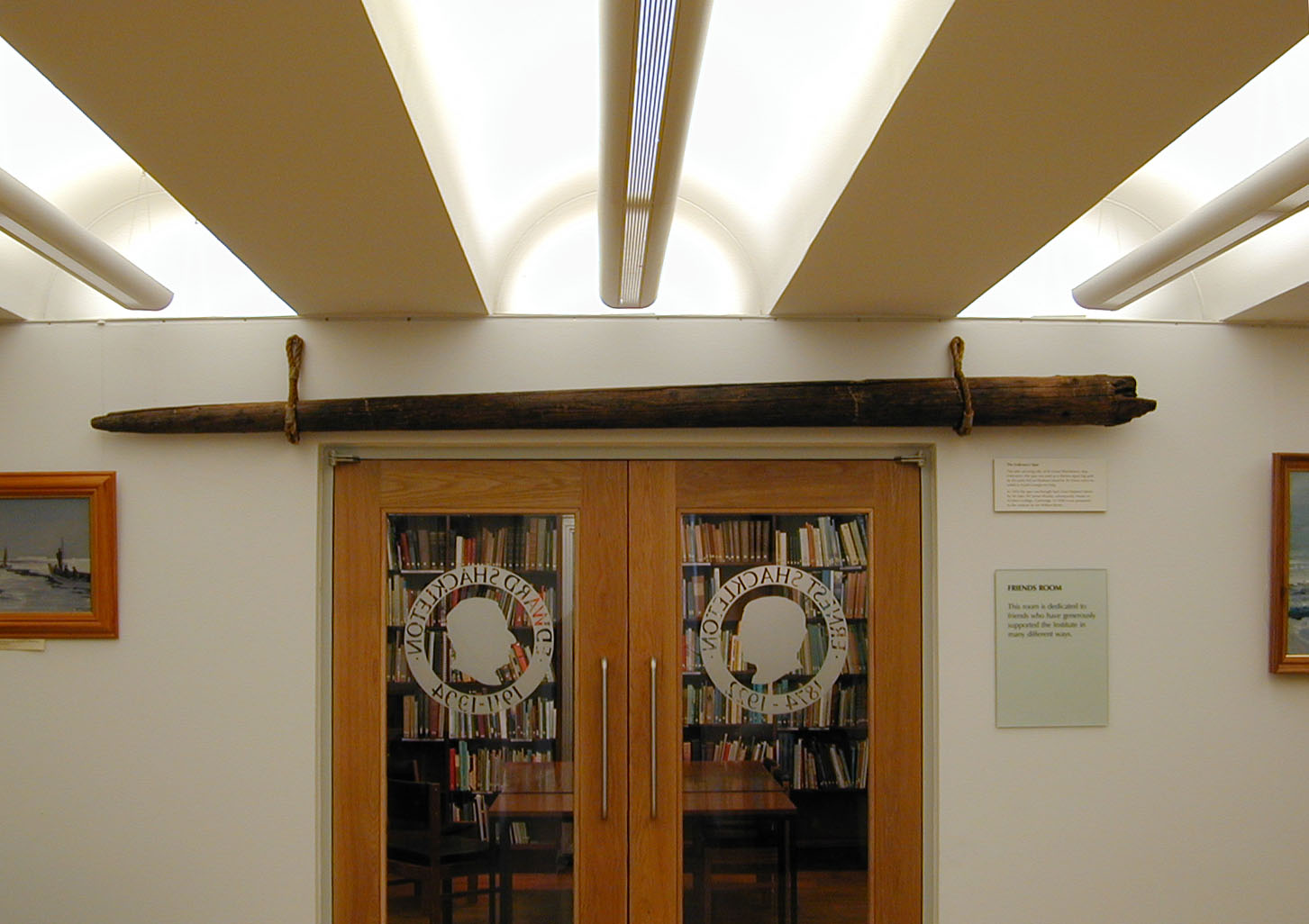
In the new Shackleton Library: Over the doorway that connects the new with the main floor of the older library is wood spar ca. 8 feet long, tapering down to a point. The caption reads: "The Endurance spar, the only surviving relic of Sir Ernest Shackleton's ship Endurance. This spar was used as a distress signal flagpole by the party left on Elephant Island by Sir Ernest when he sailed to South Georgia for help. In 1916 the spar was brought back from Elephant Island by Mr (later Sir) James Wordie, subsequently master of St Johns College, Cambridge. In 1998 it was presented to the Institute by Mr William Byrne."
Shackleton's sledging flag from the Nimrod expedition 1907-09. "This was displayed at the farthest south position . . . 9 January 1909."
Chelsea ships clock. Caption reads: "A brass marine clock from the R.Y.S. Quest presented in 1922 to the Boss from the boys." Inscribed on the rim around the face.
Wooden mailbox that says in relief: "South Polar Times Discovery 1902." Caption reads: "The box of South Polar Times articles. This is from Captain Scott's Discovery Expedition 1901-04. Shackleton was a member for the first year and became editor of the expedition's journal."
Sculpted head of Shackleton, life size or a bit larger. Mounted on top of a globe. (This is a plaster version of the bronze original in Christchurch's Canterbury Museum. See below.)

(L) SPRI from Lensfield Road with the Shackleton Library on the left.
(R) The Endurance Spar over the doorway between the Shackleton Library and the main library of SPRI.
Site No 021
Canterbury Museum.
Rolleston Avenue, Christchurch, New Zealand.
Some of the many items at the Canterbury Museum.
Christchurch's Canterbury Museum is well known to most Antarcticans. Its collections displayed in the 'Sir Robertson Stewart Hall of Antarctic Discovery'—opened in 1977 and refurbished since my last visit so there may have been some rearrangement—are extensive, expansive and important; and I'm sure there's a lot more stashed away in the back rooms! Is there any doubt that this is the most comprehensive collection of Antarcticana anywhere? Very centrally located on Rolleston Avenue and adjoining the superb Botanic Gardens, the Museum's a must for all those visiting New Zealand. (Tip: When I was last there I stayed at the nearby, modern and affordable YMCA.)
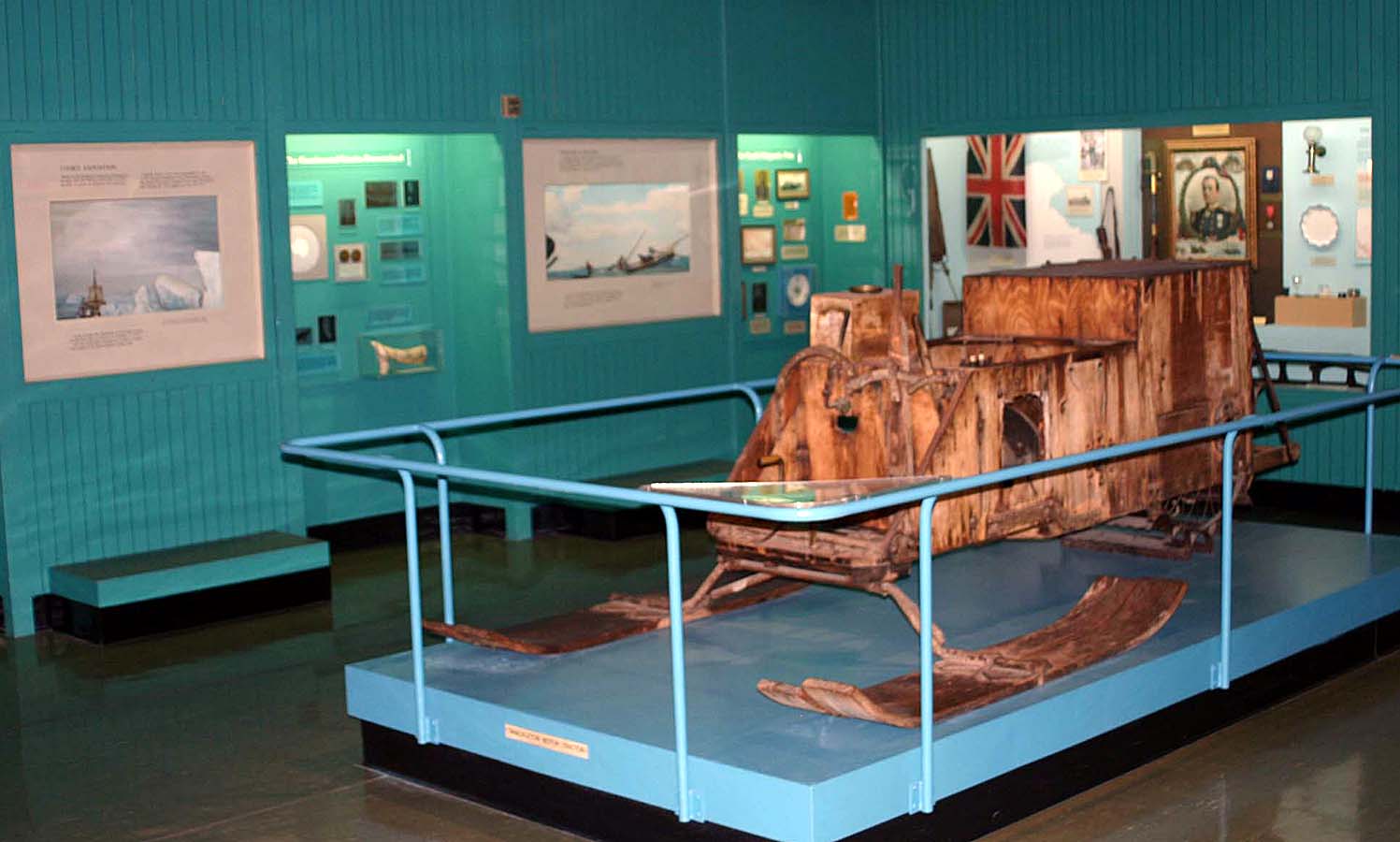
What are some of the highlights? Among the artifacts that caught my fancy were a china plate from HMS Erebus; a compass and sextant from the Southern Cross expedition; quite a few philatelic items; busts of Scott (by his wife), Shackleton, Amundsen, Byrd and Mawson; Hurley's Kodak Model B pocket camera; Amundsen's sledge with its zinc runner plates, the Norwegian flag flown at the Pole and his pocket knife; an oil painting of Shackleton's Nimrod done on a venesta case board (also used to bind copies of the Aurora Australis); Scott's ceremonial hat, belt, epaulettes, sword, polar medal and Legion of Honor (wolfskin gloves, too); Shackleton's Arrol Johnson motor sledge; a bottle of champagne (Methuselah size - 6-1/2 quarts!) emptied in celebration of Byrd's safe return from the first flight to the Pole (inscribed by expedition members); Wilson's microscope; a box of cigars from Scott's last expedition with typed inscription "for final dash, compliments of the Sol factory, Havana;" original plan and inscription for the Cape Evans cross in memory of A. E. Mackintosh; and the silver communion vessels from Scott's Cape Evans hut. And that's just for a start!
By the way, don't miss the associated P.J. Skellerup Antarctic Library.
[Episode 28, Low-Latitude Antarctic Gazetteer, posted 28 November 1996]
Jonathan Shackleton wrote in the May 2006 issue of the James Caird Society Newsletter: "In the Canterbury Museum are artefacts donated by Richard Richards, an Australian member of Shackleton's Ross Sea Party, including a Primus carried on the James Caird together with the Bournville cocoa tin in which it had been kept dry and in working order. Afterwards McNeish brought it to New Zealand and later it was presented to the Museum."
A bronze bust of Shackleton, the base of which is a globe, is in the collection. (There is a plaster version at Scott Polar Research Institute in Cambridge. See above.)

Site No 026
Lyttelton Museum.
End of Norwich Quay on the comer of Donald Street and Gladstone Quay, Lyttelton, New Zealand.
The Museum in Lyttelton, the picturesque port town of Christchurch, NZ, is one of those unpretentious local museums featuring eclectic collections that are always fun to view. A major component is Antarcticana, which is understandable as Lyttelton has lots of south polar associations. On the upper floor of the Museum (Gladstone Quay) is a variety of Antarctic memorabilia, artifacts and interesting odds and ends: A stuffed Emperor Penguin, a model of the
Discovery, memorial tablets and scrolls, expedition packing cases and crockery, Wm. McDonald's (Terra Nova) polar medals, a sledge from Shackleton's Nimrod expedition, geological samples, and much more.
[Episode 14, Low-Latitude Antarctic Gazetteer. Posted 7 July 1996.]

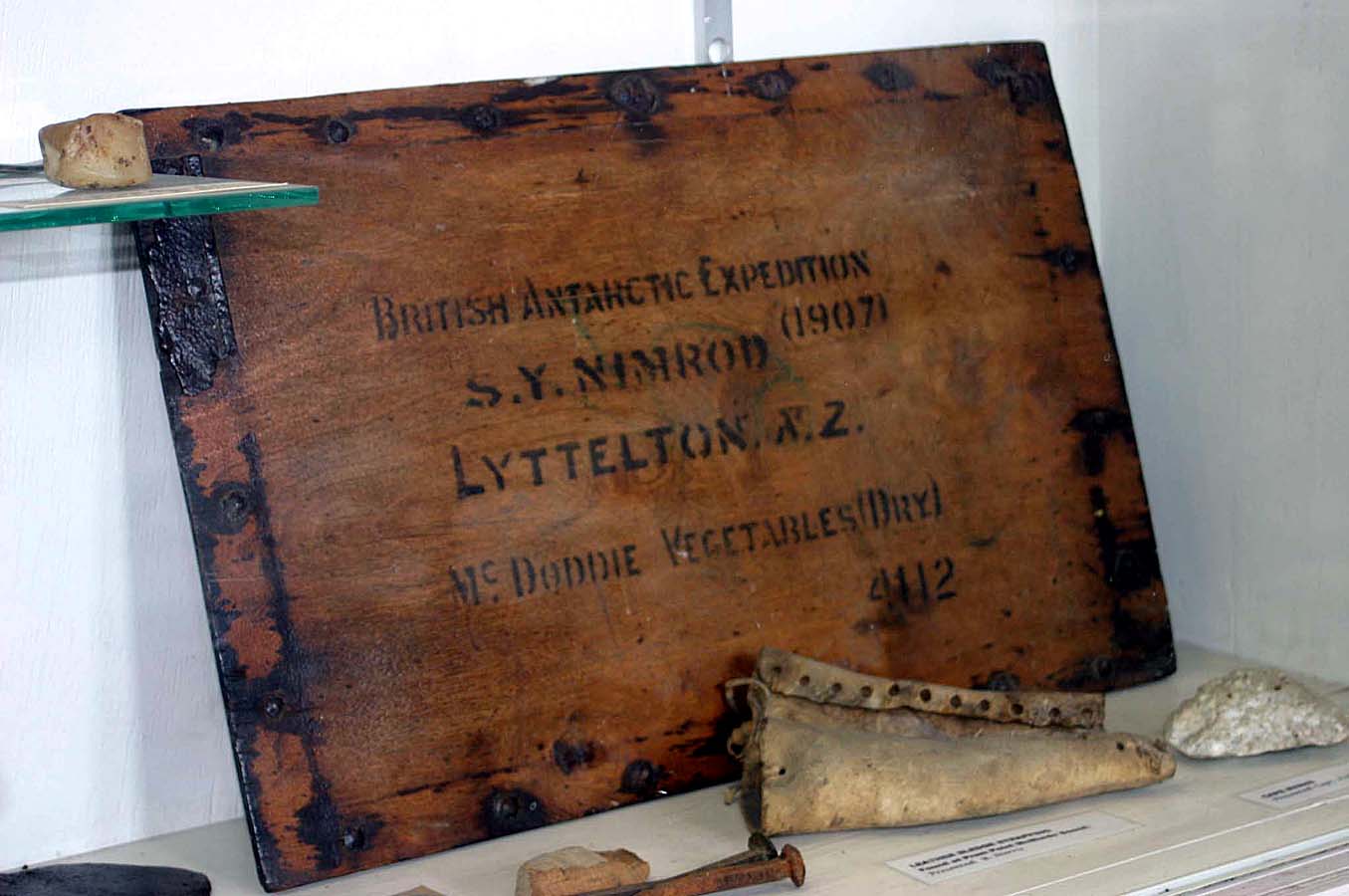
Photo on right: Courtesy of Jonathan Shackleton.
Site No 084
Royal Geographical Society.
1 Kensington Gore, London SW7, UK.
Some Antarctic treasures at the Royal Geographical Society.
The Royal Geographical Society's house at 1 Kensington Gore, London (LLAG 058), is a treasure-trove of Antarctic memorabilia, over and above the numerous journals, logbooks, correspondence and such mss material with which it is richly endowed.
I dropped by a little over a year ago and sat there very comfortably as Karen Gee brought forth a variety of artifacts for my inspection. Some of the highlights (alphabetically): Birdie Bowers' ski sticks; a match box and flag belonging to Byrd; a variety of polar equipment from Sir Ranulph Fiennes; from Sir Vivian Fuchs, playing cards, a medal and an altimeter; Cherry-Garrard's skis; Sir Joseph Hooker's stockings, collecting bag and watch (he was assistant-surgeon/botanist on the Erebus under Ross); and Sir Douglas Mawson's half-sledge.
Items associated with Robert Scott are in abundance, including medals, a horse shoe and a matchbox. His chemistry set is there, including containers of chemicals, a mortar and pestle, funnels, etc. (see Geographical Journal, July 1913). There are canvas bags with the wax seals of the RGS; inside are tea and pepper, provisions from the 'last camp;' also a small cylindrical sextant telescope, left by Amundsen at the South Pole.
Other 'Last Expedition' items: Wilson's camera flash lamp with refill packet; a small bound New Testament with "Antarctic Expedition Terra Nova" stamped on the cover (noted as Wilson's); and a dining knife.
From the Discovery: a very large coffee mug with fancy handle (white with blue and gold rim and the penguin logo of the 'Discovery Antarctic Expedition 1901' (on underside: "Doulton Burslem England"). There's a matching one on the Discovery in Dundee.
Among the Ernest Shackleton artifacts: medals; a belt and knife; cap ribbon; ship's bell and a helmet worn on his Nimrod expedition, 1908-09. Shackleton gave his cotton helmet to an old friend, writing on it: "To Frank Thornton, I give this helmet, though it is not of any use in combat in 'When Knights Were Bold' it may be liked as it was worn 'When Nights Were Cold' when the most southerly point in this world was reached by man. With kindest wishes from E H Shackleton." (see the August 1993 issue of the Geographical Magazine).
Other treasures within: The original photographic negatives of Scott's 1901-04 expedition; glass plate negatives taken by Hurley during Shackleton's Endurance expedition; a three volume set of Ponting's photographic prints given to the Oates family; a full portrait of Scott in uniform by Harrington Mann (in the new map room); a posthumous portrait of Weddell painted by Peake in 1838 and presented by John Barrow (according to A.G.E. Jones, although I didn't see it); and near the entrance, a model of the 'Discovery' in a glass case (scale of 1/4 inch to 1 foot; made by Sunderland Model Making Co.)
[Episode 30, Low-Latitude Antarctic Gazetteer, posted 7 December 1996]
According to Harding Dunnett: "Shackleton had preserved the flyleaf of the Bible with Queen Alexandra's message enscribed on it, the 2nd Psalm and pages from the Book of Job, but jettisoned the rest. Apparently, McNeish regarded this as unlucky and rescued the rest of the Bible, which is now in the possession of the Royal Geographical Society."
The RGS holds the original first two volumes of the South Polar Times, volume one being edited by Ernest Shackleton. Although published in two volumes (the third volume covered the first half of the Terra Nova expedition, the originals being held by the British Library), the originals are bound in 9 volumes (published volume 1 composed of original volumes 1-5; published volume 2 composed of original volumes 6-8; unnumbered volume 9 are the bound covers). (The South Polar Times covering the second half of the Terra Nova expedtion has yet to be published, the original single volume being held by the Scott Polar Research Institute.)
On the Exhibition Road facade, set in a niche, is the monumental statue of Shackleton. It is included separately below under 'Graves, Cairns, Memorials, Statues,' No. 007.
Prior to moving to Kensington in 1913, the Society had its house on the corner of Savile Row and Vigo Street. (Across Vigo Street was where, appropriately, Penguin Books was founded.) Both Scott and Shackleton must have known this location well.
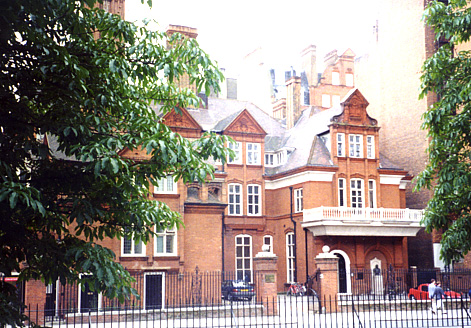
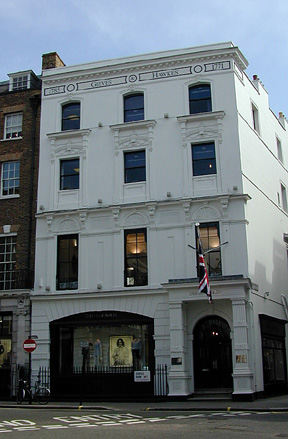
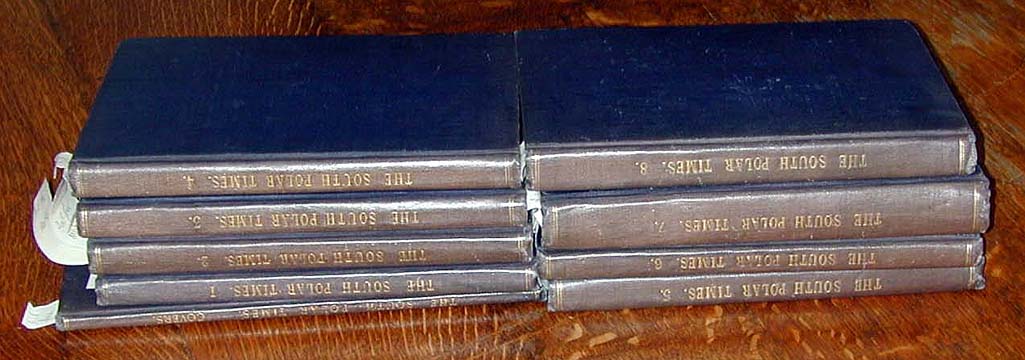
Left: The RGS from Kensington Gardens. Center: The old Savile Row. location. Right: The original South Polar Times.
Site No 046
U.S. Navy Museum.
Building 76, 805 Kidder Breese SE, Washington Navy Yard, Washington, D.C. 20374-5060, USA.
EPISODE 9 (No 046): The Navy Museum at the Washington Navy Yard.
This being Memorial Day it's appropriate that we visit the Washington Navy Yard in Washington, D.C. You'll find there the Navy Museum, a cavernous warehouse full of interesting exhibits including a large one devoted to polar subjects, both north and south. Byrd's famous hut (Alone) is recreated, and there is on display a variety of odds and ends such as radio equipment, clothing, and the original stove with kerosene burner that almost led to disaster. On the roof of the hut are two stuffed penguins: an Adelie and an Emperor. Included in the exhibit are polar medals, extensive collections of Finn Ronne and Byrd memorabilia, a 1965 1"=100' model of McMurdo Station, numerous examples of expedition china and even Byrd commemorative wood matches and paper cups and two tires from a Ford Trimotor. There's both an oil portrait by J. G. Cowell of Byrd and and a 30-inch high statuette (by deWeldon from the looks of it). Some Scott items are on display, too: a Wilson watercolor, a telescope with Scott's name engraved on it and several items (a theodolite, a film container and chocolate) lent by the Mariners Museum in Newport News. There are two fine ship models: The Flying Fish (Wilkes) and the Astrolabe (Dumont D'Urville) crafted of ivory. A large collection of papers and artifacts concerning both American and British Antarctic exploration are at the Navy Yard, catalogued but not on exhibit. Charles Wilkes' pistol is here as is his copy of the History of Greece (London, 1829), not to mention a cake of hand soap and a box of matches from Shackleton's hut at Cape Royds, a wood fragment from the bow of Ross's HMS Erebus and a variety of food rations from Scott's last expedition.
My guess is that this collection—displayed and otherwise—qualifies as the largest in the U.S.
[Episode 9, Low-Latitude Antarctic Gazetteer, posted May 27, 1996]
Since September 11th it's not been easy to get into the Navy Yard. The Musem's website doesn't help much (www.history.navy.mil/branches/nhcorg8.htm). So a phone call should be made before attempting a visit: 202-433-4882.


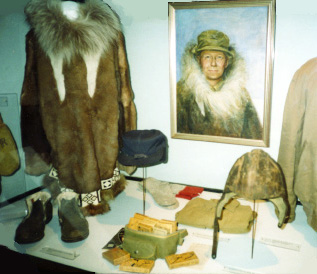
Site No 051
National Maritime Museum.
Greenwich, UK.
This is the world's premier maritime museum. Every time I visit, either the Museum itself or its website, I find additional Antarctic material. Often things are on display for an exhibit of several months then go off to storage for years. But there's always at least something worth seeing. My last visit was in November 2006 when I found that they now have what I was told is a permanent exhibit on Antarctica. It's Shackleton items include Elizabeth Beardmore's copy of the Aurora Australis; a replica of the James Caird used for a movie; a matchbox from the Nimrod expedition; a sextant and a compass used on the James Caird; a sketch by Shackleton on a hotel letterhead showing his proposed route across Antarctica; and a 78rpm recording by Shackleton.
Below are some of the Antarctic related paintings, artifacts, books, manuscripts and photographs that are included in the Museum's holdings. (Some may repeat those noted above. Shackleton items in bold)
1. Commemorative silver medal by G. Bayes 1904. 70mm in diamter. Obverse: Bust of Scott in uniform coat and cap. Legend: "To Captain Robert Falcon Scott RN, CVO, FRGS. Commander of the Expedition. Jan 2, 1902-March 5, 1904. Reverse: Scott in Antarctic dress standing in front of a sldege with 3 men in the background. Legend: Presented by the Royal Georgraphical Society for Antarctic Discoveries." Inscribed on edge: "Arthur K. Quartly RN."
2. Two-day chronometer, John Poole, maker to the Admiralty, 57 Fenchurch Street. Used on Scott's 1902 expedition. Diameter of dial: 4.9 inches.
3. Two-day box chronometer signed: Thomas Mercer maker to the Admiralty. Used by Shackleton 1916. Presented by Committee of British Club of Puntas Arenas. On box: Royal Geographical Society No. 2. Diameter of dial: 5 inches.
4. Sledge used on one of Scott's expedition.
5. Emperor Penguin one of Scott's expedition.
6. In the collection is "a silver statuette of polar explorer hauling a sledge heavily laden with boxes, bags and various equipment, including a pair of skiis. This is mounted on a plinth made of Discovery oak which has a silver plaque inscribed: Sir Clements Markham KCB FRS from the officers and men of the Discovery in commemoration of the Antarctic Expedition 1901-4."
7. The Henley Collection of photographs, donated by Mr. M. Henley. 48 negatives. Related to Shackleton's Antarctic expedition of 1914, also other subjects.
8. Three copies of the Aurora Australis (PBB 4190 & PBB 2621). Presentation to E. Dawson-Lambton 25 Dec 1909 by Shackleton and to Mr & Mrs Buckley by Ernest Joyce.
9. Signed copy of Shackleton's Heart of the Antarctic.'
10. A variety of items associated with Robert Scott including: Silver cigarette case (prize for winning cutter race in 1874); knife and sheath; sealskin boots (reputedly Scott was wearing these when he died; given by Lady Scott); pair of skiis; tobacco pipe; Discovery uniform button; sleeping bag; pocket compass; theodolite, etc., used for fixing position at South Pole; telescope.
On my last visit (2005) I stumbled upon a ship's nameplate from the HMS Scott, on display with those from many other British ships.
According to A. G. E. Jones (p. 379, Polar Portraits) "The illustration of the Jane and the Beaufoy at the farthest South was used on a copper seal made for Weddell's private use. It is now in the National Maritime Museum, and an impression of it is held by the Royal Geographical Society."
Here's what I said after a visit on May 23, 1999: The Museum has reopened with a new series of displays in an atrium. Not very successful: exhibits are dark and the captions hard to read. They have on the ground floor Hussey's autographed 6-string banjo, in a glass case. Label reads: "Hussey's banjo made by A O Windsor about 1900. Dr Leonard Hussey was a member of Shackleton's crew on the ill-fated Endurance, which was crushed by ice in the Antarctic in 1915. Shackleton and a small group of men sailed their 20-foot (3 m) lifeboat, the James Caird, on an epic voyage travelling hundreds of miles across dangerous seas to the whaling station in South Georgia to fetch help. Hussey played his banjo for the shivering crew and the signatures on it are those of the men who shared the boat." The signatures include: Shackleton, Wild, Worsley, McIlroy, James, Greenstreet, Hurley, Marston, Cheetham, Greene.
In ground floor in a display of naval uniforms is a suit of woolen clothes. Caption reads: "Woolen clothing supplied by Jaeger of London to the Mawson Australasian Antarctic Expedition 1911-14. Pajama top and bottom, balaclava helmet, gauntlet gloves. Woolen clothing, especially worn in layers, was effective in combatting the severe Antarctic climate. Douglas Mawson, leader of the expedition, recognized not only the strategic importance of the Antarctic continent to Australia but also its potential for marine and mineral wealth." Pajama top has a breast pocket on the left side, 5 buttons, collar, long sleeves, wheat colored. Balaclava is a dark ribbed wool. The gloves are dark as well. Two photographs show boxes of wool products supplied by Jaeger.
In the same room, in the floor covered by glass, are a pair of finneskoe. Caption reads: "Pair of finneskoe or raindeer skin boots from Australasian Antarctic Expedition."
On ground floor in explorers hall is a reindeer skin sleeping bag. Caption reads: "Reindeer hide sleeping bag from Scott's 1910-12 Antarctic expedition. This sleeping bag belonged to Commander Murray Levick, the surgeon attached to Scott's ill-fated party. These sleeping bags could be rolled up and transported in a metal case but they were very heavy and would have been quite awkward to carry and use. They were extremely warm and similar bags were used on most polar explorations. Captain Scott would have slept and died in one."
Cook's sextant is on display. "Made by Jesse Ramsden 1770. This sextant was one of several used by Cook and is by one of the most famous of 18th century instrument makers. An extremely accurate instrument, Cook would also have been able to use it when ashore to calculate his longitude by the lunar distance method and thus check the precision of his chronometer."
In the Special Exhibitions section there are 3 Hurley photos, a Ponting photograph showing waves breaking over small iceberg.
Selected items on the website when searching under 'Antarctic,' August 2006
1. Oil portrait of Ernest Shackleton by Reginald Grenville Eves, 1921.
2. Oil portrait of James Cook by Nathaniel Dance, 1775-76.
3. Oil portrait of James Clark Ross by John R. Widman, 1834.
4. Oil painting of the Erebus & Terror in the Antarctic, John Wilson Carmichael, 1847.
5. Medal commemorating the Antarctic exploration voyage of the Vostok and Mirny, 1819-22. Made 1819. Artist: I. Shilov.
6. Oil painting of HMS Erebus passing through the chain of bergs, 1842. Artist: Admiral Richard Brydges Beechey.
7. Single sheet mss. St. George's Bay surveyed by Edward Bransfield, master of HMS Andromache, 22 Jan 1821.
8. Medal commemorating Sir Vivian Fuchs. 1958
9. Sectional model of the Discovery. Maker: Severn-Lamb Ltd. ca 1983.
From SOUTH: THE RACE TO THE POLE (2000-01). Items displayed that were from the collections of the NMM:
Captain Cook portrait by James Dance.
Portrait by John Wildman 1833-34 of Sir James Clark Ross.
Two Ponting photos: Pancake Ice, from a private collection. Wave crashing on iceberg.
William Colbeck's sledging flag from the Southern Cross expedition. Skull and crossbones.
Emperor Penguin. Brought back by the Discovery expedition, skinned by Dr Wilson.
Three small pen and ink drawings by Dr Wilson.
Very large leather-covered telescope made by Ross used on the Discovery.
Crew on board the Discovery at East India Dock 16 September 1904. Photo by Thomson.
Ticket for launch of the Discovery.
Printed "appeal on behalf of the National Antarctic Expedition."
Large detailed plan of the Discovery.
Sledge harness.
Ice axe used on the Discovery.
Photo album from the Discovery compiled by Ernest Shackleton.
Captain Colbeck's photo album from Discovery.
Letter from Scott to Admiral Markham 27 February 1903.
Copy of The Blizzard.
Discovery entertainment program.
Sledging compass from the Discovery.
Scott's watch.
Skin of a female snow petrel.
Written document entitled "Arrangements for Abandoning the Discovery" Signed by Scott.
Sir Clements Markham's silver presentation sledge.
Printed dinner menu of Savage Club. 5 November 1904.
Program of Sports for 8 November 1902 in honor of birthday of King Edward VII.
Signed photo of Shackleton. By Lallie Charles, London.
Photo of Shackleton. By G.C. Beresford, London.
Photo of Shackleton and Prime Minister Balfour. 29 June 1909.
Shackleton sketch of his proposed route to the South Pole, Nimrod expedition. On stationery of the Grand Hotel, Eastbourne.
The Invernairn Letters. Donated in 1958. First time on display.
Terra Nova burgee.
Murray Levick's sleeping bag.
"Ponko" Ponting Penguin toy.
Album of photos by Ponting.
Photo of Dr Wilson in tropical clothing; photo of Scott in tropical clothing.
Aurora Australis.
Shackleton's phonograph record, RCA Victor, recounting his dash to the Pole in 1909.
Nimrod commemorative postcard.
Scott's overshoes. Taken south.
Scott's sledging satchels and sledging goggles.
Pair of Finneskoe.
Summit ration bags found at Scott's last camp.
Scott's silk sledging flag found at last camp.
Letter from Teddy Evans on board the Terra Nova to Admiral Markham 3 February 1913.
Letter from Francis Drake on board Terra Nova to Admiral Markham 25 January 1913.
Letter from Admiral Markham to Captain Scott 22 August 1912.
Parts of primus stove found at Scott's last camp.
Theodolite taken by Scott's party to the Pole.
Wyllie's etching of Scott's message to the public.
Scott commemorative postcard.
Service for the unveiling of the Scott memorial at St Paul's Cathedral 5 May 1916.
German medal presented to Amundsen.
Booklet of Shackleton family holiday photographs from Sheringham 1910.
Letter 13 January 1914 from Shackleton to Elspeth Beardmore.
Photo of Aeneas Macintosh in a merchant marine uniform.
Epitaph by Shackleton to the three casualties of the Ross Sea Party.
Hussey's zither banjo signed by members of the expedition including Shackleton.
Liquid boat compass thought to have been used on the James Caird.
Chronometer thought to have been used on the James Caird.
Victorian style settee. Used at Stromness.
Admiralty chart of South Georgia. Shows route taken by Shackleton added in pencil.


Site No 228
The Science Museum.
Exhibition Road, London SW7, UK.
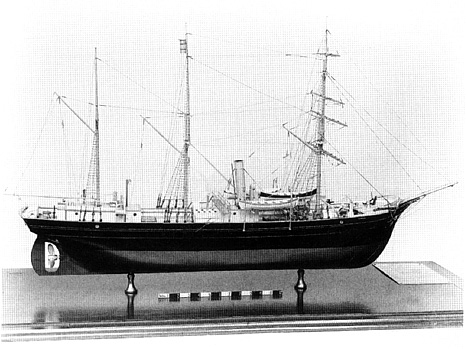
The Science Museum has at least two items of Antarctic interest in its collections: First, there is a model of Shackleton's Nimrod. Lady Shackleton presented this to the Museum in 1929. And second, a range finder associated with Scott. Louisa Young wrote in her A Great Task of Happiness; The Life of Kathleen Scott: "She [Kathleen] took him [Peter] to the Science Museum too: 'and the fellow says "This is interesting, it's the range-finder used by Captain Scott, you'll have heard of him."
Another item is a restored Sno-Cat named Haywire from the 1957-58 Commonwealth Trans-Antarctic Expedition which is now kept at the Museum's Wroughton Storage Facility near Swindon in Wiltshire.
Visit: www.sciencemuseum.org.uk

Site No 545
National Portrait Gallery.
St Martin's Place, London WC2 0HE, UK.
Among the collection of The National Portrait Gallery are the following with Antarctic connections:
- James Clark Ross. Very nice portrait medallion by Bernhard Smith, 1843.
- James Clark Ross. Appears to be a sketch, by William Brockedon 1848.
- James Clark Ross. Painting by Stephen Pearce 1850.
- Sir Clements Markham. Photograph, by Elliott & Fry, 1900s. Signed by Markham.
- Robert Falcon Scott. Painting by C. Percival Small, based on a photograph, 1910. Scott in uniform.
- Sir Ernest Shackleton. Painting by Reginald Grenville Eves, 1921. (The National Museum also possesses an Eves portrait of Shackleton.)
The Gallery has other images which are still under copyright (such as Ponting).

Eves portrait of Shackleton.
Site No 360
Peabody Essex Museum.
East India Square, Salem, Massachuusetts 01970-3783, USA.
The Museum has the A. H. Waite Collection. Waite was on the Second Byrd Antarctic Expedition. He gave/sold his collection to the Museum. Among the things in the collection are: sugar (Scott); nails (Scott); dog harness (Byrd); brass plate from the ship Bear; Biscuits; Parachute South Pole; Citroen tractor engine part; First antenna wire(?) (Scott 1902); waterproof matches Shackleton; Knife Cape Evans; Trail flag Little America; Spool of thread; Jar of cocoa; Battery cells (Scott); Piece of the ship Bear Figurehead; Test tube Cape Evans; gray woolen shirt (Byrd); Trousers Little America; Box kite (Byrd); and more.
[SEE BELOW FOR LISTING]
The Museum recently (2000) got a pair of heavy socks reported to have been worn by Shackleton.
The following are a gift of A.H. Waite [only Antarctic items included]:
Specimens collected on his various trips to Antarctica with Byrd and later trips. 1970. See File M14342-14412. Acc. #19497
M-14342. 1 tin petrol can used in the 1910 Antarctic Camp of Captain Robert Falcon Scott.
M-14343. 1 dog harness 35" long from Admiral Byrd's Antarctic Expeditions #2 1933-35.
M-14345. Brass plate from a life boat built in Scotland in 1871, presumably for the ship BEAR.
M-14347. Antarctic typical black flag used by present day Antarctic Expeditions.
M-14348. Ant.-typical orange flag use by present day Antarctic Expeditions.
M-14349. Ant. tin can containing [previous crossed out] eskimo biscuits from Scott's & Shackleton's Ant. camp 1902-7, recovered by A.H. Waite 1958-1962 7" diam 4-1/2" high.
M-14350. Remains of a blue and white cargo parachute dropped at the South Pole, approx. 9' in dia.
M-14351. Jar of sugar from Scott's 1910 base at the South Pole [question mark inserted here].
M-14352. Can of Spice - from Scott's camp.
M-14353. Can of Pemmican from Scott's camp.
M-14354. Can of "Symmington's Pea Flour" from Scott's base.
M-14355. Can of cocoa from the same base.
M-14356. Ant.- can of army rations from Shackleton's 1907 base.
M-14357. Copy of ensignia of the Signal Corp Antarctic Research Team, developed by A.H. Waite 11-1/4" diameter.
M-14358. Wooden copy of an old fashioned straight razor made on the BEAR in 1933, used to initiate the "polywogs" on that equator crossing. The names of the entire crew of the ship BEAR are inscribed on the blade (damaged) 26" long.
M-14363. Piston from a Citroen engine used in the first tractor exploration of the Antarctic in 1935.
M-14365. Ant.- fragment of bottle glass, an old belt buckle, a handmade hinge, a tin can cover and 6 nails. The glass fragment, buckle, and hinge were found at a campsite on the Northeast coast of Greenland. The tin can cover is from Eta, Greenland and the 6 nails came from Scott's base in the Antarctic.
M-14366. Ant.-part of the first antenna wire ever used in the Antarctic, used by Scott and his party in 1902, found in 1956 by A.H. Waite, (bent and twisted) approx. 30' of wire.
M-14367. Ant. and Arctic flag carried by A.H. Waite to the Arctic and Antarctic as leader of the Signal Corp Research Teams (very dilapitated).
M-14368. Ant.-Chemical jar from Scott's base with remains of specimens inside.
M-14369. Ant.-tin of waterproof matches recovered from Shackleton's 1907 hut.
M-14370. Ant.-boot sole with corroded aluminum ground plates, found outside Scott's 1910 house (just remnants).
M-14371. Ant.-knife found in Scott's 1910 house by A.H. Waite in 1956, American Expeditions. 10-1/2" long.
M-14372. Ant.-windproof shirt issued to A.H. Waite at Little America in December 1933.
M-14373. Ant.-windproof shirt of the same type as above only in better condition.
M-14374. Ant.-socks of the same type of material.
M-14375. Ant.-fragment of a trail flag brought back from Little America by A.H. Waite 16 x approx. 7".
M-14376. Ant- boot strap from Scott's 1910 hut.
M-14377. Ant.-fragment of a sled rope found in Scott's 1910 hut 7" long.
M-14378. Ant.-spool of thread found at Shackleton's hut, originally made in England before 1907. 2" spool.
M-14379. Ant.-spool of thread with a needle in it from Scott's 1910 hut. 2 " spool.
M-14380. Ant.-jar of cocoa from Scott's base.
M-14381. Ant.-box containing two of the original battery cells used by Scott and his crew.
M-14382. Ant.-leather washer used on an early British ski pole to keep it from sinking too far into the ice.
M-14383. Ant.-ski strap found at Scott's base 21" long
M-14384. Ant.-staple from one of the ship riggings from Cape Royd, which was Shackleton's.
M-14385. Apiece of the figurehead of the ship BEAR, brought back by Admiral Byrd in 1935. 11-1/2" long (this piece fits exactly with M-4396).
M-14386. Ant.wind helmet used by A.H. Waite for skiing in the Antarctic in 1933-4-5 and later in 46-47, 55-56-57.
M-14387. Ant.- a piece of the original sail of the ship DISCOVERY 190 [last digit clipped] 18-1/2" long 4" wide.
M-14388. Ant. - one of the original binding posts from one of Scott's early storage batteries.
M-14389 [and] M-14390. Ant. - a spent cartridge shell, and a small glass bottle recovered by A.H. Waite from Cape Royds, Shackleton's 1907-1915 camp.
M-14391. Ant. - bottle with an eyedropper in it, found in the Photographic laboratory of the 1910 Scott camp.
M-14392. Ant. - test tube in original wrapping paper from Scott's 1910 expedition.
M-14393. Ant. - broken glass fragment found at Scott's 1910 base weathered purple and worn by sand.
M-14394. Ant. - sugar bottle cover 3-1/2" in diameter, from Scott's 1910 base.
M-14395. Ant. - marmalade can label from Scott's 1910 base.
M-14396. Ant. - can of food recovered by A.H. Waite from Cape Royds, Shackleton's 1907 and 1915 camp.
M-14397. Ant. - gray woolen shirt made by Woods and given to the Byrd Antarctic Expedition by him, issued to A.H. Waite at Little America.
M-14398. Ant. - pair of khaki windproof trousers made for A.H. Waite.
M-14399. Ant. pair of trousers worn by A.H. Waite, patched with sheepskin on the knees and seat.
M-14400. Ant.- windproof sock of Byrd cloth used in Little America.
M-14401. Ant. - Army issue winter Arctic hat worn by A.H. Waite.
M-14402. Ant. no description
M-14403. Ant. pair of standard army issue boots worn by A.H. Waite.
M-14404. Ant. -pair of felt innersoles used by A.H. Waite.
M-14405. Ant. -pair of air force boots issued to pilots for Arctic wear.
M-14406. Ant. -pair of bamboo ski poles used by A.H. Waite in the Antarctic in 1934 54-1/2" long.
M-14407. Ant. -Byrd issue of the early Scott man-hauling harness.
M-14408. Arct. -Standard pair of army snowshoes, developed by the Natick Laboratories, Natick, Mass. Environmental Lab. for the use of army troops in the Arctic, used by A.H. Waite 57-1/4" long.
M-14409. Ant. -Typical crampons issued to all Byrd Expedition personnel, used by A.H. Waite.
M-14411. Ant. -Box kite used by Admiral Byrd on his first Antarctic Expedition and repeated on his second expedition. It carried antenna wires aloft for better radio transmissions; later proved unneccessary (dismantled).
END OF ACC. # 19497 [Those not appearing are arctic or otherwise non-antarctic]


Jonathan Shackleton holding socks said to have been his cousin's.
June 22, 2000 at the opening of the Endurance Exhibition at the Museum.
Site No 428
South Georgia Museum.
Grytviken, South Georgia.
The South Georgia Museum (formerly the South Georgia Whaling Museum) is located in what was the Manager's Villa. The Museum was established in 1992.
Some of the Shackleton items I saw on a visit in December 1998:
- Fragments of wood from the Endurance and from the James Caird.
- Shackleton's walking stick on loan from Government House, Falkland Islands.
- "Sledging Compass (one of a pair) used by Shackleton on his 'Nimrod' expedition of 1907-09 when he reached the furthest south - within one hundred miles of the South Pole."
- Photo of Shackleton, 1914, inscribed: "To Captain J. D. Thom. With kindest remembrances from E.H. Shackleton, a brother sailor, November 1914."
- What looks like a watercolor of the Quest.
- Framed cut-away diagram of the Quest from the Illustrated London News, September 17, 1921.
- A number of bronze plaques from Shackleton's grave. One says "Sir Ernest Shackleton CVO etc. a token of fraternal affection from old Alleynians in the River Plate. February 1922." Also one: "A token of appreciation to brother Sir Ernest Shackleton CVO from the English Masons of Uruguay. Acacia Lodge No 876 Silver River Lodge No 3389 Acacia Chapter No 876 Silver River Lodge of MMM No 628?" Also, there's one that reads: "This wreath was laid upon Sir Ernest Shackleton's coffin by E.J. Hope-Vere, His Britannic Majesty's Charge d'Affaires on behalf of his Majesty the King and His Majesty's Government. Montevideo February 15, 1922."
"In 1989 the Governor of the Falklands Islands W. Fullerton and researcher Nigel Bonner took an initiative to create a museum at South Georgia, to protect and preserve the abandoned whaling stations. Today Grytviken is, (being the first station on the Island from 1904 and the last to shut down) a protected area with a restored administrative house as museum and a Norwegian church which has been completely restored for the 85 years Anniversary in December 1998."
Source: www.grytviken.org
"The South Georgia Museum is the key to many visitors' understanding
and enjoyment of the island. Originally set up purely as a whaling
museum, in 1992, it has since diversified so that its exhibits now
illustrate most aspects of South Georgia's history and natural
history, as well as items of current interest.
The Grytviken "Villa", which houses the museum, was originally the
whaling station manager's house, built in 1916 by the Norwegians. The
entrance hall has current information for visitors including a large
map of the island and a photograph taken from space. There is a
reference library and video library with archival and natural history
films which can be accessed by the public on request. There is also a
gift shop.
Exhibits include discovery, exploration, Shackleton, surveying and
mountaineering expeditions, sealing in the late 18th and early 19th
centuries, the first decade of whaling, techniques of modern whaling
in the middle part of the 20th century, whalers' social life maritime
history, and natural history. Displays include the administrative
history and the 1982 conflict and subsequent British military
presence until 2001. Another exhibit centres around a working steam
pump with items from the blacksmith's workshop and foundry.
Some of the buildings which surround the museum date back to 1904
when the whaling station was first established by the Norwegian
Captain C. A. Larsen. The station is open to visitors as all the
hazardous material and unsafe structures have been removed. Visitors
can walk from the museum through the whaling station. The church,
which has been restored and is maintained by the museum, is worth a
visit. A track leads from the Church around the back of the whaling
station to the whalers' cemetery where Sir Ernest Shackleton is buried.
Funding for the museum is by a percentage of passengers' landing fees
gifted to the Museum Trust by the island's Government and from gift
shop profits. Private donations have also made a big difference to
the projects that have been undertaken. The museum has charitable
status in the Falkland Islands and it is also now possible for
American donations to be made tax deductible.
During the past fourteen years the museum has developed into a
valuable resource. With the ever increasing number of visitors and
growing interest in South Georgia's heritage, the museum fulfils an
important role."
Source: http://www.sgisland.org/papers/main/museum.htm
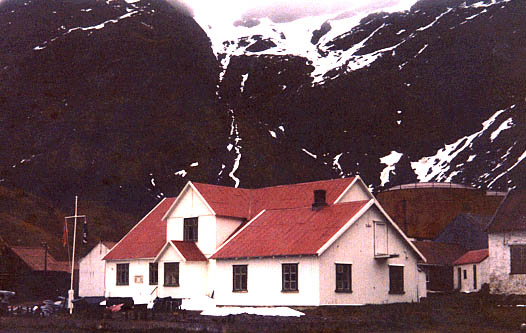
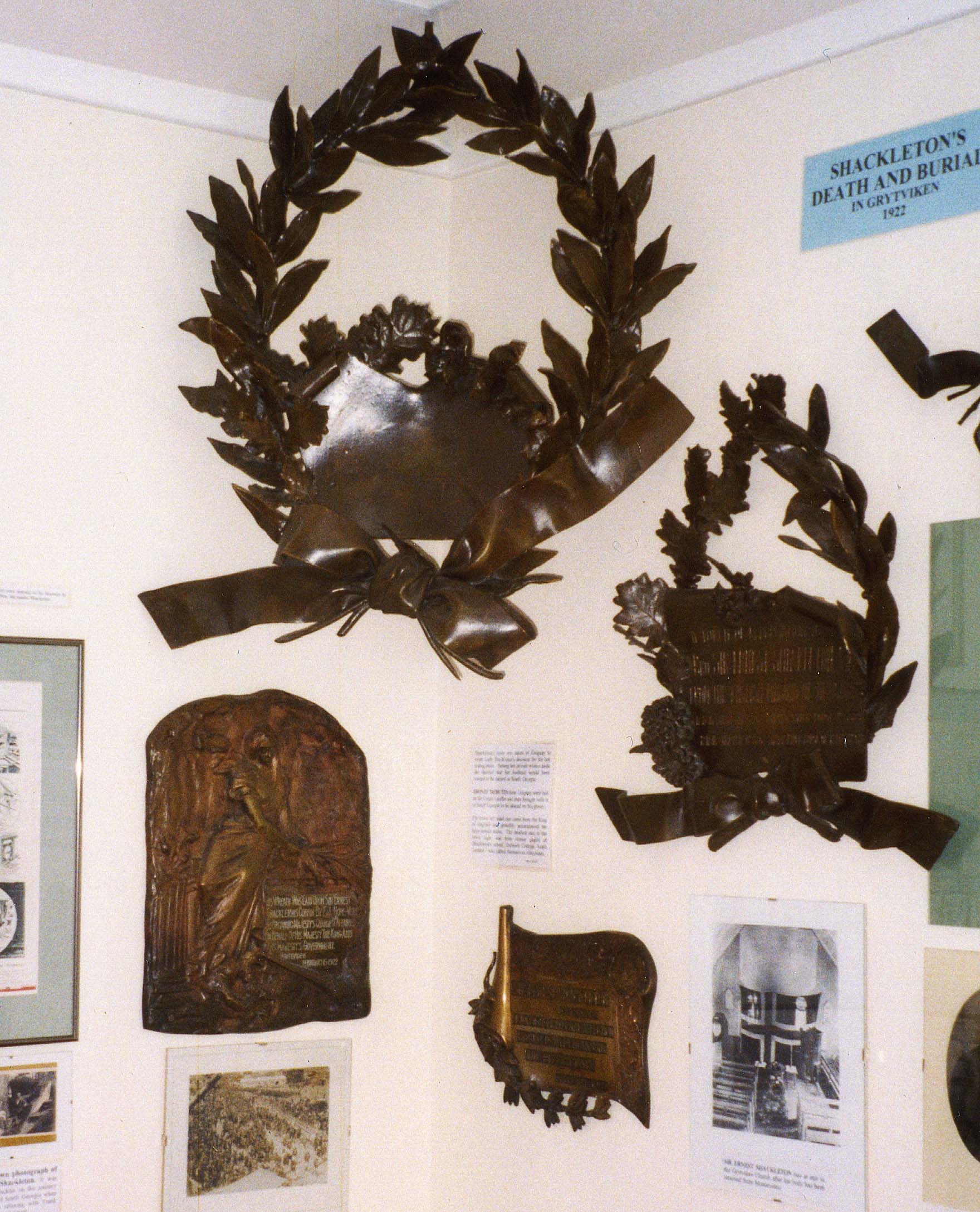
On the right are some of the Shackleton memorial wreathes and plaques.
Site No 455
The Shetland Museum.
Lower Hillhead, Lerwick, Shetland ZE1 0EL, UK.
The museum has in its collection a fragment of a bronze wreathe from Shackleton's grave at South Georgia, removed by the donor (John Harrison, Heylor, Northmavine) as a souvenir. Donated in 1965. In Maritime-Case 4. Registration No: MIS 65769.
Shown on the Museum's webpage as Photo No. 01485. Described as 'bronze leaf and twig.' Description: "British explorer, Sir Ernest Shackleton died from a heart attack on 5th March 1922. The ship he was on at the time, the Royal Yacht Quest, had called in at South Georgia while they were on exploration. It was intended that his body be shipped back to Britain, and a memorial cross erected on a mountainside in South Georgia. However, his widow sent word that as his own earlier request, he was to be buried as far south as possible. The ship returned to South Georgia, and a memorial, a cross with a bronze wreath, was erected. This is a bronze leaf off that memorial. It was broken off and taken home by a whaler working at South Georgia."
The Museum has 13 photo images in its collection related to Shackleton: One shows a Shackleton airplane airbourne. One of Shackleton's funeral. Several of his grave. One of the cairn (not grave as labeled). One of the plaque at Stromness.
Visit: www.shetland-museum.org.uk/

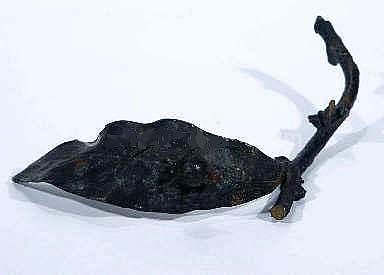
On the right, the bronze leaf.
Site No 484
Athy Heritage Centre.
Town Hall, Emily Square, Athy, County Kildare, Ireland.
"On display in the Centre is the sledge used by Sir Ernest Shackleton on his 1907-1909 expedition to the Antarctic. This particular sledge was one of ten 12 foot sledges of the Nansen pattern that Shackleton ordered for pony hauling from L.H. Hagen and Co. in Norway. The runners are made from hickory and the upper parts from ash. It also has its original rawhide bindings. Ernest's cousin, Jonathan Shackleton, obtained the sledge from Christchurch, New Zealand in 1991 when it came up for auction. The family selling it, had originally bought it or were given it, to use during a bad snow storm for feeding out hay, which they did very successfully. Ernest Shackleton, forever in debt, would have sold it in New Zealand to raise funds before setting out on his way home (to meet his creditors!).
Also on display in the Centre you can find a menu card for a farewell dinner given in honour of the Captain, officers and crew of Y.S. Nimrod, dated 6 August 1907. This menu card includes 14 signatures on the verso, including: Ernest Shackleton, Rupert England (Captain of the Nimrod), Harry Dunlop (chief engineer), Jameson Boyd Adams (shore party), Aeneas Mackintosh (shore party), Alastair Forbes Mackay (shore party), Ernest R. Joyce (shore party)."
Source: http://kildare.ie/hospitality/historyandheritage/AthyHeritage/Shackleton.html (apparently no longer online)
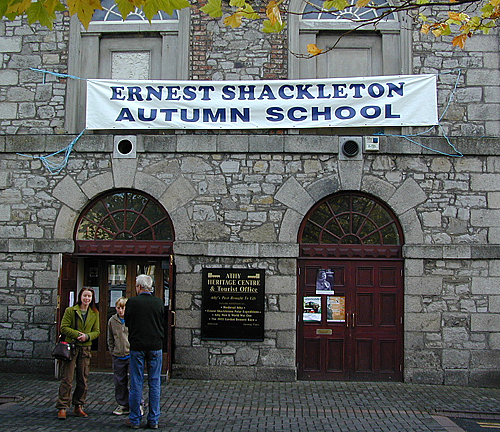
"Athy Heritage Centre has the only permanent exhibition anywhere devoted to Shackleton. Highlights include an original sledge and harness from his Antarctic expeditions, a 15-foot model of Shackleton's ship Endurance, an exhibition of unique Shackleton family photographs and an audio visual display featuring Frank Hurley's original film footage of the Endurance expedition. The Shackleton Autumn School was established to commemorate the explorer in the county of his birth. It provides a forum for the discussion of polar exploration and the presentation of artistic work relevant to Shackleton and polar exploration."
Source: http://www.athyheritagecentre-museum.ie
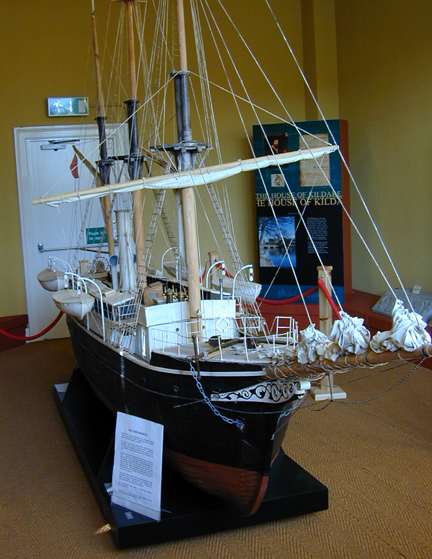
Site No 494
Central Museum & Art Gallery.
Guildhall Road, Northampton NN1 1DP, UK.
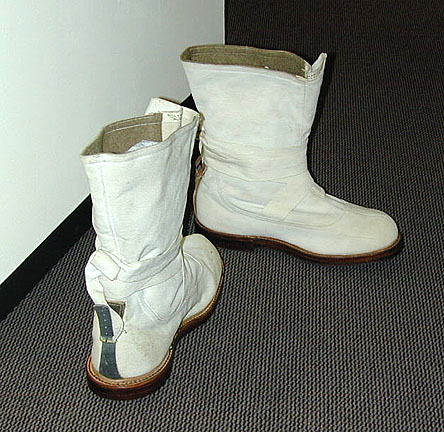
Northampton was a leading shoe center and the Central Museum & Art Gallery has the largest footwear collection in the world. Among the many examples on display are boots with a Shackleton association. These are catalogued as follows:
Army boot
Identification: Military footwear
1918
Description:
Men's single left white canvas and brown leather British Army boot. Shackleton No 1 and No 2 very broad rounded toe, calf length, brown strap and buckle at back of heel; wide tops; fastening around ankle with 2 canvas straps, lined with khaki wool. Stacked brown _ inch heel, brown sole, no rand.
Production:
Notes: Date: 1918
Historical associations:
Association type: Association
Associated person/body: Shackleton, Ernest
Notes: Similar boots to those worn on the Murman Coast Expedition 1918.
Modelled from boot worn by Sir Ernest Shackleton in the Antarctic
Identification numbers:
Object number: 1920-21.33 and 1920-21.34
The description is such that it's reasonably clear that these weren't Shackleton's boots, just boots "modelled from boot worn by Sir Ernest Shackleton."
I first learned about the boots from Bob Burton. When I arrived at the Museum I asked about them and was told that they were in storage off-site but that they would have them brought in. I therefore went off for a long lunch and when I returned was told they were unsuccessful in finding them. Resigned to the fact that it was a wasted stop, I nonetheless had a turn around the main shoe display hall, and what did I come upon? The boots in question, on display all along!
Here's Bob's description of the boots (he says he saw two pairs; I only say one):
They have two pairs of boots, sizes 10 and 12. D89/1973. 19 and 20
They are off-white canvas, with a long, broad tape and buckles on the heel. The toe cap and the heel are reinforced with leather, the former outside the lining and the latter inside, so that it is visible. The sole is brown leather, completely smooth and there is no lining on the inner surface. The lining is khaki woven wool which has been knapped so that it looks like felt. It is lighter than serge. The lining is sewn in. One boot has a "storm welt" - raised a couple of mm around the upper. They are unusual in that they are sewn continuously without a break in the welt.
They are catalogued as "Murman Coast Expedition, Shackleton".
Brian Hensman [Museum staff] says that Durox is leather which has been rolled to make it more dense and saturated with grease or wax. (There is a note that Cheltenham Museum has a pair of Edward Wilson's fur boots. Northampton Museum also has a pair of skis from one of Scott's expedition but due to
reorganisation they don't know where it is.)
See article in the "Footwear Organiser" for March 1919.
Extracts about boots from Orde-Lees journal:
Messrs. Burberry also manufactured for us boots to the pattern of those designed by Captain Roald Amundsen, which were made to measure so as to accommodate no less than five pairs of socks, a very necessary foot equipment in extreme low temperatures. Naturally these boots looked perfectly
enormous, they had "Durox" indestructible leather soles, soft leather golosh and fine cloth uppers which extended up the leg some way, they were made fast with a pair of soft webbing thongs and instead of an opening or tongue down the front they had a gusset which folded over. They were very serviceable and stood no end of hard wear and, by most members, were preferred to any for
general out-side use; their only disadvantages were that the uppers were inclined to get wet and retain the moisture and although Amundsen apparently used his constantly for skiing we did not find them very convenient for this purpose; it is just possible that his may have had stiffer, or even block, toes, as our experience was that the toe strap of the skis pressed through the boot onto the toes thus rendering them somewhat liable to frostbite and also the foot seemed to have too much play inside the boot for convenient skiing.
Other types of boots taken were long solid felt full length leg boots, short felt half boots fastening with a clip and of course plenty of the indispensable finnesko or fur boots made entirely of reindeer skin with the hair on sole and all. For walking in snow in low temperatures nothing can equal these
primitive foot coverings manufactured by the Lap-landers; the hair being on the outside repels the snow as nothing else will, but unfortunately finnesko do not last very long, on the other hand being quite light and cheap several spare pairs can be carried in the place of and at the same cost as a pair of stout boots.
Most members also had a pair of ordinary ski-boots of their own, but such boots were seldom worn, except in the height of summer for fear of frostbite.
[Bob doesn't say but presumably the following extracts are from Shackleton's journal:
12-27-14
Another day of complete inaction, dull, cold and blowing hard. It is very cold in the cabins at night. The open pools around us have all frozen over and we appear to be freezing solid into a floe but I suppose it is all right. Marston, our artist, had been making a pair of experimental lambskin boots all day, with the wool inside and having wooden soles; he is very ingenious at "fashioning"
things. He had made himself a very fine fur smock out of a nice piece of some South African fur which he brought with him. The wooden soles were sent to us by an old Lancashire clog-maker and should be a splendid insulator against cold.
11-14-15
Temperature +25 to 33.
Bother the thaw; one lives in a state of perpetually wet feet but, strange to say, it seems to do one no particular harm. Inside the tents the temperature rises at times to a mushy 50 degrees & when sitting still within ones wet boots visibly steam from the warmth of the feet, but they dry a little at
any rate!
I am now wearing ordinary Norwegian ski boots, like normal walking boot instead of the big Burberry boots made of canvas with a leather golosh & Durox sole & fastened by webbing bands were fine boots in their way & no doubt were suitable for a trans-polar journey with minus temperatures all the way, as they are capable of accomodating four or even five pairs of socks but alas are unsuitable for the present temperature.
5-2-16
Our boots are a source of even greater trouble. At these comparatively high temperatures any snow that gets on to the "uppers" at once melts and the latter being made of canvas absorbs and retains the moisture and as there is no means of drying our boots we have to put them on quite wet in the morning and remain in them wet all day.
Other Notes:
Worsley says (p 91 of Endurance) that they wore "Norwegian reindeer boots reaching nearly up to the knee" on the boat journey. And on p 111 he refers to Finneskoe on the boat journey. By p 122 they had "ceased to give protection to the soles of the feet." However, on p 151 he says his Shackleton boots had many holes in them. He then said that Shackleton was "wearing leather, instead of the Shackleton boot (which was composed of a Durox sole with leather and canvas uppers, the canvas extending half-way up to the knee, and this, instead of lacing, was fastened with broad tape bands that were criss-crossed round the leg)". On p 194 of Shackleton's Boat Journey he says they were wearing "felt-lined Shackleton boots."
SPRI no 1456/93 Fisher Collection:
Ode on the Shackleton Boot by one who tackled it
(Hussey and Birch-Jones said this was written by an American)
I am the guy I'm the giddy gallot
Who tried to dance in the Shackleton boot
Out of the house and into the street
I find it not easy to keep on my feet
One step forward and two steps back
A side slip and down with a hell, of a thwack
Up like a fairy and forward I shoot
All on account of the Shackleton boot
Sick of the sidewalk I sample the road
Onward I crawl at the pace of a toad
Tottering staggering spinning what-ho
Flop! and I sit in the thick of the snow
Right down the Troitski doing P.T
Just before breakfast doesn't suit me.
Hardly the stunt for a battered old sub
Just out of bed and before he's had grub
Stolid Russkies en route they look somewhat askance
When they see me engaged in this kiind of a dance
Drinking again is their thought which is mute
All on account of the Shackleton boot.
A.F. Birch-Jones in 'Shackleton, by Margery and James Fisher, p 434.
But always remember, from January to December,
Your Shackleton boots you can praise.
For they have taught you to stumble,
To skid and to tumble,
Three hundred and sixty five ways.
Site No 511
Saltdal Museum.
8250 Rognan, Norway.
"Located at Saltnes, about 1 km east of Rognan, this village is a collection of original rural buildings, moved to the site of the old Skippergården Farm. The oldest building is from about 1750. The original owners were sailors and traders, as well as farmers. They sailed their ships to Bergen loaded with fish and furs, and returned loaded with corn and consumer goods for the people of Saltdal.
The museum was opened by the Minister of Transport in May 1995, as part of the 50th Anniversary celebration of Norway's liberation."
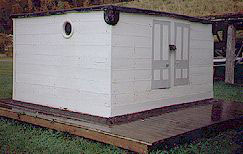
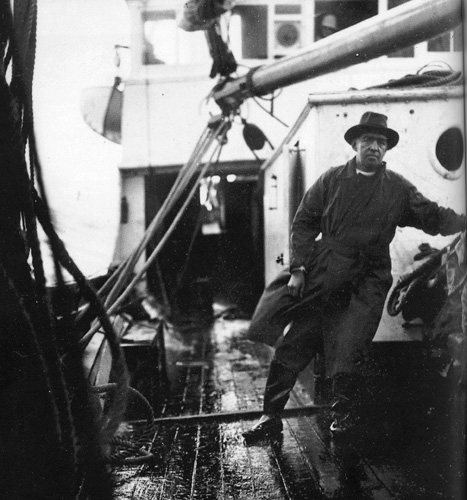
An odd and seemingly incongruous addition to the Museum's collection is the deck housing of the Quest. Previously it had been used as a chicken house in Norway. The other notable surviving bit of the Quest is the crows-nest (see No. 280 below).
I can't seem to find any information on the final fate of the Quest but perhaps that would explain the deck housing being in Norway.
Site No 572
Newberry Library.
60 West Walton Street, Chicago 60610, Illinois, USA.
This marvelous independent research library has a large polar collection mostly donated by Gerald F. Fitzgerald. Among its Shackleton holdings are:
- Aurora Australis, 1908. Signed by Shackleton, Marston and Marshall.
- Heart of the Antarctic, 1909. Edition deluxe in vellum.
- South Polar Times, 1907-14. 3 vols. Volume I edited by Shackleton.
- Engraved menu cover [menu itself is lacking], dinner for Shackleton at the Savoy Hotel, London, June 15, 1909. Among those attendees who signed the back: E.H. Shackleton, Frank Shackleton, Arthur Rackham, Wm. Heinemann, Ernest Joyce, Scott Keltie, George Marston, A.L.A. Mackintosh and Philip Brocklehurst.
- Single sheet of stationery with letterhead of 'British Antarctic Expedition 1907. S.Y. Nimrod. Signed by: Shackleton, Rupert England, Eric Marshall, Jameson Adams, James Murray, Philip Brocklehurst, John Davis, A.L.A. Mackintosh, A. Forbes Mackay, Rupert Michell and Ernest Joyce.
- Typed document. Lays out Shackleton's proposal for the ITAE. Upper left corner: 'Strictly private' "Proposed Trans-Antarctic Expedition. Objects of the Expedition. To cross the South Polar Continent from sea to sea—from the Weddell Sea to the Ross Sea. The value of the above will be:— (1) From the sentimental point of view, it is the last great polar journey that can be made. It will be a greater journey than the journey to the Pole and back, and I feel it is up to the British nation to accomplish this, for we have been beaten at the conquest of the North Pole and beaten in the first conquest of the South Pole. There now remains the largest and most striking of all journeys--the crossing of the continent. (2) From a geographical point of view, the complete continental nature of the Antarctic can be absolutely solved by such a journey. No one knows whether the great plateau dips on the south side of the Pole, and no one knows whether the great Victoria chain of mountains, which has been traced. . ."
- Polus Antarcticus. Three editions of this map: 1630, 1650 and 1680.
- A Chart of New or South Shetland, seen in 1819 by Willm. Smith, Master of the Brig Williams, Surveyed by E. Bransfield. . ., 1822. Includes 10 coastal profiles.
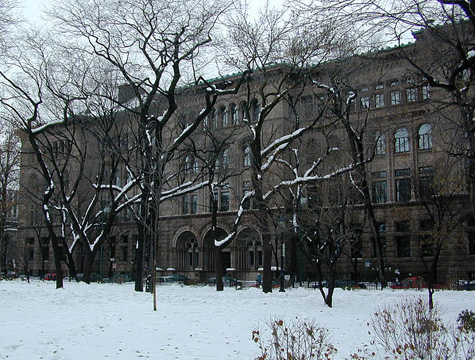
Site No 029
National Geographic Society.
600 M Street, NW, Washington, D.C. 20036, USA.
"There are several items located at the National Geographic Society Museum. Matches, a compass and binoculars are a few of the items. Some articles are Shackleton's, and there is a small section on Peary and Henson. It's not a large collection, but none-the-less quite a find for this Shackleton fanatic."
—Susan Ruggles
Site No 184
Madame Tussaud's.
Marylebone Road, London NW1, UK.
Hugh Robert Mill, in his biography of Shackleton, states that after the Nimrod expedition, in 1909 or 1910, Shackleton had his effigy added to Madame Tussaud's Waxworks, an honor also accorded to Scott.
I visited on January 18, 1998, and asked about the effigy. It's certainly not on display and no south polar explorers are apparently. They said, however, that they have all the effigies or their molds in storage.
SHACKLETON HOUSES
In my 'Low-Latitude' database I seem to have far more residential addresses associated with Sir Ernest Shackleton than any other Antarctic explorer. How might we speculate about this? Was he moving up the residential ladder? Moving down? Too jumps ahead of the bailiff? Just restless? Who knows?
House No 1 — Abraham Shackleton house, West Yorkshire. (LLAG 481)
House No 2 — Kilkea House, near Athy, County Kildare, Ireland. Shackleton was born here on February 15, 1874. (LLAG 176)
House No 3 — 35 Marlborough Road, Dublin, the Shackleton family house in 1880. (LLAG 178)
House No 4 — South Croydon, England. December 1884 saw the family moving here. (LLAG 259)
House No 5 — 12 Westwood Hill, Sydenham, London SE26. The Shackleton family moved here in 1885. (LLAG 85)
House No 6 — 14 South Learmonth Gardens, Edinburgh. The Shackletons moved into this house on the 11 April of 1904. (LLAG 180)
House No 7 — 27-29 Palace Court, Bayswater Road, London, where the Shackletons took a furnished house for a month or two in 1906. (LLAG 182)
House No 8 — Sheringham, Norfolk. In July of 1910 the Shackletons were "installed in a furnished house..." (LLAG 186)
House No 9 — 7 Heathview Gardens, Putney Heath, London. In April of 1911 the Shackletons moved here. (LLAG 187)
House No 10 — 11 Vicarage Gate, Kensington. The Shackletons moved here from Putney in 1913. (LLAG 189)
House No 11 — 14 Milnthorpe Road, Eastbourne, East Sussex. In later years the Shackletons, certainly Emily and the children, lived here. (LLAG 258)
House No 12 — Braeside, Bath Road, Devizes, Wiltshire. Dates unknown. (LLAG 825)
Site No 481
House No 1 — West Yorkshire.
Harden nr Bingley, West Yorkshire, UK.
The founder of the Irish branch of the Shackleton family, Abraham, was born here in 1696. He moved to Ireland in 1720. The actual house has gone but a new house on the site incorporates one of the old stone mullioned windows. The door was moved to Ireland and is now displayed at the Ballitore Quaker Meeting House Library and Museum (see No. 538 below) in Ballitore, County Kildare, the village to which Abraham moved and started a school in 1726.
I failed to find the house in West Yorkshire on my visit in May of 2001. The area is suburban and congested and there was no obvious place to ask about this. Harden lies northwest of Bradford.

How the Harden house might have appeared. Courtesy of Jonathan Shackleton.
Site No 176
House No 2 — Kilkea House, Shackleton's birthplace.
Castledermot near Athy, Co. Kildare, Ireland.
Ernest Henry Shackleton was born here on 15 February 1874, son of Henry Shackleton and Henrietta Letitia Sophia née Gavan. There's a faint photo of the house opposite page 172 in Roland Huntford's Shackleton.
Shackleton's parents moved here after their marriage on 28 February 1872. His father was intent on farming and leased the Kilkea property from the Duke of Leinster. In his book Shackleton: An Irishman in Antarctica, Jonathan Shackleton describes it as "a large square, comfortable farmhouse. To the side, as one entered, were solidly built, slated stone outhouses which enclosed a courtyard. The house was surrounded by rolling grassland . . . It was rich land, good for tillage as well as cattle and sheep rearing."
In 1880 the Shackleton family moved to 35 Marlborough Road, Dublin, and his father pursued medical studies at Trinity College.
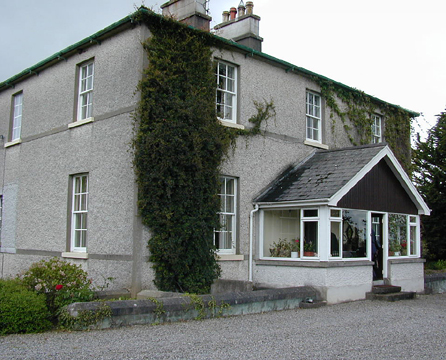
Site No 178
House No 3 — The Shackletons' Dublin house.
35 Marlborough Road, Donnybrook, Dublin, Ireland.
The Shackleton family lived at this address from 1880 until 1884 when they moved to England.
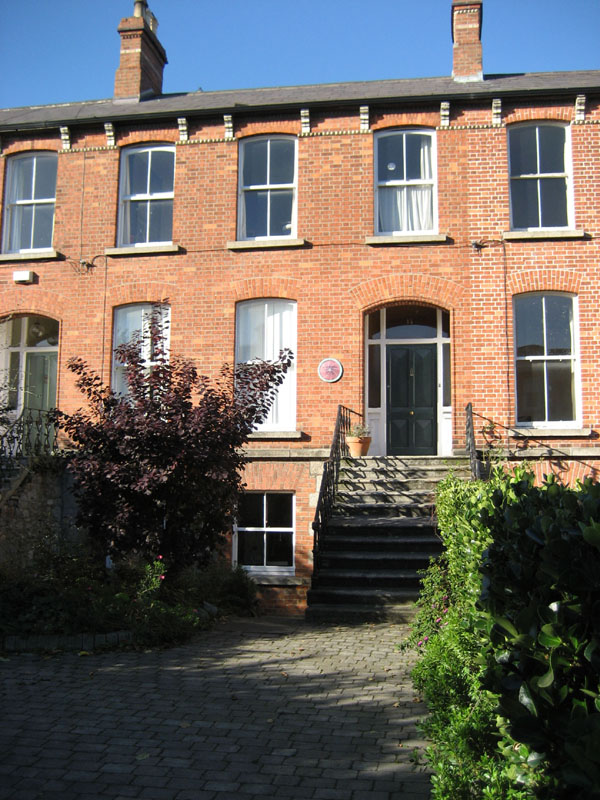
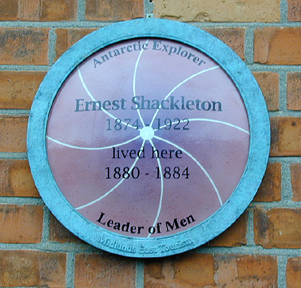
The plaque was unveiled on May 20, 2000 by the Hon. Alexandra Shackleton.
and Jonathan Shackleton (cousin) on the right.
Site No 259
House No 4 — The South Croydon house.
South Croydon, UK.
Henry Shackleton's first house in England was in South Croydon where the family moved to in December 1884. The actual address has never been determined. Not long after, June 1885, the move was made to Aberdeen House in Sydenham.
Site No 085
House No 5 — Sydenham.
12 Westwood Hill, London SE26, UK.
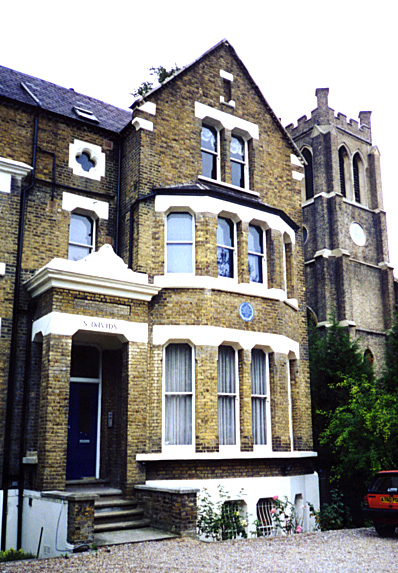
The Shackleton family arrived here in 1885 and from here young Ernest set off each day to Dulwich College, a fairly distant walk away (I know because I walked it). The house has a LCC "blue plaque," installed in 1928, that reads: "Sir Ernest Shackleton (1874-1922) Antarctic Explorer Lived Here." Dr Shackleton remained at this address for 32 years. Back then the house was called Aberdeen House and now St. Davids. Next door is St Bartholomew's Church where—I'm speculating here—the Shackleton family may have worshipped. When I first saw the house (October 1995) it was for sale, a great opportunity for any avid Antarctican.
[Episode 48 revised, Low-Latitude Antarctic Gazetteer, posted June 29, 1997]
Kathleen (EHS's sister) recalled: "...I remember him going to St Bartholomew Church..."

Site No 180
House No 6 — The Edinburgh house.
14 South Learmonth Gardens, Edinburgh, UK.
Shackleton, newly married, took this house (probably his first place on his own) in April 1904 when he became Secretary of the Royal Scottish Geographical Society—he was so elected on 11 January 1904—then located not too far away at 1 Queen Street (the offices were in what is now the Scottish National Portrait Gallery). His tenure as secretary was short-lived; he resigned the following January.
"For those members interested in retracing footsteps or SSI's [Sites of Shackleton Interest] and cannot make it to Elephant Island, etc., you can visit South Learmouth Gardens in Edinburgh. When Shackleton took up his post with the Scottish Royal Geographical Society there, he rented 14 Learmonth Gardens, from 11 April 1904 for £125 per year for the next three years. What's more, you can now sleep and eat there. Interestingly, a Petite Double Room, their cheapest, today costs £125 per night! It is an Edwardian town house on a quiet cobbled street a few minutes from the west end of Princes Street and Edinburgh Castle. Now part of a privately owned hotel, Channings, which has quote 'a cosy club-like atmosphere'."
—Jonathan Shackleton
Peter Taylor has launched a search for memorabilia connected with the Antarctic Explorer, Sir Ernest Shackleton, after discovering that the famous explorer once lived in his town house hotel.
Peter Taylor, founder and Chairman of the Town House Company, which owns Channings in Edinburgh's New Town, would like to commemorate Shackleton's stay in the hotel with a momento from his days in Edinburgh.
In April 1904, after Shackleton was named Secretary of the Royal Scottish Geographical Society, he moved into 14 South Learmonth Gardens, Edinburgh, where he stayed with his wife until 1910. Channings, opened in 1990 as an Edwardian town house hotel merging the homes of 12-16 Learmonth Gardens. Shackleton, who lived in number 14, would now find his home designated as the guest's library and the Kingsleigh Drawing Room.
Peter Taylor commented: "When I first discovered that Shackleton had lived in the Channings building as a private resident, I was amazed and delighted. Having researched a little more into his life, I have discovered his remarkable bravery and I think he is one of the most heroic explorers in history. I would like his memory to live on in Channings and I am very interested to hear from anyone who may have family memorabilia which they would like to have placed on display at the hotel. We would look after it for them very well and it could be a fitting reminder of his days in Edinburgh."
Peter Taylor also received a letter from film star Kenneth Branagh. Branagh was invited to stay at Channings to help research his role as Shackleton for a film currently planned by Channel Four. In his letter, Branagh stated: "I am fascinated to hear of the connection with Shackleton, and when next in Edinburgh will take you up on your most generous offer."
(From Channings Website www.channings.co.uk)

Site No 182
House No 7 — 29 Palace Court.
Bayswater Road, Notting Hill, London W2, UK.
Sometime probably in 1906 the Shackletons took a furnished house for a month or two at Palace Court, Bayswater Road in Notting Hill. This was during the planning phase of the Nimrod expedition, the offices of which were at 9 Regent Street, Waterloo Place (see No. 284 below). Only recently was the actual address in Palace Court determined—it (along with Number 27) is the Brigham Young University London Centre for Study Abroad. It's a short street running north from Bayswater Road. There is a framed description of the Shackleton connection hanging in the library. "Many disappearances of homework and strange noises in the night are attributed by the students to Shackleton's ghost, who they say haunts the stairs."

Site No 186
House No 8 — The Norfolk house.
Corner St. Nicholas Place, Sheringham, Norfolk, UK.
In July of 1910 the Shackletons "moved down from Edinburgh to Sheringham in Norfolk, where the family was installed in a furnished house. Its name was 'Mainsail Haul.' (It is now called 'Martin Cross.') They rented it from a Naval Commander named George Dolphin. The house has since been converted into flats.
Another famous occupant of the house was the composer Ralph Vaughan Williams who also had an Antarctic connection—he composed the Sinfonia Antarctica which was based on his score for the film Scott of the Antarctic. He lived in the house in 1919 according to a plaque
Nearly in sight is The Burlington, a large hotel where Scott spent time while writing The Voyage of the Discovery.

Site No 187
House No 9 — The Putney house.
7 Heathview Gardens, Putney Heath, London SW15, UK.
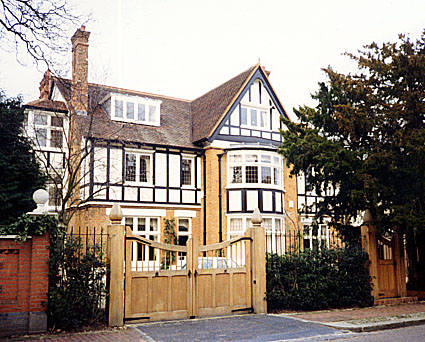
The Shackletons took this house in April of 1911 and stayed until 1913 when they moved to Kensington. It's a quiet street with some very nice houses.
Site No 189
House No 10 — The Kensington house.
11 Vicarage Gate, Kensington, London W8, UK.
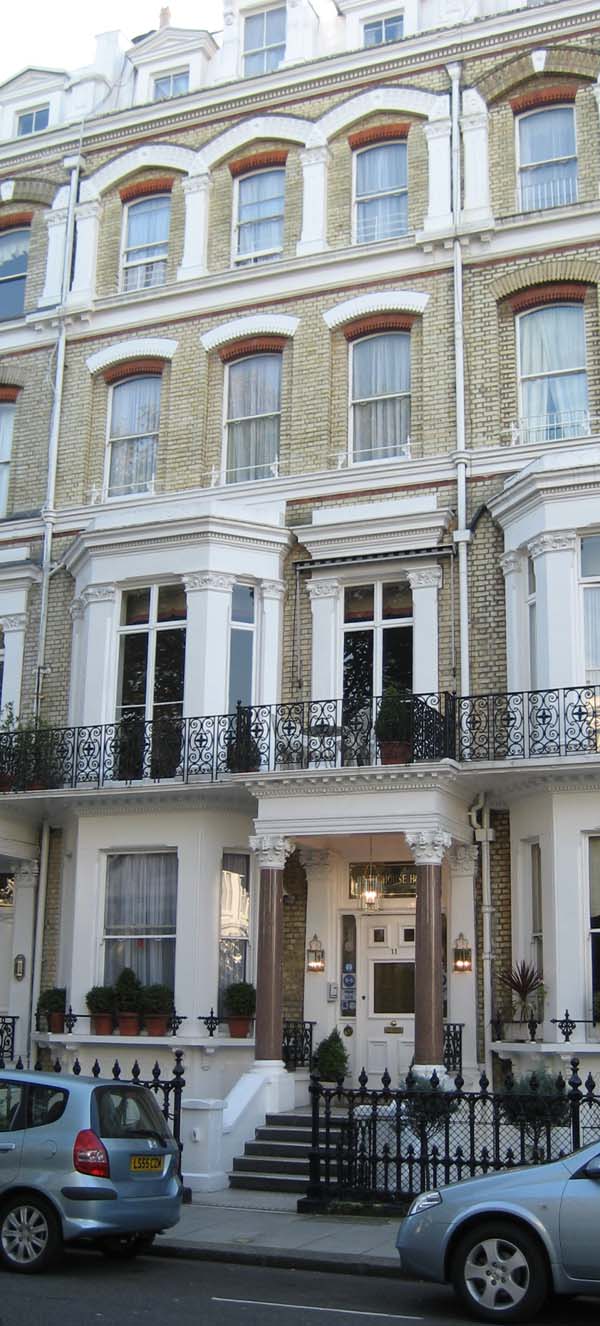
The Shackleton's moved here from Putney in 1913. The house is now a hotel called Abbey House. According to the hotel brochure the building was built about 1860 "as the home of a wealthy Victorian family and has since been the home of a bishop and a member of parliament." It is located just east of Kensington Church Street. Visit www.abbeyhousekensington.com for some interior views.
Site No 258
House No 11 — The Eastbourne house.
14 Milnthorpe Road, Eastbourne, East Sussex, UK.
In later years the Shackletons, certainly Emily and the children, seemed to be living at Eastbourne on the Sussex coast. Sir Ernest was there between April and December, 1919, from June to December 1920 and April to August, 1921 (according to James and Margery Fisher's Shackleton).
My visit of 1/30/98: The house is located perhaps a mile west (I believe) from the center of Eastbourne. It is in a very interesting section of the town called The Meads and only a block or two from the seafront.
I also visited the house with Jonathan Shackleton on 1 November 2007, and had tea with the current residents. (The house was reconfigured into four flats about 20 years before.)
When information on the Eastbourne house appeared as a 'Low-Latitude episode," Judith Faulkner in Surrey wrote to say that she had visited the Eastbourne house in June 1994 and that it had, shortly thereafter, been honored by a ceramic blue plaque placed on the ground floor facade by the Eastbourne Civic Society and the Eastbourne Borough Council. The accompanying newspaper cutting (East Sussex Eastbourne Evening Argus) notes that Shackleton lived at 14 Milnthorpe Road "...for the last five years of his life before he died in 1922." The unveiling, on the 23rd of November 1994, was overseen by Shackleton's granddaughter, Alexandra Bergel. The photographs accompanying Ms Faulkner's letter show a 2-1/2 story semi-detached brick house on a tree-lined street.
Emily lived on at this address for sometime after Shackleton's death. Her correspondence with Hugh Robert Mill while the latter was writing his Life of Sir Ernest Shackleton (1923) is from this address.

Site No 825
House No 12 — Braeside.
Bath Road, Devizes, Wiltshire, UK.
This address was recently pointed out to me by Paul Davies. The site is now the Braeside Education and Conference Centre. Its website and a brochure say that "Before 1910, a thatched half-timbered house stood on the present site. It was also called Braeside (meaning on the side of the hill) but it burnt down and remained derelict until the present house was built. The new house was originally called Beltwood Dalling, but later reverted to Braeside once more. Sir Ernest Shackleton lived at Braeside for about a year. It is impossibnle to find the exact year he lived at Braeside but it was probably 1913 [this would have been when the Shackletons were either in Putney or Kensington]. Then when Shackleton left for his expedition to the Antarctic the house was loaned for use as a military hospital. It is said that Sir Ernest Shackleton's sledge hung in the entrance hall at one time but this has now vanished. When Shackelton left for his expedition to the Antarctic, the house was loaned for use by the military."
—www.braesideeducation.co.uk

OTHER HOUSES
Site No 495
Emily Dorman's house.
19 Wetherby Gardens, South Kensington, London SW5, UK.
This house in a very nice part of Kensington appears as an address that Clements Markham gave in the Shackleton entry in the book Antarctic Obsession. I thought he was giving this as Shackleton's address but, in fact, it was his fiance's, Emily Dorman. This is what Roland Huntford wrote: "Emily was now living in Wetherby Gardens, South Kensington, with her father, who had moved there the previous year [1901] from Sydenham."

Site No 347
Sir Joseph Kinsey's cottage.
Formerly at 99 Papanui Road; moved to Ferrymead, Christchurch, New Zealand. (Ferrymead is an historical park outside Christchurch. Visit its website at www.ferrymead.org.nz)
"Earlier the [Canterbury] branch [of the New Zeland Antarctic Society] had been involved in project of Heroic Age interest—the preservation of a cottage from the property of Sir Joseph Kinsey, New Zealand agent for Scott and Shackleton. Kinsey died in 1936 and in 1971 his house, at 99 Papanui Road, was sold to make way for a block of motels. Three weeks before the site was to be cleared the branch acquired the cottage and arranged for its removal to Ferrymead, the historical park near Christchurch, where it now stands. The branch raised over $300 to meet removal costs for the cottage, which contained a darkroom believed to have been used by Herbert Ponting, Scott's photographer." (Source: Neville Peat, Looking South: New Zealand Antarctic Society's First Fifty Years 1933-1953, p74.)
"On Scott's recommendation, Cantabrian J.J. Kinsey was asked by Shackleton to act as his attorney in 1908. In 1910, when the wives of Scott, WiIson and Evans came to Christchurch, Kinsey's home became the centre of the expedition's social life, culminating with the Terra Nova garden party where 'anyone who was anyone' was invited to Kinsey's Clifton property to meet Scott."
(Source: Antarctic Heritage Trail, Antarctic Heritage Trust)
Site No 335
Middleton.
50 Acacia Avenue, Riccarton, Christchurch, NZ.
"Scott also stayed with Sir Joseph Kinsey at his home on Clifton Hill and together with Shackleton and Wilson was also a guest of the Bowen family at their home 'Middleton' which is now Middleton Grange School."
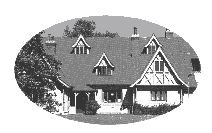
"Middleton Grange School is the result of a vision held by a group of Christchurch businessmen and professionals. United in their conviction of the foundational importance of a Scriptural education, this group established the Christian Schools Trust, an interdenominational body committed to high quality Christian education. Consequently, in order to put their vision to work, they decided to build a school. The site they purchased included one of Chnstchurch's oldest houses, the name of the 'Old House' was Middleton Grange."
Source: http://www.middleton.school.nz
EXPEDITION OFFICES
Site No 284
Shackleton's office (Nimrod).
9 Lower Regent Street, London SW1, UK.
Shackleton took an office here, probably in 1906. The expedition (Nimrod) stationery has this address on it.
Assuming that the street numbers remain the same, number 9 is on the west side of Lower Regent Street; it is now (1998) Cafe Mario, a storefront within a larger seven or so story building. The main entrance of building says: 'Charles House' There are commercial shopfronts on the ground floor and offices above. The overall building appears to predate Shackleton but this may not be so. The building's porter said that the building had been gutted not long ago and rebuilt inside, only the street facade being preserved.

Site No 188
Shackleton's office (Endurance).
4 New Burlington Street, London W1, UK.
Shackleton took offices here in 1913 as he planned the Endurance expedition. The street runs west from Regent Street.
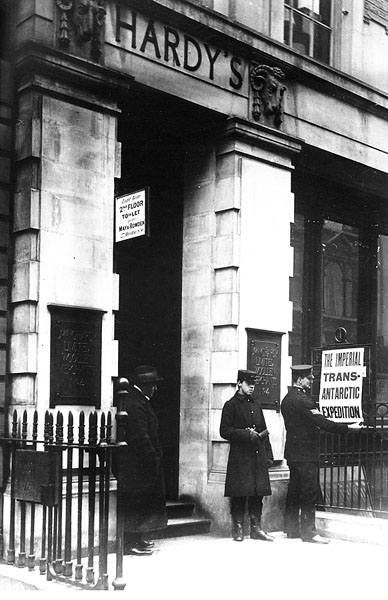

CHURCHES
Site No 508
Christ Church.
Westminster, London, UK.
Ernest Shackleton married Emily Dorman at this church on April 9, 1904.
I've tried to find the church but suspect it may have been a victim of World War II. Alexandra Shackleton believes it was in Victoria Street.
Site No 530
Christ Church Cathedral.
Stanley, Falkland Islands.
This, the southernmost cathedral in the world, was consecrated in 1892. According to Jonathan Shackleton, there is a Shackleton flag hanging inside.
Site No 538
Ballitore Quaker Meeting House Library and Museum.
Ballitore, Co Kildare, Ireland.
On display is a door from the Shackleton house in Yorkshire (see No. 481 above).
Ballitore is where the Shackletons first settled in Ireland and started their school.
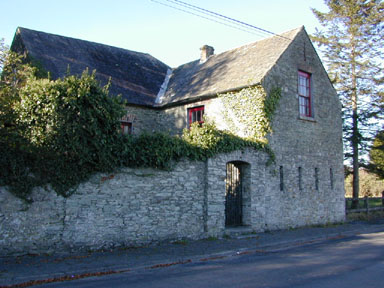

CLUBS
Site No 031
Savage Club.
National Liberal Club, 1 Whitehall Place, London SW1A 2HD, UK.
Episode 64: Dining with Savages.
The Savage Club has been host to more than one polar explorer at its frequent house dinners, dinners that continue to this day. This London club was born in 1857, named "in a spirit of pure wantonness" for Richard Savage, "...a thoroughly disreputable actor and playwright of Dr Johnson's time who killed a man in a brawl and was later imprisoned for debt." The Club's physical presence has shifted here and there over the years. At the moment it has a room or two at the National Liberal Club, a gigantic pile of Victorian masonry at 1 Whitehall Place SW1. Not long past the Club had quarters in the Lansdowne Club in Berkeley Square and before that at a long string of other addresses. However, for 50 years starting in 1888, the Club leased premises in a since-demolished house at 6-7 Adelphi Terrace. No doubt it was here that the Savages, "probably the warmest-hearted clubmen in London," gave dinners for Nansen, Scott and Shackleton.
Mementos of these house dinners—member-designed menus—adorn the walls of the Club. The only one with an Antarctic connection on display during my visit in early February 1998 (Savages ARE warmhearted and I spent most of an afternoon in their company) was for a dinner to welcome home Ernest Shackleton, held on June 19, 1909, a mere five days after the explorer's return to England. The menu: Spinach Soup, Scotch Salmon, Hindquarter of Lamb, Roast Duckling, Cabbage & New Potatoes, Kipper on Toast, et al. There are portraits of a balaclavered Shackleton and Scott (in the chair that evening) at the top of the menu; also a very nice view of the Nimrod forging through the ice (it resembles Marston's painting opposite page 124 in vol. I of The Heart of the Antarctic), not to mention the two penguins smoking cigars! According to Mill, "Shackleton solemnly signed his name in the wall behind the chair, to be glassed in later like the autographs of Nansen and other great travellers..." Supposedly the wall in question was hacked away and carried along as the Club moved from place to place. We had a good look around but no initials could we find.
A few years earlier—November 5, 1904—Scott, Shackleton and the other officers and scientific staff of the Discovery expedition were welcomed home at the Club (the Dulwich College Archives has a photostat of the menu).
And earlier still, on the 6th of July, 1901 (one month before Discovery departed England), there was a farewell dinner for the "Officers and Members of the Antarctic Expedition." Drawn by Charles Dixon it shows the Discovery under sail and has portraits of six of the expedition members, including Scott, Wilson and Shackleton. The menu I have in my collection for that dinner has, among others, the signatures of Scott, Shackleton (which looks nothing like Shackleton), Armitage, Skelton, Royds, Koettlitz.
[Episode 14, Low-Latitude Antarctic Gazetteer, posted 4 August 1998]
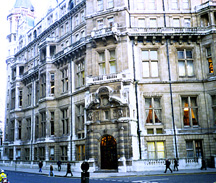

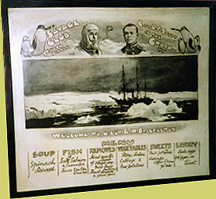
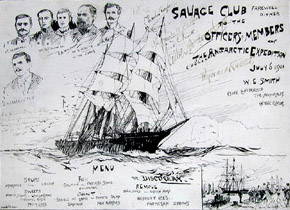
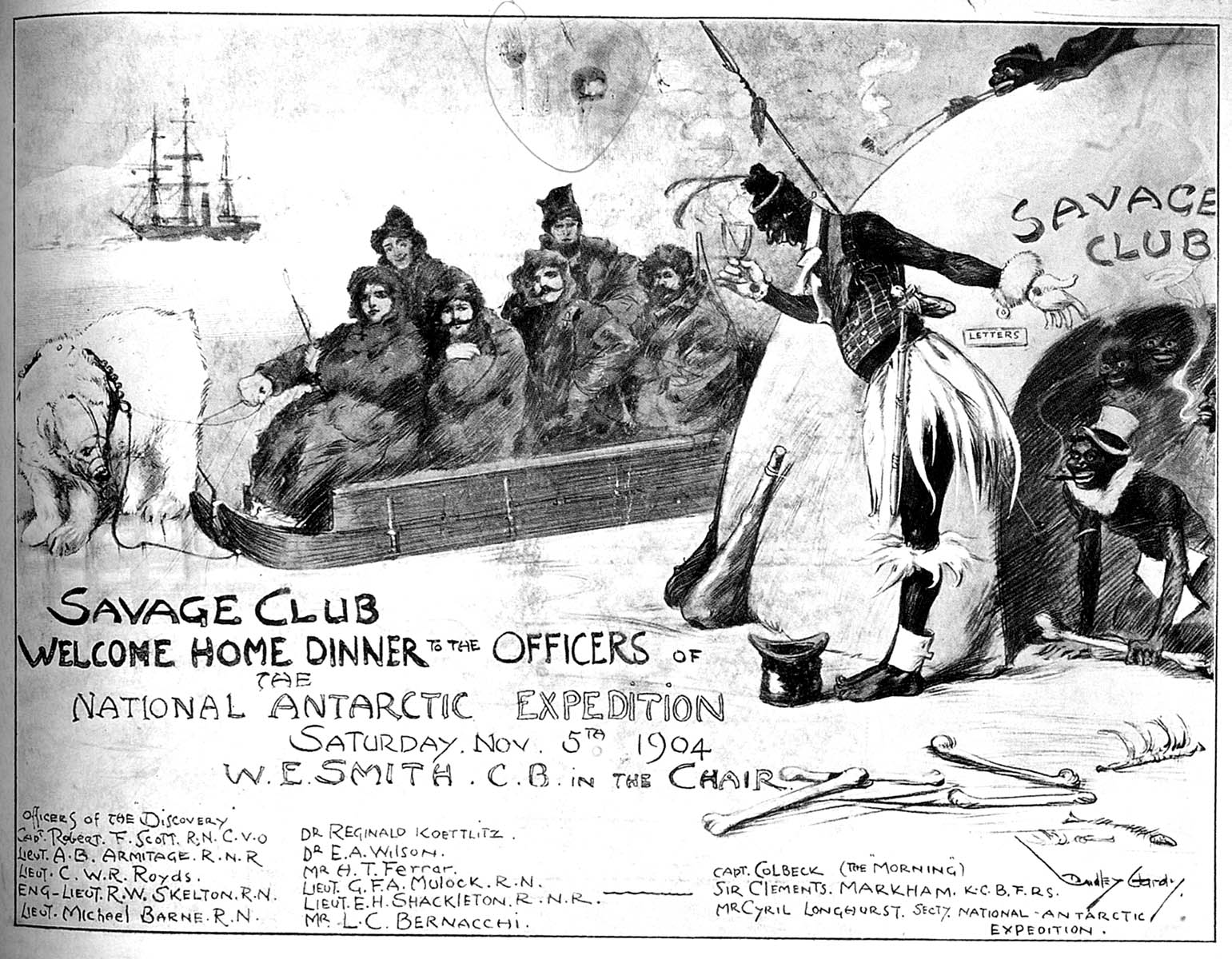
Top row from left: National Liberal Club; Savage Club interior (note the Shackleton dinner menu in the lower center); Menu for the Welcome Home dinner for Shackleton;
Bottom row from left: Menus from the National Antarctic Expedition Farewell Dinner, July 6, 1901, and the Welcome Home Dinner on November 5, 1904.
Site No 185
Marlborough Club, London.
Pall Mall, London, UK.
Shackleton was elected to the Marlborough Club on his return from the Nimrod expedition. (Scott was also a member.)
The Club was closed and converted to offices in 1953. Exactly where in Pall Mall it was is unclear.
Site No 277
Union Club (Club de la Union).
Ave. Bernardo O'Higgins between Bandera and Neuva York, Santiago, Chile.
The Club de la Union is an impressively large architectural assemblage that would not be out of place in London and takes up an entire block (between Bandera and Nueva York) on the Avenida Bernardo O'Higgins, Santiago's principal thoroughfare. Being Sunday, the handsome and elaborate iron gates, with their gold emblazoned and intertwined "UC"s, were shut tight. The building dates to 1925, so it could not have been the actual venue for an October 1916 post-'Endurance' dinner for Shackleton and his men (where it was at that time I haven't be able to determine). The honored guests included (according to an autographed menu shown in Harding Dunnett's book, Shackleton's Boat; The Story of the James Caird) Shackleton, Worsley, Hussey, Crean, James, Marston, Orde-Lees, Rickinson, Kerr, Wild, McIlroy, Crean, Macklin and Greenstreet. It must have been a lively affair as Tom Crean signed twice!

Site No 370
Royal Yacht Squadron at Cowes.
Royal Yacht Squadron, The Castle, Cowes, Isle of Wight PO31 7QT, UK.
According to the Hon. Alexandria Shackleton, the White Ensign that covered her grandfather's casket at Grytviken is at the Yacht Squadron and has been recently refurbished. Could this be the same one that Harding Dunnett speaks of below?
By the way, the RYS elected Robert Scott as its Honorary Member No. 3079.
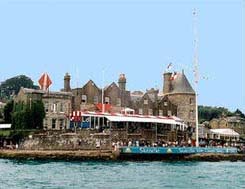
Site No 440
Club Central Rio de Janeiro.
Rio de Janeiro, Brazil.
A luncheon was held at this club for Shackleton as he was proceeding south on his last expedition. He would be dead less than a month later. The Club may still exist but I've not been able to track it down. This luncheon came to my attention because of an auction lot at Christie's King Street rooms on April 8, 1998:
Lot 175
"SIR ERNEST HENRY SHACKLETON (1874-1922)
4pp. menu card Lunch given to Sir Ernest Shackleton C.V.O. by Sir Alfred Yarrow, Bart. at the Club Central Rio de Janeiro 7th of December 1921 (21 x 13cm.), in blue, with crossed flags printed in colours on the first page. With signatures of Shackleton, Frank Wild, F.A. Worsley, Sir Alfred Yarrow and 14 others on 4th page.
Rio de Janeiro was the final port of call for the Quest before sailing for South Georgia. Shackleton was plainly ill, and indeed suffered a heart-attack. Despite this warning, preparations for the expedition continued and social obligations were honoured: Shackleton may well have enjoyed the present luncheon more than many, Sir Alfred Fernandez Yarrow (1842-1932) was an octogenarian shipbuilder and marine engineer of great drive and vitality (he made an aerial tour of Europe in 1931)—very much a kindred spirit. A certain poignancy is added to the present memento by the knowledge that Shackleton had little more than a month to live when he, his shipmates and other diners signed the final page. The Quest arrived at South Georgia on January 4th, 1922, Shackleton died of a heart-attack the following day, aged 48." The lot went for £1035 including the buyer's premium.
Site No 510
A club in Rio de Janeiro.
Rio de Janeiro, Brazil.
Harding Dunnett, the late founder of the James Caird Society, told me that the White Ensign from the Quest was hanging in an unknown club in Rio de Janeiro, and that a friend of his—Amy Wade—had sent a photograph of it to him. If the ensign does indeed hang in a club in Rio, could it be the Club Central Rio de Janeiro mentioned above (No. 440)? And what about the one at the Royal Yacht Squadron (No. 370 above)?
On page 11 of Bob Burton and Stephen Venables' book Shackleton at South Georgia, there's an illustration of a flag-draped coffin being transferred from the Quest to a launch. The caption reads: "Shackleton's body, covered by the White Ensign, is taken ashore from the Quest at Grytviken."
Just like skiis, Scott and Shackleton flags abound. At Dulwich College (see No. 292 below), the Union Flag that was placed on Shackleton's coffin at his funeral service in Grytviken, hangs above the entrance to the library.
PUBS, HOTELS AND RESTAURANTS
Site No 285
Park Hotel (now the Thistle Hotel Cardiff).
1 Park Place, Cardiff, Wales.
The Park Hotel was the venue for a Scott lecture on December 6, 1904 after his first expedition. And Shackleton spoke to Cardiff Naturalist's Society here on November 29, 1909. They weren't the only celebrities to pay a visit. Among the guests over the years: Peter Sellers, Petula Clark, Gloria Swanson, Spike Milligan, Ronald Reagan, Laurel and Hardy, et al.
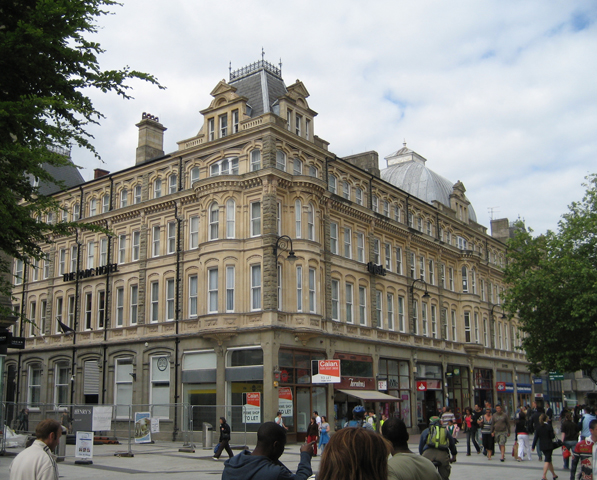
Site No 293
Torbay Hotel.
Torbay Road, Torquay, Devon, UK.
On August 6, 1907, a farewell dinner was given at this hotel for Ernest Shackleton and the British Antarctic Expedition. This was the evening before the Nimrod's departure for Antarctica.
The hotel still exists. It's on the seafront in the center of the town and has seen better days. There are no plaques or other indications of the dinner.

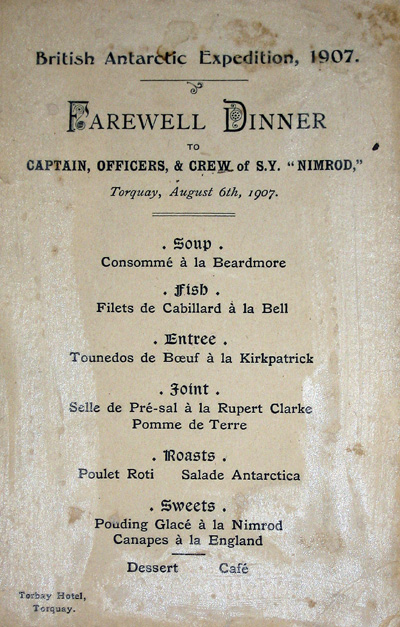
Site No 307
Berkeley Hotel.
East corner of Piccadilly and Berkeley Street, London, UK.
A very fashionable hotel in the 1930s and 40s. It has since relocated to Wilton Place.
A luncheon of about 20 people including Ernest Shackleton was held at the Berkeley on December 13, 1909. And according to Sara Wheeler, Cherry-Garrard frequently went there to dine or to stay.
Site No 374
Savoy Hotel.
Strand, London WC2, UK.
The Savoy has at least two Antarctic connections:
"Charles Royds (1876-1931), lieutenant with Discovery, became assistant commissioner of the Metropolitan Police, was appointed vice admiral and KBE, and dropped dead in 1931 while dancing at a charity ball at the Savoy."
Source: Michael De-La-Noy, Scott of the Antarctic, p.104
A dinner was held at the Savoy on June 15, 1909, for Ernest Shackleton. Among those who signed a menu that is now in the Newberry Library, Chicago, were Frank Shackleton, Arthur Rackham, Wm. Heinemann, Ernest Joyce, Scott Keltie, George Marston, A.L.A. Mackintosh and Philip Brocklehurst.
Site No 443
Shackleton Mountain Resort.
Via Assietta, Sestrière, Italy
"The beautiful hotel is situated 2000 mt in Sestrière in the center of the famous Via lattea, a 500 km Olympic ski ...
...hub, whit the most oustanding alpine ski runs, where sits also in the summer, one the most actractive golf course in high altitude. Shackleton Mountain Resort is a real mountain jewel, which matches the most up to daye thecnology, whithout compromising the charm and confort of wellbeing (ski scool, fitness center, tours and many sports...)..." [sic]
Source: http://www.j2ski.com/ski_hotels/Italy/Piemonte/Torino/Sestriere/Shackleton_Mountain_Resort.html
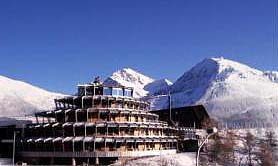
Site No 615
The Whaler's Rest and Shackleton Diner.
19 Francis Street, Stornoway, Isle of Lewis, Outer Hebrides, UK.
"Lewisman and member John 'Jock' Murray was whaling with Christian Salvesen between 1960 and 1962, finishing the last season that Leith Harbour was operational. Days at Stromness and a visit to Shackleton's grave at Grytviken gave him a life-long interest in the Shackleton story. For 28 years, from
1963, he served in the Metropolitan Police.
In 1996 Jock returned to his roots on the Isle of Lewis in the Outer Hebrides where he bought a local pub and renamed it 'The Whaler's Rest'. The restaurant he named after his hero, Shackleton.
Soon after, when researching the area, Jock discovered that Thomas MacLeod, who was with Shackleton on all his Antarctic expeditions, was born on the site where his pub is now situated. Jock had many conversations by telephone with Harding Dunnett, who had been stationed in Stornoway on the Isle of Lewis during the war. Jock has sold many of Harding's book, Shackleton's Boat, in his restaurant. Jock vowed that one day he would create his own blend of whisky, as he has with 'The Whalers Dram'. Another jaunt for the Society to embrace!
THOMAS F. MACLEOD, Lewisman, 1869 - 1956 [Actually 1873-1960]
Thomas Macleod had the distinction of sailing with Robert Falcon Scott on his last voyage in the Terra Nova in 1910. Three years earlier he had sailed with Ernest Shackleton on Nimrod [see correction below] and in 1914-17, again sailed with Shackleton in Endurance. MacLeod was also with Shackleton on his last voyage in the 'Quest' in 1921-22.
Little is known of his life in Stornoway, where his father was a draper. He had three brothers and one sister and almost certainly left to join the Merchant Service at the age of 14. Few have sailed in four Antarctic expeditions or witnessed at close quarters the strengths and weaknesses of both Scott and Shackleton. It was MacLeod who suggested to Frank Wild, who had taken over as captain of Quest after Shackleton died, that it would be appropriate to raise a cairn to the memory of the 'Boss'. Stones were gathered and the cairn was built by MacLeod, still there today. It was also MacLeod who salvaged the Bible, most of which Shackleton had thrown down after ordering his men to keep only bare essentials. The Bible, presented to the Expedition by Queen Alexandra, is now in the Royal Geographical Society in London, as are MacLeod's two Polar medals [see correction below].
—edited from a paper written by a MacLeod relative, Robin Mackenzie, and sent from Lewis by Jock Murray."
Source: James Caird Society newsletter, June 2001, p. 5.
UPDATE: Margaret Macinnes, of the Stornoway Historical Socoety, has submitted the following information, expanding upon and correcting the above entry (3 August 2006):
"Tom died in Canada aged 87. This was on 16th December 1960. (See the Kingston Whig Standard of 17th December 1960). He was therefore born in 1873 not 1869. His death certificate states he was born on 3rd April 1873 to parents David and Barbara McLeod. Some years ago articles appeared in the Stornoway Gazette detailing Tom's adventures. No one knew who he was. As there was no Thomas McLeod/Macleod born in Stornoway that year it was assumed he was the Thomas Macleod born in 1869. Further research by Stornoway Historical Society has now proved Thomas WAS born in 1873, but in Glasgow. His mother, Barbara, from Point Street, Stornoway was in Glasgow when she gave birth to Tom, therefore his birth appears in the Glasgow Registers. (No father is recorded on his birth certificate). Tom was brought up in Point Street by his widowed grandmother, Mary McLeod. Tom did serve on the Terra Nova, Endurance and Quest, but not the Nimrod (SPRI will verify this). The Endurance expedition Bible is indeed with the Royal Geographical Society, but Tom's Polar Medals are in private hands in Canada."
From the Highland News:
"08 Jul 1911-- Stornoway's Farthest South Man--letter to the Editor--Sir:--as a constant reader of your valuable paper I have the greatest pleasure in reading from time to time of the experience of some Lewismen in different parts of the world. There has just arrived at Lyttleton [sic], New Zealand, the Antarctic ship Terra Nova after successfully landing Captain Scott and his party at Cape Adair [sic] in the South Antarctic. I am sure all Lewismen, more especially the seafaring class, will be surprised to learn that a Stornoway man is a member of the Terra Nova's crew, a seaman by the name of Thomas F Macleod, familiarly known as little Tommy Macleod. Mr Macleod is none the worse for his experience down south.
Tommy ought to be well remembered by some Stornowegians. He was born and brought up on Point Street but it is over twenty years since he left his native town and he has spent a number of years in South Africa and also in New Zealand. The Terra Nova is now engaged in surveying the New Zealand coast after which she will have a thorough overhaul prior to sailing south again to bring back once more to civilisation the members of the gallant explorers expedition.
Should Captain Scott be successful (and we all hope he will) in discovering the South Pole, Mr Macleod intends to return home in the Terra Nova when I hope all Stornowegians will gather together and give him a hearty welcome, not only for his safe return after a long absence in foreign lands, but also for being "Stornoway's Farthest South Man".
Wishing your well-known paper every success, I am, Sir, yours etc
AONGHAS IAN"
UPDATE: Sadly, Margaret Macinnes e-mailed recently to say that the Whaler's Rest has changed hands and now it is called the Carlton Lounge without any obvious Shackleton connection.
(21 January 2007)
Site No 636
Shackleton Lodge..
Brathay Hall, Ambleside, Cumbria LA22 0HP, UK.
"A self-catering accommodation located one mile from Ambleside in the Lake District. The recently built facility was named for Shackleton and can accommodate up to 30 people. It is operated by the Brathay Exploration Group which is a Registered Charity which has been running expeditions, training courses and other events around the world and at home in the U.K., for over 50 years.
Mission Statement:
To provide young people and their leaders with the opportunity to increase their environmental and cultural experience and understanding through adventure, exploration and personal development projects in the U.K. and throughout the world."
Site No 767
Crookstown Inn - Shackleton's Restaurant.
Crookstown, County Cork, Ireland.
Crookstown is close to Ballitore and Kilkea, both with their Shackleton connections. I'll have to find out whether there's Shackletonia inside.
At the Athy annual Shackleton gathering in 2007 I learned that the Crookstown Inn had just closed. Sadly, I never got to visit it.
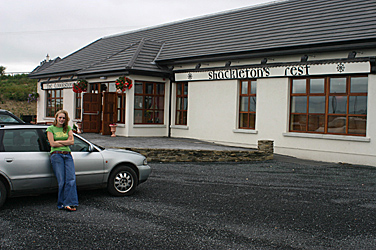
Photo: Courtesy of Jonathan Shackleton. That's his daughter Hannah.
Site No 773
Bar Shackleton.
Hotel José Nogueira, Punta Arenas, Chile.
The bar is named for Shackleton. In all likelihood there are some photographs or artifacts on display.
"Right in the middle of downtown is located one of the oldest buildings of the entire Patagonia, the centenary old mansion formerly owned by Don José Nogueira and Doña Sara Braun, two characters who 'wrote' the history of Patagonia. Don José Nogueira, of Portuguese origin and a sailor by profession, was the most sucessful of the patagonian pioneers. He amassed a grand fortune during the second half of the nineteenth century. In 1890, ordered the construction of a splendid mansion in the middle of downtown Punta Arenas.
The mansion became one of the most outstanding symbols of the city, and in 1982 it was declared a National Monument, therefore prohibiting its modification. In 1992 was settled as an small and exclusive hotel, which has the privilege of being chosen by his majesty the king of Spain Juan Carlos de Borbon as his temporary residence during his visit to Punta Arenas in 2004."
Source: http://www.hotelnogueira.com

Site No 789
The Sir Ernest Shackleton.
122 Bowen Drive, Tulse Hill, London SE21 8PL, UK.
A pub about a kilometre from Dulwich College. Described in a pub website as "a down-at-heel local in a nest of council estates, this place fails to live up to its illustrious namesake. Intrepid pub explorers should head elsewhere." Nonetheless it's on my list to visit.
Jonathan Shackleton and I spent a lot of time searching for this in November 2007. We had a cab and would through the streets of this housing estate. We finally concluded that the construction going on in Bower Drive was where the pub once stood. So The Sir Ernest Shackleton is no more. We were nonetheless thirsty so the cab dropped us off at the Crown & Greyhound in Dulwich Village and we enjoyed a pint.
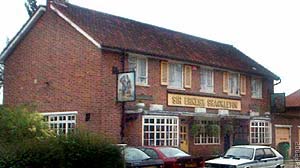
Site No 791
The Troubadour.
263-7 Old Brompton Road, London SW5 9JA, UK.
"The Troubadour is a proper café . . . the last 50's coffee house in Earl's Court with a proud history as a low temperature centre of courtesy, peace and artistic energy . . . Downstairs is the Club which Jimi Hendrix, Joni Mitchell, Bob Dylan and Paul Simon all played in the 60's . . . The Shackleton Room is named after Sir Ernest, and decorated with Frank Hurley's photographs of the 1914 expedition. It's part of the Café, but can be reserved for private meals for up to 14 guests."
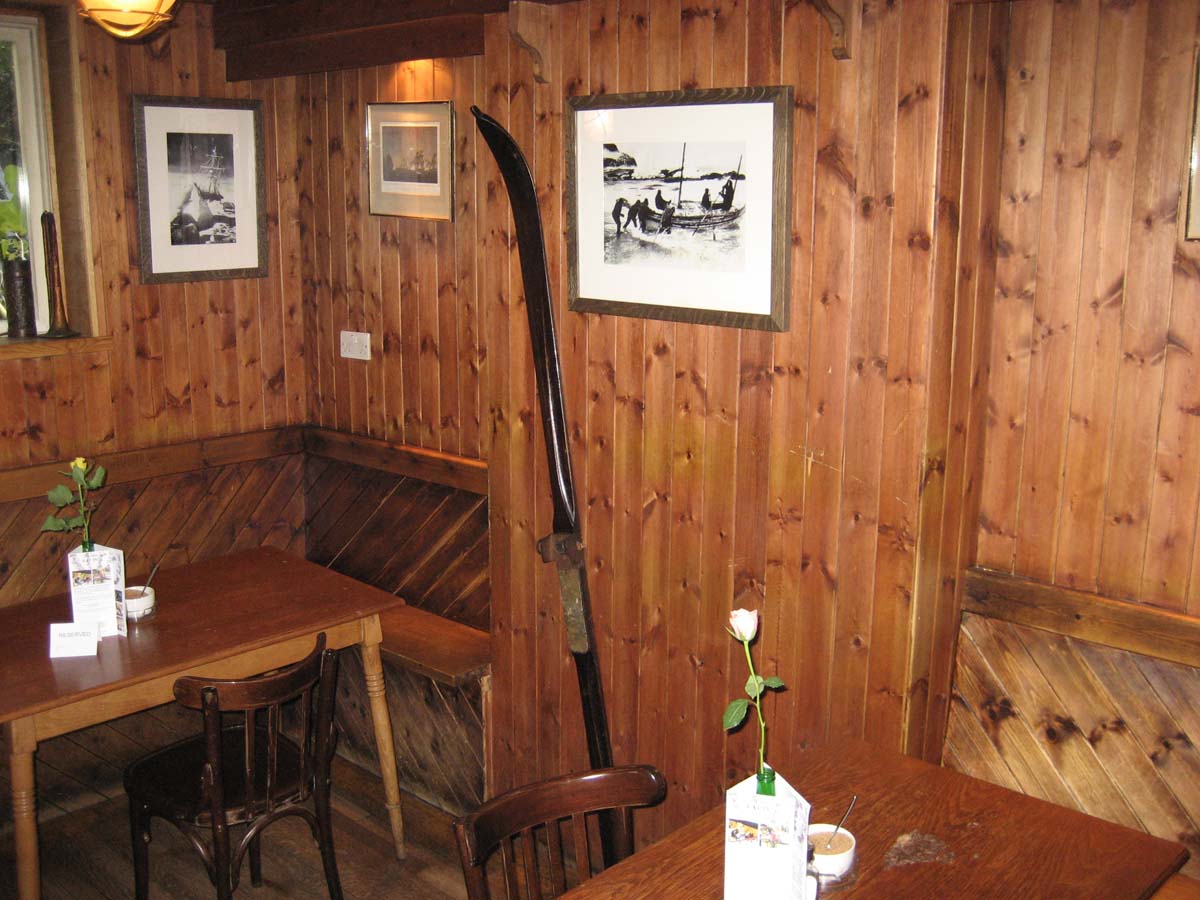
Site No 824
Shackleton Lounge.
Av. Del Libertador 3287, El Calafate, Santa Cruz, Patagonia, Argentina.
I learned about this at the 2006 Athy Shackleton Autumn School. Since then I've heard from the proprietor, Agustin Calvetti, who sent along some photos and further information.
"Welcome to the Shackleton Lounge Restaurant & Bar
A place where you can enjoy our special cuisine, chill out & relax with a cocktail in your hand and listen to great music.
But above all, a place which is a truly Patagonian experience. The landscape is omnipresent. The huge windows show Lago Argentino in all its splendor, and the ever changing Patagonia skies at sunset.
We receive travelers from all over the world. Just take a look at our Guest book and you`ll realize that our visitors feel grateful for the quality of our service and an unforgettable moment in their trip. Every visitor is treated as a friend.
In our first floor we have an exhibit room. There you can watch a very interesting DVD about Sir Ernest Shackleton (45 minutes) while having a drink. Walls are usually decorated with works by local artists.
Sometimes holidays can be tiresome. If you need a place to take a break, chill out and enjoy great food, music & drinks, visit us.
You won't regret it.
We'll make you feel welcome."
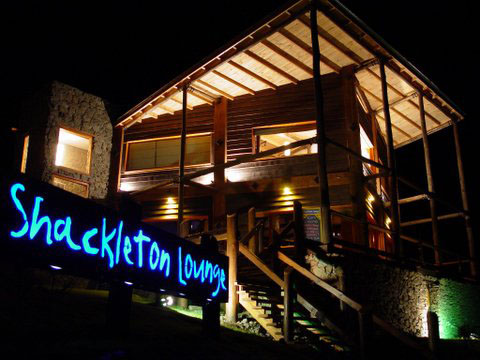

Site No 845
The Grand Hotel.
King Edwards Parade, Eastbourne, East Sussex, UK.
Probably when fundraising for the Nimrod expedition, Shackleton sketched out his plan for reaching the South Pole on notepaper from the Grand Hotel. The hotel, since renovated and still very much in business, is within walking distance of 14 Milnthorpe Road, where the Shackletons lived in later years.
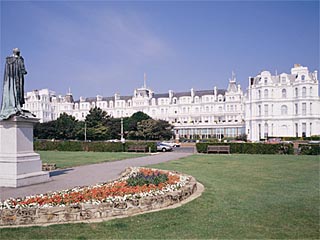
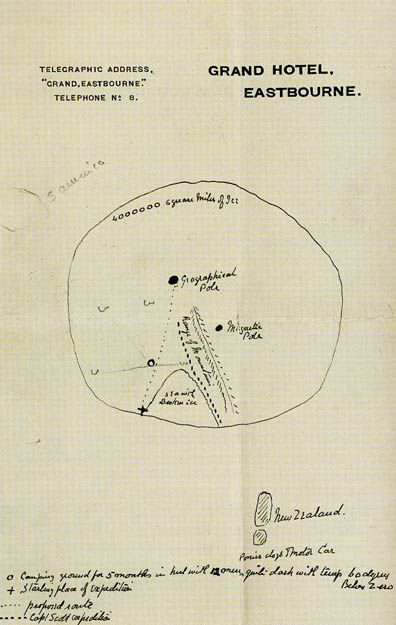
SHIPS, BOATS, PLANES AND TRAINS (AND BITS OF SAME)
Site No 204
Ships & aircraft.
The following footnote appears on p. 487 of James and Margery Fisher's Shackleton:
"Ernest Shackleton's inspiration to men of action is, in another way, celebrated by sea and air. In 1937 a 245-foot Fleet Minesweeper of 1260 tons was completed in the Royal Dockyard, Devonport. As H.M.S. Sharpshooter she served through World War II, at the end of which she was converted to a surveying-ship for service with the Royal Naval Surveying Service. In 1953, after she had for some years been surveying in British Home Waters, her name was changed to Shackleton: the other two Home Surveying Ships at that time being Franklin (now in reserve) and Scott (still, like Shackleton, on active work). In 1955 the Falkland Islands Dependencies purchased a two-hundred-foot motorship, built in 1954 as the Arendal. Her name changed to Shackleton, this surveying-vessel of 1102 tons gross (274 net) now crosses Ernest Shackleton's Antarctic trail many times every year.
On 9 March 1949 the first prototype of a powerful maritime reconnaissance bomber, developed from the Lincoln class, flew as a Shackleton aircraft. The Avro Shackleton M.R.3, to give it its full title, was still in production in 1955. Sir Ernest Shackleton is the name of a Vickers Viscount V701 propeller-turbine aircraft, G-AMNY, in service with British European Airways since early 1953. It was the third such aircraft to enter their passenger fleet."
Site No 010
The James Caird.
North Cloisters, Dulwich College, London SE21 7LD, UK.
Shackleton's famous boat was given to his school, Dulwich College, in 1924. In 1968 it went on display at the National Maritime Museum, Greenwich. Since 1986 it has been back at Dulwich College (when it's not 'on tour.')
EPISODE 29 (No 010): The James Caird—A remarkable voyage 80 years ago.
The James Caird is one of the more storied vessels in the history of Antarctic exploration. A whaleboat named for Sir James Caird, a Dundee jute manufacturer and the principal backer of Shackleton's British Imperial Transantarctic Expedition (1914-17), it made that remarkable sixteen-day voyage from Elephant Island to South Georgia, 800 miles across some of the most daunting ocean anywhere. Rescued from the Endurance as it was crushed in the Weddell Sea,
hauled over the ice, altered by the ship's carpenter for added seaworthiness, the 23-foot long James Caird was sailed by Shackleton, Worsley, Crean, Vincent, McCarty and McNeish.
Today the James Caird sits restored and on display at Dulwich College in the southern outskirts of London. Shackleton attended Dulwich while growing up nearby (his house still stands and will be the subject of a future episode). From 1968 to 1986 the boat was at the National Maritime Museum, where I first saw it (previous to that it was at the College). Not long ago I ventured to Dulwich to where it has been permanently repatriated. It is nicely exhibited in the North Cloisters, sails raised, sitting on a bed of rocks imported from South Georgia. There is an informative display of photographs, clippings and such. The public may view it without charge, although it might be best to call the College first.
Dulwich College is itself an interesting place to visit, a marvelous concoction of elaborate Victorian architecture. The famous nearby Dulwich College Picture Gallery is certainly worth a visit, too.
Antarcticans may be interested in the James Caird Society, "formed in 1994 to educate the general public about all of Shackleton's . . . expeditions and related aspects of antarctic history."
Episode 29 focused on the James Caird, the ship's boat that made that remarkable voyage from Elephant Island to South Georgia during Shackleton's Endurance expedition. Since that Episode I've come upon Harding McGregor Dunnett's book Shackleton's Boat; The Story of the James Caird (Cranbrook, Kent, UK: Neville & Harding Ltd., c1996). This very informative book (with many illustrations previously unpublished) traces the history of the Caird from its construction in 1914 at W & J Leslie's Thameside boat yard to its present home at Dulwich College. Sir Vivian Fuchs in the Foreword writes: "Originally she was saved by the Norwegian whalers at South Georgia in 1916. The boat then arrived in Birkenhead in 1919. Thereafter the history of her travels is quite remarkable—Middlesex Hospital, then the Albert Hall, the roof of Selfridges, Ely Place in Frant, Kent, Dulwich College as a gift, the British Polar Exhibition, the National Maritime Museum; and so to her final resting place back at Dulwich College in 1986."
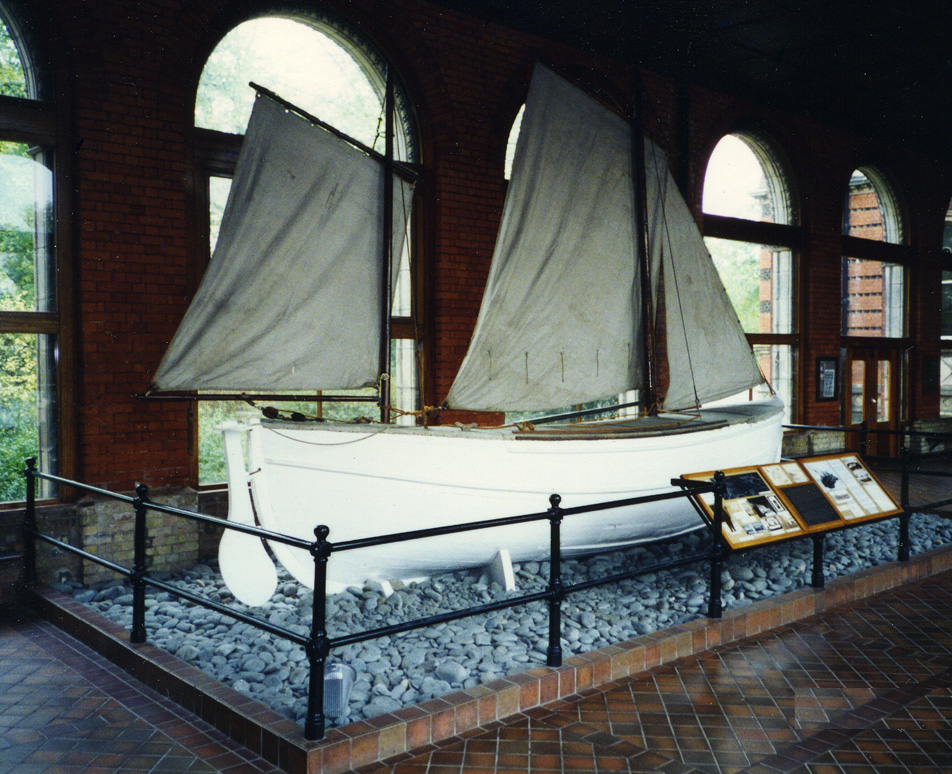
Site No 050
Prow of the tug Yelcho.
Puerto Williams, Chile.
All that remains of the tug Yelcho, which under the command of Captain Luis Alberto Prado Villalon rescued Shackleton's men from Elephant Island, stands in front of the Chilean Navy supermarket in this town on the Beagle Channel.
The 120-foot Yelcho was built in 1906 at Greenock, Scotland.
"Once Shackleton had arrived back at South Georgia he immediately set about trying to organize the rescue of the 22 men left stranded behind on Elephant Island. Between 23rd May 1916 and 31st August 1916 he made four attempts to return to Elephant Island and secure their rescue:
1) Southern Sky (Loaned by English Whaling Co.) 23rd - 31st May 1916
2) Instituto de Pesco No 1 (loaned by the Government of Equador) 10th - 16th June 1916
3) Emma (Sealer, funded by the British Club. Punta Arenas) 12th July - 8th August 1916; and
4) Yelcho (loaned by the Government of Chile) 25th August - 3rd September 1916.
Shackleton's first three attempts had failed due to bad weather and adverse ice conditions. By early August 1916 he was desperate to reach his men and was offered a small steam tug by the Chilean Government, the S.S Yelcho, captained by one Luis Alberto Pardo Villalon.
The Yelcho was totally unsuited for the job in hand, having no radio, no proper heating system, no electric lighting and no double hull.
This time luck was with Shackleton, as the Yelcho somehow managed to find a safe passage through the ice and arrived at a mist-covered Elephant Island at around 1:10pm. on August 30th 1916.
Shackleton would not risk landing on the island himself and instead stayed on one of the landing boats close enough to the shore to be able to throw packets of cigarettes to the men massed on the shoreline. He insisted that all were evacuated immediately before the ice started to close in again. By 2:10pm all 22 men were safely on board the Yelcho. Once on board food was arranged and many of the men happily chain-smoked having been without any real tobacco for some considerable time.
Years later, Charlie Green the cook on the Endurance was to write:
"Shackleton sent me down to the galley to do the cooking for all their crowd and our crowd too. That was a bit thick I thought! They had some live sheep aboard and the captain ordered them to be killed. Well, his chef was slicing pieces of meat off and cooking it like bacon. But I chopped the things up and put them in the oven, in three or four sections. They all joined in doing the potatoes and then I made a dumpling and put an onion in it. They couldn't understand what it was! Then the boss told me to make some puddings. I must have made twelve pounds of macaroni cheese. They all went down well—and then everybody was sick!!
Dr. Macklin told me afterwards, 'That's just what they needed, Green, that's cleared their stomachs!'"
The 23 crew of The Yelcho that fateful day were:
Captain: Luis Alberto Pardo Villalon.
2nd in Command: Leon Aguirre Romero.
Chief Engineer: Jorge L. Valenzuela Mesa.
2nd Engineer: Jose Beltran Gamarra.
Engineers: Nicolas Munoz Molina and Manuel Blackwood.
Firemen: Herbito Cariz Caramo, Juan Vera Jara, Pedro Chaura, Pedro Soto Nunez, Luis Contreras Castro.
Guard: Manuel Ojeda, Ladislao Gallego Trujillo, Hopolito Aries, Jose Leiva Chacon, Antonio Colin Parada.
Foreman: Jose Munoz Tellez.
Blacksmith: Froilan Cabana Rodriguez.
Seamen: Pedro Pairo, Jose del C. Galindo, Florentino Gonzalez Estay, Clodomiro Aguero Soto.
Cabin Boy: Bautista Ibarra Carvajal.
So it was that the Yelcho with her crew of 23 and cargo of 25 men from Shackleton's expedition (McNish, Vincent and McCarthy were already on their way home to England), headed back to Chile and on 3rd September 1916 stood off Rio Seco whilst Shackleton, always the one to seek publicity, telephoned the Governor of Punta Arenas to forewarn him of their imminent arrival. Shackleton made sure that none of the men shaved or cut their hair, and that they wore their tattered soot covered clothing. Presumably he wanted the outside world to appreciate just what these men had been through.
The welcome they received on arriving at Punta Arenas was unbelievable. Almost the entire population had turned out to welcome them. This was to be nothing compared to the reception they received when the Yelcho arrived at Valparaiso on 27th September. At least 30,000 people thronged around the harbour and nearby streets. Shackleton wrote "Everything that could swim in the way of a boat was out to meet us". The Captain of the Yelcho, Luis Pardo had played a great part in the rescue and was quite rightly honoured in his home country of Chile and also by the British Government.
Luis, it seems was a modest man and it is believed that he declined a reward of £25000 (an absolute fortune at the time) from the British Government. He said that he had "simply done his duty". He became a friend of Shackleton, and between 1930-1934 was the Chilean Consul to Liverpool. Quite an honour as at that time Liverpool was the greatest sea-port in Europe if not the world.
The Yelcho was retired from active Navy duty in 1945, but was still used as a ship's tender at the Chilean School for Cabin Boys until 1958. In 1962 she was sold off, presumably for scrap.
The plaque below the Yelcho's bow translated from Spanish reads: "Bow of Chilean Navy tugboat "Yelcho" that commanded by 2nd Pilot Don Luis Pardo Villalon, rescued the members of Sir Ernest Shackleton from the H.M.S. Endurance in Elephant Island, Chilean Antarctica. The 30th of August 1916. Donated by the Navy to the city of Punta Arenas 21st May, 1970."
With Thanks to Roy Cockram, Nephew of Charles Green.
Captain Ben Garrett and Grace Garrett.
—Excerpted from http://www.visitandlearn.co.uk/factfiles/obit30.asp


Photo courtesy of Grace Garrett.
Site No 280
Quest's crow's-nest.
All Hallows Barking (by the Tower), Byward Street, London EC3, UK.
All Hallows Barking (by the Tower) is a church with lots of history: the foundations date to the 11th century; from its tower Pepys viewed the effects of the Great Fire, 'the saddest sight of desolation'; and here William Penn was christened and John Quincy Adams married.
And down below in the crypt is an unlikely Antarctic artifact, the crow's-nest from Shackleton's Quest. It's a simple wooden barrel with four slender metal roped-together uprights extending from its top. The brass tablet affixed to it reads:
"Once the Crow's Nest used by Sir Ernest Shackleton on his last Antarctic expedition in the good ship Quest, now brought here by "Tubby" in quest of "siller" for Talbot House. 'Winds blow south, or winds blow north. Day come white, or night come black. Home, or rivers and mountains from home, singing all time minding no time.' Walt Whitman"
I was to learn from the verger that "Tubby" was F.T.B. Clayton, the vicar (from 1920 to 1963); that "siller" is a nickname for a Scottish coin, perhaps a sixpence; and that "Talbot House" was a World War I rest and recuperation home in Flanders.
The Quest started life as a Norwegian sealer and was not in the best of shape when it sailed from London on September 17, 1921. Apparently, neither was Sir Ernest for it was on this, his fourth Antarctic expedition, that he died, on the 5th of January 1922 at South Georgia (where he now lies buried). Opposite page 108 of Shackleton's Last Voyage is a photograph of Frank Wild and the crow's nest.
All Hallows is just to the west and within sight of the Tower at Byward Street EC3.
[Episode 58, Low-Latitude Antarctic Gazetteer, posted 21 February 1998]
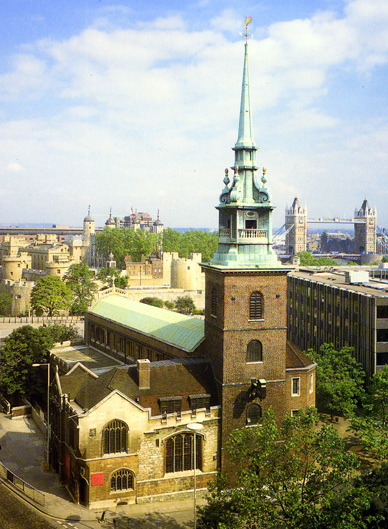
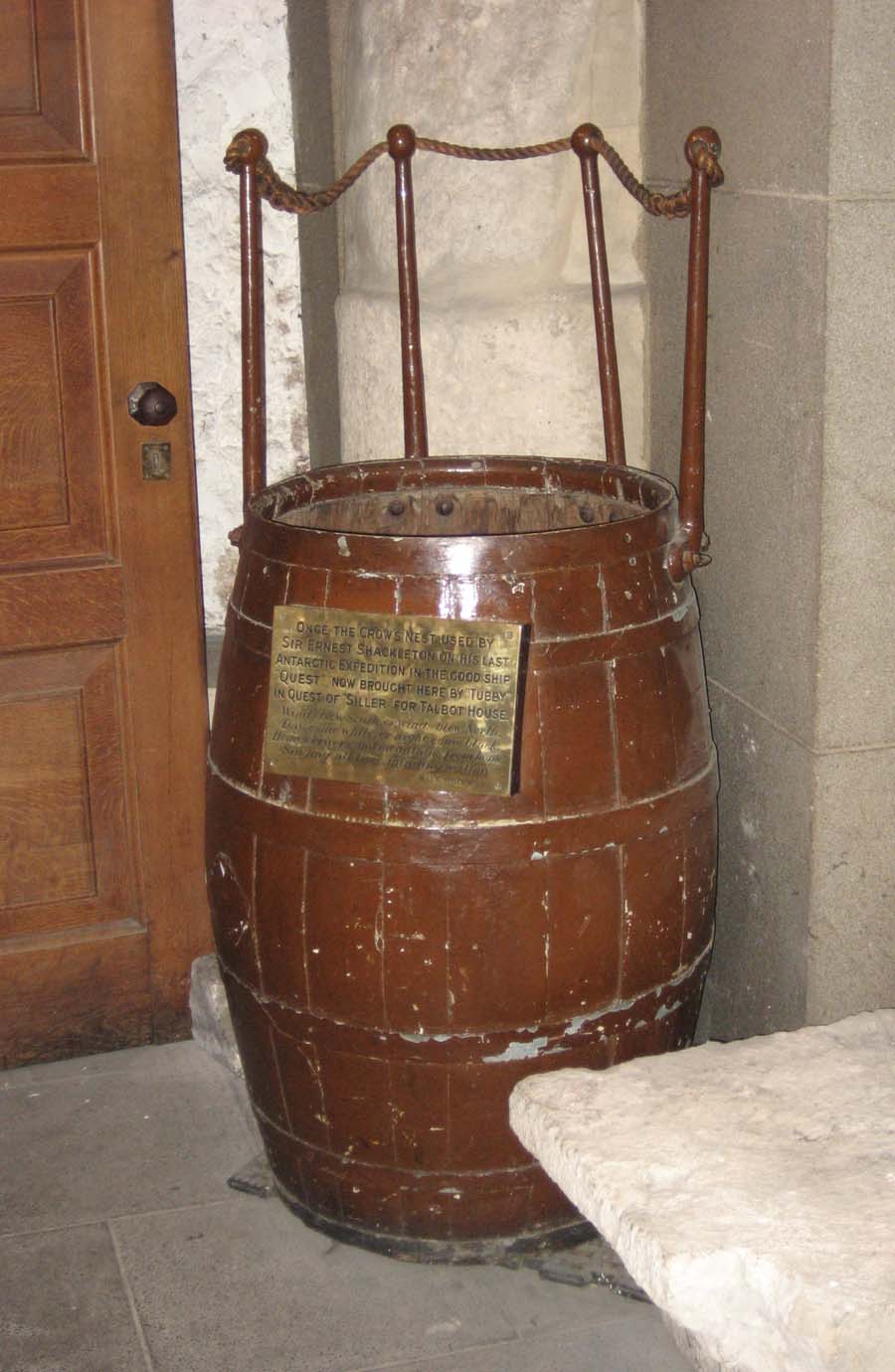
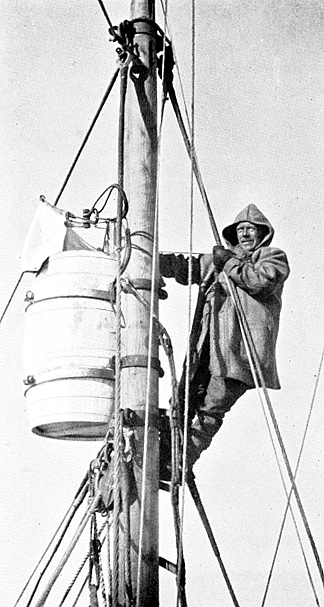
Photo on right shows Frank Wild and the crows nest. From Shackleton's Last Voyage.
Site No 608
Model of the Aurora.
Tower Place, Marsh & McLennan European headquarters, London EC3, UK.
This large builder's model (and a second one of the Terra Nova) now are displayed in a non-public area of this new office building overlooking the Tower of London. Why are they here? Marsh & McLennan acquired Bowring Brothers which was the original owner of these two famous Antarctic ships. The Aurora featured in Mawson's AAE 1911-14 and Shackleton's Ross Sea Party 1914-17.

Site No 401
HMS Endurance.
"A Class 1 Icebreaker she was originally built in Norway in 1990 as MV Polar Circle. The RN chartered her in 1991 before she commissioned as HMS Polar Circle on 21 November 1991. She was subsequently renamed HMS Endurance.
Her Mission is "To patrol and survey the Antarctic and South Atlantic, maintaining Sovereign Presence with Defence Diplomacy and supporting the global community of Antarctica". This involves close links with the Foreign Office, United Kingdom Hydrographic Office and the British Antarctic Survey. She deploys annually to the Antarctic, her operating area for 7 months of the year. Her base port is Portsmouth, which is also the ship's affiliated town.
The Ship's motto is "Fortitudine Vincimus" ~ 'By Endurance We Conquer' The motto originates from that of the great Antarctic explorer, Sir Ernest Shackleton who made history in his ship, Endurance in his expedition south in 1914-15."
Source: http://www.royal-navy.mod.uk/static/pages/467.html

Site No 547
RRS Ernest Shackleton.
Built by Kverner Klevin Leirvik A/S, Norway as the MV Polar Queen in 1995, it was acquired by the British Antarctic Survey in August 1999 and renamed the RRS Ernest Shackleton.
The vessel is ice strengthened and capable of a wide range of logistic tasks as well as having a scientific capability.
Length Overall: 80.00m; Beam: 17.00m; Draught Icebreaking: 06.35m; Gross Tonnage: 4028Grt
Officers and Crew: 21; Hospital: 01; Scientists: 59
See http://www.marine.gov.uk/ernest%20shackleton.htm for full specifications.

Site No 755
Virgin Super Voyager Train named Sir Ernest Shackleton.
Number: 221108
Location: Crofton Depot
Named by: No ceremony
Date applied: 22/4/02
Style: Virgin Super Voyager
Meaning: Series naming of Super Voyager fleet with voyagers. Sir Ernest Shackleton (1874-1922) British explorer, made four Antarctic expeditions and in 1909 reached within 100 miles of the South Pole
Notes:
Supplier: NR*
Source: http://www.btinternet.com/~cjmarsden/S.html
Other polar explorers that have trains named for them include: Amundsen, Bruce, PO Evans, Oates and Scott

Site No 797
Shackleton aircraft, Gatwick Aviation Museum.
Vallance By-Ways, Lowfield Heath Road, Charlwood, Nr. Gatwick, Surrey RH6 0BT, UK.
In October 2006, Jonathan Shackleton and I were flying from Dublin to Gatwick and decided to drop in at the Gatwick Aviation Museum which is in Charlwood, right on the edge of the airport. This is quite an establishment, created and maintained by Peter Vallance, an extraordinary man.
The Museum has two Shackletons in its collection. The aircraft were used for maritime reconnaissance and anti-submarine work in the 1950s and 60s. They carried a crew of 10, have a wingspan of 120 feet and are 87 feet long. If you go to the Museum's website
www.gatwick-aviation-museum.co.uk
you can learn much more.
In any event, Peter showed us around and we crawled about inside. Here are some photos. The one on the left shows Jonathan with Peter Vallance. On the right is Jonathan at the controls.
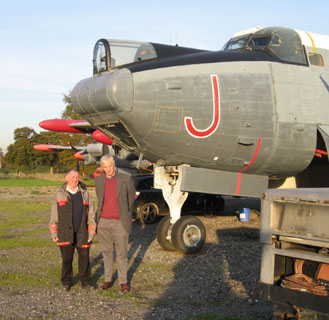
Site No 435
Shackleton aircraft, Imperial War Museum Duxford..
Duxford, Cambridgeshire, CB2 4QR, UK.
There is a non-flying Shackleton aircraft at Duxford although there is little about it on the museum's website: http://duxford.iwm.org.uk
 Source: www.jetphotos.net. © Robert Hodgson.
Site No 829
Shackleton aircraft, American Airpower Heritage Museum.
9600 Wright Drive (at Midland International Airport), Midland, TX 79711-2000, USA.
I had heard that there was a Shackleton aircraft at this air museum in Texas. There's no mention of one on its website www.airpowermuseum.org
ROADS AND STREETS (Some of these could quite possibly be named for an entirely different Shackleton.)
Site No 354
Shackleton Drive.
Stanley, Falkland Islands.
Site No 356
Endurance Avenue.
Stanley, Falkland Islands.
One assumes this is named for Shackleton's ship.

Site No 493
Shackleton Circuit.
Mawson, ACT, Australia
Mawson is a suburb of Canberra and is named for Sir Douglas Mawson. It has the largest colleciton of Antarctic related street names of any place in the world, at least 32.
"A SUBURB DEVOTED TO ANTARCTICA
In 1927 the Australian Government established laws and guidelines for the naming of suburbs, parks, avenues and streets for the Nation's capital, Canberra. Since then certain criteria have been applied to the naming of public places -
a) the names of persons famous in Australian exploration, navigation, pioneering, colonisation, administration, politics, education, science or letters;
b) the names of persons who have made notable contributions to the existence of Australia a nation;
c) the names of Australian flora;
d) the names of things characteristic of Australia or Australians; and
e) the words of the Aboriginal natives of Australia.
The naming of a public place after a person is a memorial to that person and their life-time achievements. It has therefore been administrative practice to only commemorate deceased persons to allow a full assessment of the person's contribution to Australia.
One of the unique features of Canberra's nomenclature is the relevant or direct connective theme that streets have in relation to the name of their suburb wherever possible.
As Canberra developed, a new town of Woden Valley was built south west of the inner Canberra area in the early 1960s. One of the new suburbs was named Mawson and its theme is dedicated to Antarctic exploration.
The suburb of Mawson was formally established on 12 May 1966. It was named after Sir Douglas Mawson (1882-1958), Antarctic explorer; lecturer 1905-1920, Professor of Geology and Mineralogy University of Adelaide 1921 to 1952, Emeritus Professor 1953-1958; member of Shackleton Expedition 1907-1909; leader of Australasian Antarctic Expedition (AAE) 1911-1914; leader of British Australian and New Zealand Antarctic Research Expedition (BANZARE) 1929-1931. After the second World War, Mawson was a major driving force in convincing the Australian Government to establish the Australian National Antarctic Research Expeditions (ANARE) in 1947 and which continue to this day."
Source: Canberra's Suburb and Street Names, Department of the Environment Land and Planning, Canberra 1992. And thanks to Gordon Bain.
Site No 550
Shackleton Road.
Mt. Eden, Auckland, NZ.
Shackleton Road runs between Mt. Eden Road and Dominion Road south of the center of Auckland.
Site No 676
Shackleton Street.
Orbost, Victoria, Australia.
In the northern portion of this small Victorian town are several streets named after Antarctic explorers: Bowers, David, Evans, Mawson, Oates, Scott, Shackleton and Wilson.
Site No 784
Shackleton Road.
Ealing, UK.
Runs betweens Greensford Avenue and North Road.
Site No 787
Shackleton Close.
London SE23, UK.
A tiny close east of Dulwich College. The nearest rail station is Forest Hill.
Site No 795
Shackleton Street and Amundsen Crescent.
Hobart, Tasmania, Australia.

That's Jonathan Shackleton holding on.
Site No 798
Shackleton Road.
Tilgate, Crawley, West Sussex RH10 BX, UK.
Site No 799
Shackleton Road.
Ipswich, UK.
Site No 801
Shackleton Road.
Slough SL1 3QT, UK.
Site No 802
Shackleton Road.
Celbridge, Co. Kildare, Ireland.
Site No 803
Shackleton Road.
Rowner, Gosport, Hampshire, UK.
Site No 804
Shackleton Road.
Doncaster, South Yorkshire, UK.
Site No 805
Shackleton Road.
Apex, North Carolina 27502, USA.
Site No 808
Shackleton Street.
New Brighton Central, Christchurch, NZ.
Site No 809
Shackleton Street.
Gerringgong, Sydney, NSW, Australia.
Site No 810
Shackleton Street.
Dutton, Ontario, Canada.
Site No 811
Shackleton Street.
Belmont, Victoria, Australia.
Site No 812
Shackleton Street.
Kedron, Queensland, Australia.
Site No 813
Shackleton Street.
Bassendean, Western Australia.
Site No 814
Shackleton Street.
Colne, Lancashire, UK.
Site No 815
Shackleton Street.
Mt. Isa, Queensland, Australia.
Site No 816
Shackleton Street.
Duke Bar Pheasantford, Burnley, Lancashire, UK.
SCHOOLS
Site No 179
Fir Lodge Preparatory School.
near Shackleton's house, Sydenham, UK.
In 1885 Ernest Shackleton went to the Fir Lodge Preparatory School "a few hundred yards from his home" in Sydenham. Hugh Robert Mill, The Life of Sir Ernest Shackleton, p.23.
Ernest was first taught in one of Sydenham's many 'Dames Schools' - Fir Lodge run by "the redoubtable Miss Higgins (with ear trumpet) and her Chief of Staff Miss Parry".
(Source: www.sydenham.org.uk/ernest_shackleton.html)
According to Jan Piggott, former Dulwich archivist, the school no longer exists.
That's Ernest at the top in the window, possibly the only normal appearing boy in the lot.

Site No 292
Dulwich College.
Dulwich, London SE21, UK.
Dulwich College is what the English call a public school and the Americans, a prep school. It's south of central London and is easily reached by train from Victoria Station to West Dulwich. The two best known Dulwich 'old boys' are Shackleton and the novelist P.G. Wodehouse (whose study is recreated in the library).
Shackleton entered Dulwich in 1887 and stayed until 1890. He would walk from the family house in Sydenham, about a mile or so.
Of course the main Shackleton attraction here is the James Caird (see No. 010 above). But there's a lot more on display and in the archives. Here's a sampling:
1) A British Union Flag that covered Shackleton's casket in Grytviken (gift of the Hon. Alexandra Shackleton). But see Nos. 370 and 510 above.
2) Blue leather bound volume of Hurley photos presented by Shackleton to Dulwich.
3) Wool balaclava from Dr Macklin.
4) A copy of the Aurora Australis. 'Petit Pois' copy with Rudyard Kipling's bookplate.
5) A copy of the very rare mimeographed The Blizzard, a less polished and shorter lived version of the South Polar Times.
6) Epic of the Sea, a oil painting by Norman Wilkinson of the James Caird in high seas.
7) An oil painting by Gerald M. Burn of the Discovery passing the Royal Yacht at Cowes in 1901.
8) An elaborate Victorian chair from the manager's villa at Stromness, South Georgia, given to Dulwich College by Noel Barber in 1962.
9) In a tall glass case near the James Caird stands a manikin dressed in Burburry polar clothing.
10) Two sledges used by Shackleton.
11) An original sail from the James Caird.
There's now a new building at Dulwich named for Shackleton.

Dulwich College from the air some years ago. The James Caird is displayed in the North Cloisters, the narrow arched single story connector between the central building and the building on the left.


Left: The flag that covered Shackleton's coffin. Right: Robert Stephenson in the chair from Stomness.
Site No 410
Shackleton School.
Spring Hill Road, Ashby, Massachusetts, USA.
An alternative private school with close philosophical ties to 'Outward Bound'. The name was used with the permission of the Shackleton family. Sadly, after seven years of life, it closed its doors in June of 2005.

GRAVES, CAIRNS, MEMORIALS, STATUES
Site No 037
Sir Ernest Shackleton's grave.
Whalers Cemetery, Grytviken, South Georgia.
South Georgia is often called the 'Gateway to Antarctica.' It's not really a 'low-latitude' area but it's included in the 'Low-Latitude Antarctic Gazetteer' nonetheless. And why not?
Shackleton, on his fourth and final Antarctic expedition aboard the Quest, reached Grytviken, the main whaling station on South Georgia, on January 4, 1922. He was not a well man. Bob Burton—in his Shackleton at South Georgia—describes the expedition as one that "should not have been: an ill-found ship, no grand plan and an ailing leader." The great explorer—The Boss—died of heart failure early the next morning, January 5, 1922.
Later that day Shackleton's body was taken ashore. An autopsy was performed, a plain wooden coffin was made and on the following day the remains were taken to the Whalers Church. Later it went by ship to Montevideo, accompanied by Leonard Hussey who had decided he wouldn't continue aboard the Quest (which soon departed under the command of Frank Wild). Once in Uruguay, Hussey learned of Lady Shackleton's wish that the Sir Ernest be buried in South Georgia, so he accompanied the body back to Grytviken aboard the British ship, Woodville.
The funeral was held on March 5, 1922. Hussey was the only 'old comrade' in attendance. About 100 men (there was only one woman on the island then—she provided the flowers) gathered at the Whalers Church and following the ceremony the coffin was carried by six Shetlanders to the Cemetery. A rough wooden cross was used to mark the spot.
In 1928, the carved Scottish granite headstone that marks the grave today was unveiled by the Governor of the Falkland Islands.
I have visited the site on several occasions. It's a short walk from the former Manager's Villa, now the Museum. To get there you occasionally have to walk around an elephant seal or two. As you enter the cemetery there is a sign that reads:
"The Whalers Cemetery. The first graves are those of men from the Esther, who died of typhus in 1846. Some of the graves on the left of the cemetery resulted from an outbreak of typhus at the whaling station in 1912. On the right lies the grave of William Barlas, British magistrate who died by drowning after an avalanche pushed him into the icy sea. The grave of Sir Ernest Shackleton is at the back of the cemetery. He died on board Quest in 1922. The latest grave is that of Felix Artuso. an Argentine casualty of the 1982 war. The cross on the hillside above the cemetery is a memorial to Walter Slosarczyk, an officer of the German polar vessel Deutschland who went missing in 1911."
There are 6 rows of graves: First row 11 graves; second 11; third, 9; fourth, 11; fifth, 10; sixth, 12. Total 64 graves.
Most of the graves have flat marble stones that are hard to read. There is a white metal pipe cross in the center of the cemetery that has no inscription.
There is one granite marker with a cross & circle [in first row]: the inscription reads: "In memory of William Barlas, Magistrate, South Georgia. Born 8th May 1888. Killed by avalanche in the course of his duty 2nd September 1941."
In the area surrounding Shackleton's grave there are several bronze swags or plaques [these are apparently rotated with others from time to time]. In December 1998, these included: [1] "El Uruguay" on left side of swag, "Sir Ernest Shackleton" on the right. [2] Another one: "From the British" on the left side of swag, "Society of Uruguay" on the right. [3] Another one, rectangular plaque: "El commandante planamayr y tripulacion | del transporte de guerra Argentino | guardia nacional | Sir Ernest Shackleton | Februero de 1923" [4] Another one: "Sir Ernest Shackleton el Yacht Club Argentino, enero 1923." [5] Also a round plaque: "This tribute to The Boss is placed here by the crew of the ship bearing his name. [above] RRS Shackleton 1980/81." A total of five plaques/swags.
Shackleton's gravestone is roughly the height of a man; probably 2 to 2-1/2 feet wide on each side. On the back, is a quote in attached lead letters: "I hold [I is missing]...that a man should strive to the uttermost for his life's set prize." [second apostrophe is missing] Robert Browning.
The inscription on the marker reads: "To the dear memory of Ernest Henry Shackleton Explorer. Born 15th Feb. 1874. Entered Life Eternal 5th Jan. 1922." With a star motif at the top.
Directly behind the cemetery, high on the hill, is a cross erected to the memory of 17 men who drowned when their fishing vessel, Sudur Havid, sank off South Georgia on 6th June 1998."
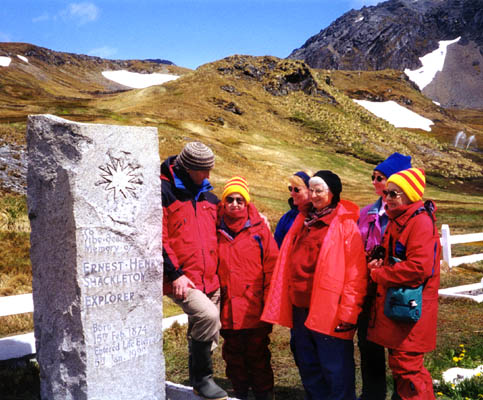
Standing left to right beside Shackleton's marker are descendants of some of those on the Endurance: Irish cousin Jonathan Shackleton, Adelie (or is it Toni) Hurley (Frank's daughter), Elizabeth Bakewell (William Bakewell's daughter, with her two daughters in the rear) and Toni (or is it Adelie) Hurley.
December 6, 1999.
Site No 190
Shackleton memorial cairn and cross.
King Edward Point, Grytviken, South Georgia.
At the conclusion of the Quest expedition, Frank Wild and his comrades built a memorial cairn surmounted by a cross in memory of Shackleton.
My visit of 12/11/98: "At the base of the cross at King Edward Point is a metal marker that reads: 'Sir Ernest Shackleton | Explorer | Died Here | January 5th. 1922. | Erected | By his comrades.'
A signed photograph, dated May 3, 1922, was left at the cross by the crew of the Quest. It was buried in a concrete compartment beneath the cross. It's signed by all the party and notes: "Finder please report to the Royal Geographical Society London England." It says in the caption that the cross was originally built in 1914 and was reconstructed in Shackleton's honor. "The photograph was removed by a Falkland Islands magistrate for safer keeping and in 1997 was delivered to the Royal Geographical Society."
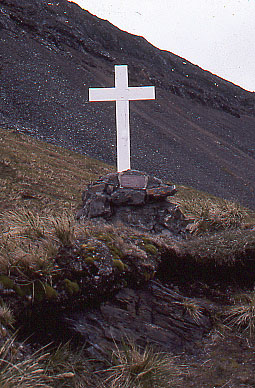
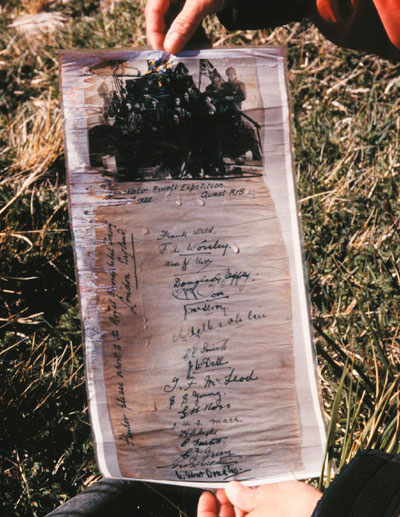
Right: A modern facsimile of the photograph that is kept in the compartment. Photo courtesy of Jim McCarthy.
Site No 007
Statue.
Exhibition Road facade of the Royal Geographical Society, London SW7, UK.
Captain Scott statuary abounds but I know of only one Shackleton example. Fortunately, it's as good as public art gets: skillfully done and like the man himself, powerful and bold, larger than life. Sir Ernest, dressed in polar sledging gear, stands there, high up in his niche, staring intently out over Exhibition Road to the distant horizon of Knightsbridge! Today [9 January 1998] is the 89th anniversary of the 'Furthest South' of Adams, Marshall, Wild and Shackleton (97 miles from the Pole) and the 66th anniversary of the unveiling of the statue on the facade of London's Royal Geographical Society. Sculpted by Charles Jagger, apparently after designs by the great architect Sir Edwin Lutyens, the bronze heroic figure was unveiled by the Marquess of Zetland, Chairman of the Shackleton Memorial Committee. A note in the Geographical Journal (v 79, no 2) relates the interesting observation that "those who had...the privilege of seeing the clay in the sculptor's studio were able to admire his treatment of the picturesque sledging kit and his skill in finding a convention for representing fur in bronze."
[Episode 56, Low-Latitude Antarctic Gazetteer, posted 9 January 1998]
THE SHACKLETON MEMORIAL
The heroic statue in bronze, modelled by Mr. Charles Jagger, A.R.A., for the Shackleton Memorial Committee, was unveiled by the Marquess of Zetland, Chairman of the Committee, on the afternoon of Saturday January 9, the twenty third anniversary of the day when Shackleton reached his farthest south in latitude 88° 23'. Before the ceremony of unveiling Lord Zetland and Dr. Hugh Robert Mill delivered commemorative addresses in the Hall before a large company which included many who had sailed with Shackleton; and at their conclusion the President of the Society expressed to the Committee the gratitude of Lady Shackleton and her family, and accepted the custody of the memorial. A photograph of the statue and the text of the addresses will be published in the Journal for March.
When the Committee some years ago asked the Council to grant a site for the memorial they had in mind a place in the forecourt of the original house. The scheme for building the Hall was then at a very early stage: but it was evident that to exclude the noise of a busy corner the outer walls of the Hall must be windowless, and would be suitably adorned by memorial statues. On the instructions of the Council Mr. George Kennedy therefore provided in his plan a stone niche in each of the two outer walls, and that on the eastern wall, overlooking Exhibition Road, was proposed for the Shackleton Memorial. The Committee thereupon invited Mr. Jagger to accept the commission, and his sketch model was very soon approved by the Council and exhibited in the Society's House.
Those who had at a later stage the privilege of seeing the clay in the sculptor's studio were able to admire his treatment of the picturesque sledging kit and his skill in finding a convention for representing fur in bronze. When the completed statue was unveiled the full measure of his success was apparent. The figure is monumental and at the same time an excellent portrait, as those who had sledged with Shackleton and knew him well were able to assure the sculptor, who had never seen him. The heroic figure is well placed to catch the sidelight of the morning sun in the niche which was destined for it from the first sketch-plans of the Hall. The vacant sister niche facing Kensington Gore awaits some other British explorer of fame and affectionate regard great enough to secure him a National Memorial.
(Geographical Journal, Vol 79, No 2, February 1932, pp 153-54)
The next issue of the Journal (Vol 79, No 3, March 1932) includes a photograph of The Shackleton Memorial and the speeches given at the unveiling by Hugh Robert Mill, The Marquess of Zetland and Admiral Sir William Goodenough (President R.G.S.)
According to a note on a photograph in the Dulwich College archives, the height of the statue is 8 feet, 6 inches.
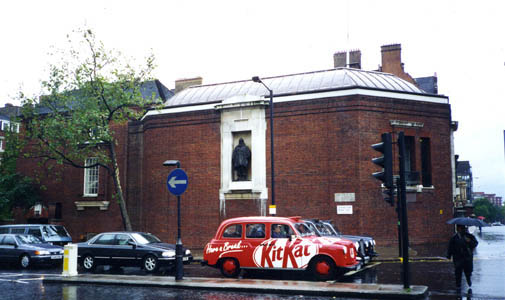
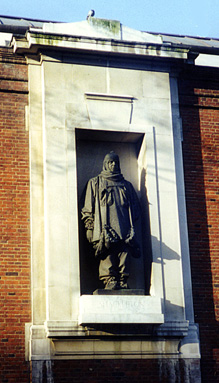
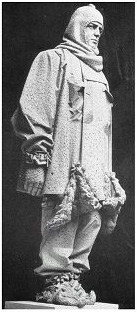
Site No 067
Bust of Captain Luis Pardo.
Point Wild, Elephant Island.
Bust of the Captain of the Yelcho, the boat that rescued Shackleton's men from Elephant Island.

PLAQUES
Site No 056
Plaque.
Lyttelton Harbor, New Zealand.
A few steps away, near the ferry jetties, is a plaque inexplicably mounted on a pedestrian bridge column that reads:
"During a decade of Antarctic Exploration the following ships, each less than 486 reg. tons, used Lyttelton as the Main Port of Departure:
Discovery Cdr. R. F. Scott, R.N. 21 Dec 1901
Morning Capt. W. Colbeck, R.N.R. 6 Dec 1902
Nimrod E. H. Shackleton 1 Jan 1908
Terra Nova Capt. R. F. Scott, R.N. 26 Nov 1910"
"Take the overhead bridge opposite the comer of Norwich Quay and Oxford Street, this is the main road across to the port. Take the second set of stairs on the left. Situated on the seaward side of the uprights that support the bridge are two plaques; one commemorating the Antarctic expeditions that took place at the turn of the century, and the second commemorating the use of Lyttelton by US ships engaged in Antarctic research.
Lyttelton Harbour and No. 3 wharf served as the last port of call for many of the British Antarctic Expeditions at the turn of the century. The use of the harbour by the expeditions gave Lyttelton a sense of being near the centre of events that were of world-wide interest.
On New Year's Day 1908 the ship Nimrod left for Antarctica directly from Lyttelton, while both Discovery and Terra Nova called at Port Chalmers. The departure of the Nimrod was a feature of the annual regatta and a crowd estimated as high as 50,000, (probably the largest in Lyttelton's history), gathered on the wharves to farewell Shackleton's expedition. In The Heart of the Antarctic, Shackleton wrote of this day "such a farewell and 'God speed' from New Zealand as left no man of us unmoved".
Lyttelton's relationship with the early Antarctic expeditions was a special one. Parades were held in the streets of Lyttelton with the crew dressed in their special clothing. The Port area was used by the crews to practise putting up the prefabricated buildings used on the Ice. Another link between Lyttelton and the early Antarctic expeditions was forged when three local Lyttelton men crewed on the Terra Nova.
During the 1960s Operation Deep Freeze had a warehouse in Lyttelton and the first American style coffee bar known as Revells (now Lyttelton Takeaways) was opened. Today Lyttelton Harbour is home to a busy port and B Jetty is the departure point for various scenic harbour cruises."
(Source: Antarctic Heritage Trail, AHT)
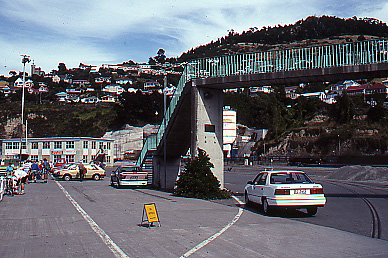
The dark brown rectangular plaque can be seem on the vertical concrete support.
Site No 513
Bronze plaque at Cave Cove.
King Haakon Bay, South Georgia.
The James Caird first landed at Cave Cove near the entrance to King Haakon Bay. Barely discernible because of overhanging vegetation is a bronze plaque commemorating the landing. The plaque itself—installed by the Irish South-Aris expedition in 1997—is difficult to read because of its being exposed to the elements. Here's what it says (I think):
On the 10th of May 1916 Sir Ernest Shackleton landed
at Cave Camp after his journey from Elephant Island in the
open boat James Caird.
His five companions were Frank Worsley,
Tom Crean,
Tim McCarthy,
Harry McNeish,
J. Vincent
"Sir Ernest Shackleton's name will for
evermore be engraved with letters of fire in the history of
Antarctic exploration"
Roald Amundsen
Erected in February 1997 by the
Irish South-Aris Antarctic Expedition

The plaque can be seen above the man with the white beard (Jarlath Cunnane).
Photo source: http://ireland.iol.ie/south-aris/pics10.htm
PLACES
Site No 027
Quail Island.
Lyttelton, NZ.
Quail Island lies near the head of Lyttelton Harbor. It was used as a quarantine station and here the dogs and ponies used by Scott and Shackleton were kept prior to going south. The dog kennels built by Scott are still extant and can be visited.
During the heroic era of Antarctic exploration, Quail Island served as a stock quarantine station due to its natural water boundary. The animals which formed an important part of the expeditions of Scott (Discovery and Terra Nova), Shackleton (Nimrod) and Byrd (BAEI), were held on the island for quarantine and training purposes. The animals used were Samoyed and Husky dogs, Manchurian ponies and Indian Army mules.
Today Quail Island is administered by the Department of Conservation, (DoC). The Interpretation Centre established by DoC, is located in the former Manager's residence and includes information relating to the Island's role in early Antarctic exploration.
Quail island is accessible via a chartered cruise or your own boat. Lyttelton Harbour Cruises Ltd. run from B jetty, Port of Lyttelton. For timetable and enquiries please phone (03) 328 8368 or contact the Lyttelton Information Centre, 20 Oxford St, phone (03) 325 9093.
(Source: Antarctic Heritage Trail, AHT)
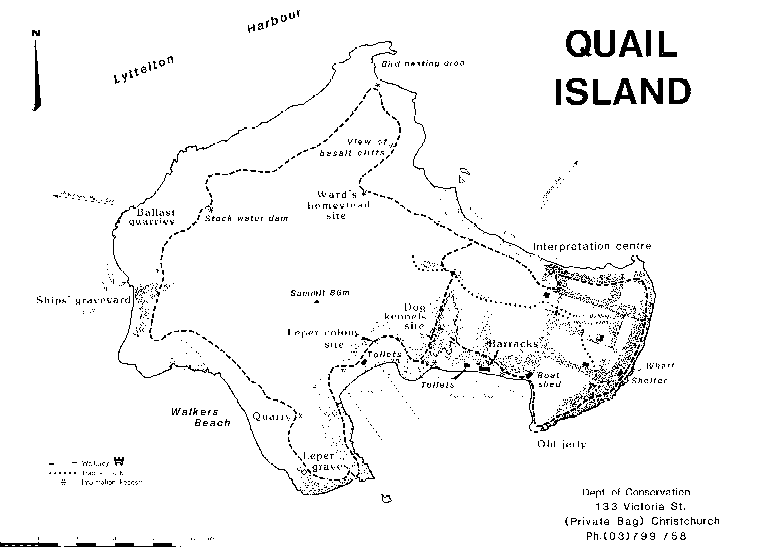
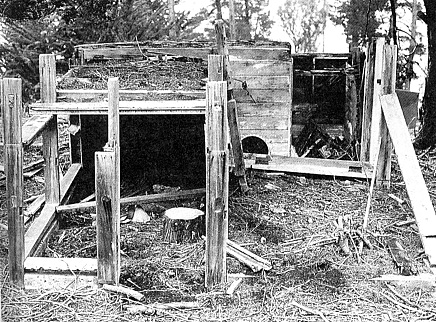
The photo on the right, from Quail Island; A Link with the Past, shows the condition of the kennels in 1984.
Site No 177
Village of Shackleton.
Near Heptonstall and Hebden Bridge, West Yorkshire, UK.
The Shackletons took their name from the village of Shackleton, near Heptonstall, in the West Riding of Yorkshire. It's not really a village but a collection of buildings surrounded by fields and pasture.
My visit of 11 May 2001: I couldn't get to the site itself because of foot and mouth restrictions but I was able to drive along the ridge opposite (village of Slack) and had good views across to Shackleton Knoll. It would be a lovely area for walking if it weren't for the restrictions. Nearby Hebden Bridge is an attractive market town.
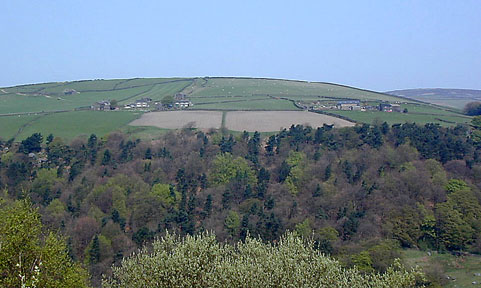
View of Shackleton and Shackleton Knoll from the ridge to the south near village of Slack.
Site No 183
Telegraph office.
Oban, Half Moon Bay, Stewart Island, NZ.
On 23 March 1909 Shackleton called at Stewart Island on the way back from the Antarctic to wire news of his Nimrod expedition.
". . . we had a good voyage up to New Zealand, and on March 22 dropped anchor at the mouth of Lord's river, on the south side of Stewart Island. I did not go to a port because I wished to get the news of the expedition's work through to London before we faced the energetic newspaper men.
That was a wonderful day to all of us. For over a year we had seen nothing but rocks, ice, snow and sea. There had been no colour and no softness in the scenery of the Antarctic; no green growth had gladdened our eyes, no musical notes of birds had come to our ears. We had had our work, but we had been cut off from most of the lesser things that go to make life worth while. No person who has not spent a period of his life in those "stark and sullen solitudes that sentinel the Pole" will understand fully what trees and flowers, sun-flecked turf and running streams mean to the soul of a man. We landed on the stretch of beach that separated the sea from the luxuriant growth of the forest, and scampered about like children in the sheer joy of being alive. I did not wish to despatch my cablegrams from Half Moon Bay until an hour previously arranged, and in the meantime we revelled in the warm sand on the beach, bathed in the sea and climbed amongst the trees. We lit a fire and made tea on the beach, and while we were having our meal the wekas, the remarkable flightless birds found only in New Zealand, came out from the bush for their share of the good things. These quaint birds, with their long bills, brown plumage and quick, inquisitive eyes, have no fear of men, and their friendliness seemed to us like a welcome from that sunny land that had always treated us with such open-hearted kindliness. The clear, musical notes of other birds came to us from the trees, and we felt that we needed only good news from home to make our happiness and contentment absolutely complete. One of the scientific men found a cave showing signs of native occupation in some period of the past, and was fortunate enough to discover a stone adze made of the rare pounamu, or greenstone.
Early next morning we hove up the anchor, and at 10 A.M. we entered Half Moon Bay. I went ashore to despatch my cablegrams, and it was strange to see new faces on the wharf after fifteen months during which we had met no one outside the circle of our own little party. There were girls on the wharf, too, and every one was glad to see us in the hearty New Zealand way. I despatched my cablegrams from the little office, and then went on board again and ordered the course to be set for Lyttelton, the port from which we had sailed on the first day of the previous year. We arrived there on March 25 late in the afternoon."
From Heart of the Antarctic vol II, pp.230-31.
I can find nothing that suggests there might be something in Oban that commemorates this event.

"The first landing in New Zealand on the return of the expedition. A bay in Stewart Island."
[Source: Heart of the Antarctic vol II, opposite p.230.]
Site No 278
Townsite of Shackleton.
Western Australia.
"Latitude 31° 56' S Longitude 117° 50' E
The townsite of Shackleton is located in the central agricultural region, 209 km east of Perth and 32 km west of Bruce Rock. It is located on the railway line from Quairading to Bruce Rock, and was approved as a siding in 1913,the year the railway line opened. A townsite was gazetted at the siding in 1951, the area having been privately developed some years earlier. There is a nearby hill named Mount Shackleton,and both the hill and townsite are named after the Antarctic explorer Sir Ernest Shackleton."
Source: www.dli.wa.gov.au/corporate.nsf/web/History+of+country+town+names+-+s
Site No 783
Village of Shackleton.
Saskatchewan, Canada.
With a 2001 population of 10, this can only be a speck on the map, probably no more than a crossroads. Located off of Route 32, northwest of Regina and not too far from the Montana border. We can only assume it's named for Ernest Shackleton.
Site No 817
Hay's Galleria and Shackleton House.
4 Bainbridge Lane, London SE1 2HP, UK.
"The first wharf on the Pool of London was Hay's Wharf, built 1651 to the east of St Olaf's church. For 300 years it grew, until Tooley Street and the surrounding industrial development was nicknamed "London's Larder". The warehouses burned down in a disastrous fire on 22nd June 1861. It burned for two weeks and smouldered for 6 months. The chief of the fire bridge, James Braidwood died in the fire. He is commemorated in a plaque on Tooley Street, high up on the wall of London Bridge Hospital. The small dock in Hay's Wharf was where Ernest Shackleton's ship "The Quest" lay in 1921. The dock was filled in during extensive rebuilding in the 1980's and is now a shopping mall called "Hay's Galleria". The office block attached to it is called "Shackleton House".
Source: http://en.wikipedia.org/wiki/Tooley_Street
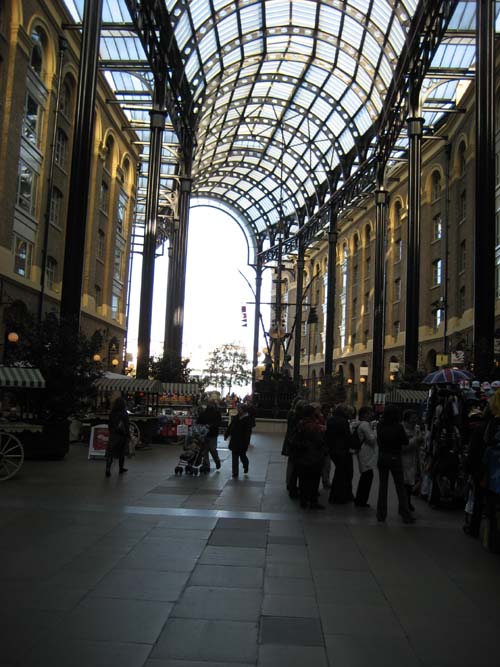
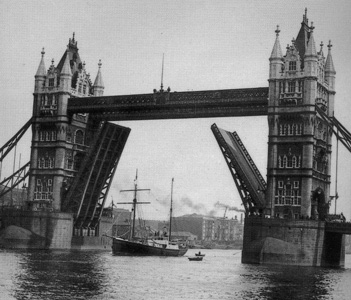 On the left is what was once Hay's Wharf, looking toward the Thames.
On the right is the Quest passing under Tower Bridge after departing from Hay's Wharf, heading south.
Site No 818
Shackleton House.
Challenge Road, Bedfont Industrial Park, Hounslow, UK.
"In February 2002, Hines Air Property began construction on this warehouse in the Bedfont Industrial Park in Hounslow, just west of London at Heathrow Airport. Built specifically to service an airport-related occupier, the 1,980-square-meter (21,300-square-foot) warehouse includes four dock-level doors, external lighting, a perimeter fence and electrically operated security gates. The building also includes 350 square meters (3,800 square feet) of office space with central air conditioning and a transport office overlooking the yard. Shackleton House was completed in September 2002 and sold in December 2004."
Source: www.hines.com/property/detail.aspx?id=404

Site No 819
Shackleton House.
Archer's Wood, Clonee, Dublin, Ireland.
"SHACKLETON House, the latest section of Archer's Wood to be brought to the market, goes on sale this week, with Hooke & MacDonald in charge. On offer will be one-, two-, and three-bedroom apartments and three-bedroom houses, with prices starting from €199,000."
Source: www.unison.ie/irish_independent/index.php3?ca=51&issue_id=12978
Site No 820
Shackleton House.
West Hillside, Stanley, Falkland Islands.
The offices of the Falkland Island Development Corporation (FIDC).
Source: www.fidc.co.fkorwww.falklandislands.com
TOPOGRAPHIC FEATURES
Site No 033
Crater on the Moon named Shackleton.
"The Shackleton crater lies at the south pole of the Moon. The pole lies within the rim of the crater, and is only a few kilometers from the mid-point. From the perspective of the Earth, this crater lies along the limb of the Moon, making observation difficult. The crater is small and is viewed edge-on in a region of rough, cratered terrain. Detailed mapping of the terrain in the vicinity did not occur until the advent of orbiting spacecraft.
The Shackleton crater lies entirely within the rim of the immense South Pole-Aitken basin, the largest known impact formation in the Solar system. This basin is over 12 kilometers deep, and an exploration of its properties could provide useful information about the lunar interior.[1]
Nearby craters of note include the Shoemaker, Sverdrup, De Gerlache, and Faustini craters. Somewhat further away, on the eastern hemisphere of the lunar near side, are the larger Amundsen and Scott craters, named for two other early explorers of the Antarctic continent.[2]
Diameter 19 km
Depth 2 km"
Source: http://en.wikipedia.org/wiki/Shackleton_(crater)

Site No 614
Craters named Endurance and James Caird.
These Martian craters are named for the Endurance and James Caird. There's also a Fram crater.

Site No 758
Undersea features names for Shackleton.
From the Antarctic Gazetteer of Undersea Feature Names.
Shackleton Canyon 75° 15' S 166° 00 W Chart Type: GEBCO Reference: 5.18
Shackleton Fracture Zone 50° 00' S 61° 00W GEBCO 5.16
60° 40' S 56° 30'W
Named after Sir Ernest Shackleton, arguably the greatest British Antarctic Explorer of all time."
Source: http://72.14.209.104/search?q=cache:f4RLJ9jBJU4J:www.iho.shom.fr/REG_HYD_COM/HCA/HCA3/HCA3-6.3A_Gazetteer.pdf+topographic+features+names+for+Shackleton&hl=en&gl=us&ct=clnk&cd=1
Site No 058
Mount Shackleton.
Antarctic peninsula.
"Latitude: 65° 13' 00.0" S (-65.2166667°)
Longitude: 63° 56' 00.0" W (-63.9333333°)
Altitude: 1465 m
Mountain, 1,465 m, with perpendicular cliffs facing W, standing 2.5 mi E of Chaigneau Peak between Leay and Wiggins Glaciers, on the W side of Graham Land. Discovered by the FrAE, 1908-10, under Charcot and named by him for Sir Ernest Shackleton."
Source: http://aadc-maps.aad.gov.au/aadc/gaz/display_name.cfm?gaz_id=131458
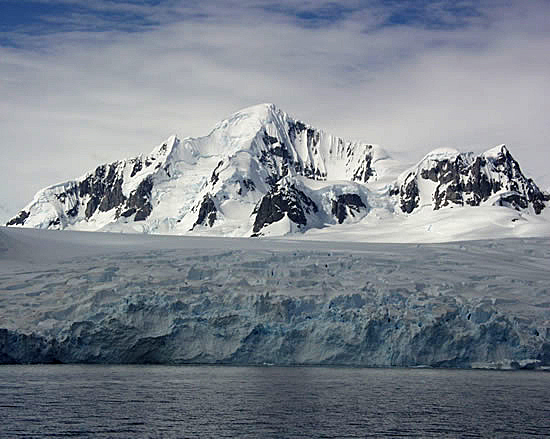
Site No 785
Mount Shackleton and Sir Ernest Peak.
British Columbia, Canada.
3330m (10926ft.)
Located north of Shackleton Glacier, 8 km southeast of Mount Clemenceau. Park, Major headwater Columbia River.
Latitude 52; 11; 00 Longitude 117; 54; 30, Topo map 83C/04
Named in 1919. Shackleton, Sir Ernest Henry (Explorer Ernest Shackleton's party set off to try to be the first to cross Antarctica. Shackleton became a legendary figure for his actions to reach safety and rescue his crew following the destrucion of their ship.) Official name.
First ascended in 1951 by G.I. Bell; D. MichaelJournal reference AAJ 8-255.
Sir Ernest Peak is an outlier of Mount Shackleton that lies one kilometre to the northeast.
Source: http://www.rmbooks.com/peakfinder/peakfinder.ASP?PeakName=mount+shackleton
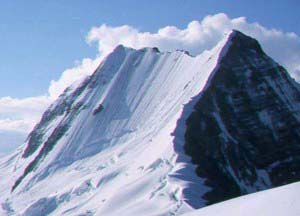
Photo: Mount Shackleton from the northwest at the Tusk-Irvine col (courtesy Alan Kane)
Site No 786
Mount Shackleton.
Western Australia, Australia.
"The townsite of Shackleton is located in the central agricultural region, 209 km east of Perth and 32 km west of Bruce Rock. It is located on the railway line from Quairading to Bruce Rock, and was approved as a siding in 1913,the year the railway line opened. A townsite was gazetted at the siding in 1951, the area having been privately developed some years earlier. There is a nearby hill named Mount Shackleton,and both the hill and townsite are named after the Antarctic explorer Sir Ernest Shackleton."
Source: www.dli.wa.gov.au/corporate.nsf/web/History+of+country+town+names+-+s
OTHER AND SUNDRY
Site No 346
Oak tree planted by Shackleton.
Christchurch Polytechnic Hostel, Christchurch, NZ.
In Christchurch, in the grounds of the Christchurch Polytechnic Hostel, is an oak tree planted by Shackleton in 1917. The marble slab with plaque was stolen in 1981, according to David Harrowfield.
He reported in an e-mail: "Located a new site yesterday. Oak tree with black granite stone at base: 'This Tree was Planted By Sir Ernest Shackleton 24th February 1917.' Done soon after the relief of the survivors of the Ross Sea Party.
There appears to be just the one tree that Shackleton planted. It must be close to a metre thick at the base. The place was once a girls' training hostel but has not been used for many years. I checked the paper and the plaque was stolen but is now back in-situ. It is black granite not marble."
Site No 371
Grace & Favor Apartments.
Hampton Court, UK.
Robert Scott and Kathleen Bruce were married in the Chapel Royal of Hampton Court on 2 September 1908. And later, both Scott's mother and Shackleton's widow were assigned quarters in Hampton Court.
Site No 433
Charles Shackleton Furniture.
The Mill, Route 4, Bridgewater, VT 05034-0048, USA.
Charles Shackleton and his wife Miranda Thomas carry on a high-end business making furniture and pottery in an old mill complex in Bridgewater, Vermont, not far from Woodstock. There are a few Shackleton related books, photographs, etc., on display and for sale.
Charlie is an Irish cousin of Sir Ernest and is brother to Jonathan, a well-known Antarctic writer, lecturer and tour guide.
http://www.shackletonthomas.com

Site No 431
Manager's Villa.
Stromness, South Georgia.
There's been some recent indications that what had been thought to have been the Manager's Villa was only such since 1926. A smaller, nearby building—still extant—was the villa prior to then, and was apparently the one that Shackleton, Crean and Worsley arrived at after their crossing of the island.
"For many years people have assumed the Managers Villa at Stromness
was the same one that Shackleton knocked on the door of at the end of
his epic voyage to save his shipwrecked crew at Elephant Island. This
history, as well as the building's pivotal role in the whaling
station, has lead to many calls for the Villa to be preserved. There
is a plaque outside the Villa commemorating the Shackleton story, and
the bath from the building was taken by the South Georgia Museum as
it was supposed to be the same one Shackleton had bathed in, however
it now seems it may be a case of the wrong villa.
During a recent Whaling and History symposium, at Sandefjord in
Norway, South Georgia a Norwegian historian, Professor Bjørn Basberg,
voiced his doubts, and photographs and documents that have turned up
since seem to confirm that the current Managers Villa had not been
built by 1916 when Shackleton passed through. At that time the
Managers Villa was a smaller building later used as the Foremen's
quarters. A group from the Norwegian branch of the South Georgia
Heritage Trust will be evaluating the earlier Villa later this summer
to see if it is suitable for preservation work.
New evidence will be published in an article by Professor Bjørn
Basberg and Robert Burton, in the forthcoming Polar Record.
In any event, a modern plaque stands (or did in 1998) on the inland side of the larger building and reads:
"[Profile silhouette head of Shackleton]
Stromness Whaling
Station
Manager's Villa
On 20 May 1916 Sir Ernest Shackleton
arrived here accompanied by Frank
Worsley and Tom Crean after an epic
trek of 30 miles from 'King Haakon
Bay. There they had left three comrades with the tiny boat 'James
Caird'. In her they had sailed 800
miles from Elephant Island for help
after their ship 'Endurance' had been
crushed by ice in the Weddell Sea.
This was their first contact with the
outside world for seventeenth months.
[profile silhouette of the 'James Caird']
This commemorative plaque was unveiled by
The Hon. Mrs Alexandra Bergel,
Granddaughter of Sir Ernest Shackleton,
February 1994.
David Tatham, Commissioner."
[Plaque has a blue background and white or light colored lettering.
"The Villa at Stromness whaling station was the home of the managers and also the Norwegian whalers' administrative centre. Compared with the rest of the station, it was extremely comfortable: it boasted a bathroom, soft chairs, flowers in pots and other luxuries. The manager Thoralf Sorlle, who welcomed Shackleton to the Villa in 1914 and again following the boat journey in 1916, was sometimes accompanied to South Georgia by his wife and four daughters.
As 'Journey's End' for Shackleton, Worsley and Crean, the Stromness Villa remains one of South Georgia's historic sites: 'Mr Sorlle's hospitality had no bounds. He would scarcely let us wait to remove our freezing boots before he took us into his house and gave us seats in a warm and comfortable room.' - Shackleton in South
Stromness closed as a whaling station in 1931, but the site was converted into a ship repair yard until its final closure in 1961. Since then, the Stromness Villa has suffered from the weather and vandals. Destruction of the windows and doors has allowed snow, rain and seals indoors, and some of the wooden fabric is rotten. The gaping holes have now been boarded up so that deterioration has been greatly reduced and the Villa is safe from imminent collapse.
An increasing number of visitors to South Georgia walk Shackleton's route from Fortuna Bay to Stromness. A hardy few attempt the complete crossing from King Haakon Bay. At the moment they are denied their ultimate destination - the Stromness Villa - as access to the whaling station is forbidden for reasons of safety.
A message from the Commissioner of South Georgia was read out at the London premiere of the Shackleton IMAX film, confirming the planned restoration and preservation of the Manager's Villa. Funds are now being raised for saving the Villa and clearing the area so that all visitors can visit without danger. Members of the army will clean up debris and make a structural survey.
'It is hoped', Bob Burton writes, 'that everyone who has fallen under the spell of South Georgia and the story of Shackleton's Endurance expedition will feel inspired to contribute to the restoration, perhaps by buying this little book' [Shackleton at South Georgia]. 'The generous support of so many individuals and organisations means that the entire price of each copy goes to helping save the Villa.'"
Source: http://www.jamescairdsociety.com/southgeorgia.php
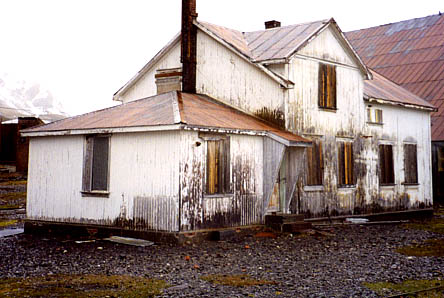

Photo on right is from www.sgisland.org/pages/main.news27.htm and shows what is believed to have been the villa in Shackleton's time.
Site No 426
Shackleton House.
King Edward Point, Grytviken, South Georgia.
"Shackleton House" was built in 1963 as the main accommodation building at King Edward Point. Sometime after 2000 it was removed, why I'm not sure, although one benefit of it being gone is that the nearby Shackleton cairn and cross now has a better setting. I visited the three-story Shackleton House in December 1998. It wasn't an easy thing to do: I had made arrangements ahead of time and had a Gurkha officer escort me the mile or so from Grytviken. Two others made up our party: Ian and Jim Cumming. Ian was a dentist at Grytviken in the 1960s during the last days of whaling (his wife was the physician). They lived in a small house named "Quigleys" which we walked by at King Edward Point as we headed towards "Shackleton House." At this time there wasn't anything of a Shackleton nature in the building other than the name, but apparently there was at one time. Some comments by Stephen Venables in his 1991 book Island at the Edge of the World was the inspiration for my visit:
"The mess was a friendly room panelled in yellowing pine. The bar top was gleaming copper and the electric lights were fitted inside old ships' lanterns. Almost every foot of wall space was hung with nautical and polar bric-a-brac: a pair of Canadian snowshoes framing a window, ships' bells and wheels, a globe, a helicopter blade, balalaikas donated by Russian trawlermen, sledging photos by Duncan Carse, sketchy old charts of the island, ships' pennants, whaling harpoons and a piece of whale baleen. There were official photos of the Queen, of C. Biffy and of King Edward VII, in whose reign the settlement was established. Captain Cook was also honoured and a whole corner was set aside for Shackleton, with 'a token of appreciation to Bro. Sir Ernest Shackleton CVO from the English masons of Uruguay Acacia Lodge No. 876' and a bronze plaque 'from His Britannic Majesty's charge d'affaires on behalf of His Majesty's Government, Montevideo, February 1922'."
My recollection is that the Shackleton memorabilia at least went to the South Georgia Museum in Grytviken.

Shackleton House in the center with King Edward Point to the left and Grytviken in the distance.
The Whalers Cemetery—site of Shackleton's grave—can just be made out, surrounded by a white fence, on the far shore left of center.
Site No 796
Sir Shackleton.
Lexington, Kentucky, USA.
Sarah, Duchess of York, admires Sir Shackleton in Kentucky.

