Last updated: 4 May 2020.
Accessed at least
Click here for an Index to Selected Antarctic Obituaries appearing in the Polar Record of the Scott Polar Research Institute.
Click here for an Index to Antarctic Obituaries appearing in the Geographical Journal of the Royal Geographical Society.
Commander Sir Jameson Adams
Francis Howard Bickerton
William Speirs Bruce
Colin Bull
Lt Cmdr Malcolm Burley
Charles Robert Burton
Verner Duncan Carse
Fauno Lancaster Cordes
Paul Dalrymple
Harding McGregor Dunnett
Commander Angus Erskine
Virginia Frances Pepper Fiennes
Bob Finch
George W. Gibbs, Jr.
Alan P. Gurney
John Arnfield Heap
Sir Wally Herbert
Captain Leonard Charles Hill
Sir Edmund Hillary
Adelie Hurley
Nicholas Johnson
A.G.E. Jones
Phillip Garth Law
John M. Levinson
Jim McCarthy
William James Mills
Frank O'Brien
Edith Maslin "Jackie" Ronne
Peter Jensen Skellerup
Charles Swithinbank
Norman Dane Vaughan
Margery Glover Wharton
PAUL DALRYMPLE 24 April 2020.
Long-time Editor of The Antarctican Society Newsletter, Treasurer of the Society, host of summer-time gatherings of Antarcticans at his Port Clyde, Maine, home, Dr. Paul C. Dalyrymple died in Rockland, Maine, on April 24, 2020.
SOUTH POLE REMAINS CLOSE TO PORT CLYDE MAN
By Stephen Betts, Bangor Daily News Staff, February 11, 2012 3:52 pm
Updated: February 11, 2012 3:58 pm
PORT CLYDE, Maine — You can take the man out of the South Pole but you can't take the South Pole out of one man.
Paul Dalrymple said his heart remains at the South Pole even though it has been 54 years since he first stepped foot on the southern most point of the Earth.
His home is filled with photographs, paintings, multiple stacks of books, magazines, letters and a daily journal — all related to the Antarctic.
A climatologist by profession, the 88-year-old Dalrymple continues to stay active both in the study of weather and in news concerning the Antarctic.
For the past 23 years, the Port Clyde resident has reported daily on weather conditions to the National Weather Service. He also holds regular reunions for members of the Antarctican Society.
"I feel something like Lou Gehrig in his farewell speech at Yankee Stadium, 'I am the luckiest man in the world,'" Dalrymple said.
His roots to Port Clyde are deep. His grandfather Charles Skinner was the longest serving lighthouse keeper in the Lighthouse Service. Skinner manned the Marshal Point Lighthouse, located several hundred yards from Dalrymple's home, from 1875 until 1919. Dalrymple's mother Marion Skinner was born at the light keeper's house in 1895.
Dalrymple said his life path was influenced greatly by a lecture he attended in 1936 at Watts Hall in Thomaston. Armory "Bud" Waite, who was a member or Admiral Richard Byrd's second expedition to Antarctica from 1933-35, was the speaker in Thomaston. Waite also came up with a system to determine the depths of snow using radio echos. The young Dalrymple said he had read the two books written by Byrd about his Antarctic adventures, before attending the lecture.
Byrd was the first person to fly over the South Pole, achieving that milestone in 1928.
Dalrymple was an infantryman in World War II and was captured during the Battle of the Bulge which was waged from December 1944 into January 1945. He spent the final four months of the war in a German-run prison camp.
After he left the service, he went to college, noting that his father Charles Dalrymple was a great believer in education. After obtaining his master's degree from Syracuse University, Dalrymple said he decided he needed to get a job and hitchhiked to the Blue Hill Observatory in Milton, Mass. The observatory has been collecting weather observations south of Boston since 1885.
He recalls climbing the hill and knocking on the door of the observatory and asking the man who answered the door about what they did there.
"Three hours later they escorted me back to the door which was to become my home off and on for the next several years," he said. Dalrymple was a resident observer, earning $115 per month.
Dalrymple took courses in meteorology at the Massachusetts Institute of Technology and oceanography at Harvard University in Cambridge, Mass.
He worked one summer aboard the Albatross III in the North Atlantic studying the Gulf Stream. He later worked as a meteorologist for the U.S. Weather Bureau. In this job, he was stationed on Coast Guard cutters in the North Atlantic.
In 1957 during the International Geophysical Year, which was a joint effort by countries of the world to study various scientific endeavors, there was an opening for someone with micrometeorology training—the science of weather at ground level—to serve at Little America V. Little America V was the United States base of operations in Antarctica.
Dalrymple was selected to go and while there, he got a call from the station scientific leader of the Amundsen-Scott South Pole Station asking if he knew of anyone back at his home office in Massachusetts who would be qualified to serve as a micrometeorologist at the South Pole. He said he would like the opportunity and so he spent 1958 stationed at the South Pole.
The cold seldom bothered Dalrymple during his stay even though temperatures dipped to 102 degrees Fahrenheit below zero.
"The wind doesn't blow very strong at the South Pole, so you can walk around with no discomfort," he said. "The South Pole has the best weather in the world."
The only times the cold got to him was when he had to climb a mast where the anemometers, which record wind speeds, are located to replace the cups to the equipment. He said he had to take off his heavy mittens to do this work and it would sometimes make him sick to his stomach.
He said he has never forgotten his time at the South Pole.
"Today, I feel like I am still at the South Pole," Dalrymple said.
He returned to Antarctica in the late 1960s as the program manager for micrometeorology. And around 1990, he served as a lecturer in history aboard cruise ships that went to the Antarctic.
He moved to Port Clyde and built his house 23 years ago so he could care for his aging mother who lived in the neighboring house. He contacted the National Weather Service and agreed to be one of its weather observers.
Every evening at 6, he checks the equipment at his small climate station and records the current temperature, the high temperature for the day and the low temperature. He also records the amount and type of precipitation.
Through his decades of studying the weather, Dalrymple said he is convinced that mankind was influencing the climate by warming the globe.
"I certainly believe that humans are warming the Earth," he said.
He noted that on Christmas Day in 2011, the South Pole recorded its warmest temperature on record, 9.9 degrees Fahrenheit.
Another big news item coming out of Antarctica that he believes lends credence to global warming is the expected breaking free of a chunk of ice the size of New York City.
This current winter in Maine is one of the warmest and least snowiest but Dalrymple said this year is similar to about four other winters he has experienced since maintaining records in Port Clyde.
In the 23 years he has recorded the weather in Port Clyde, the least amount of snow fell in 1999-2000. That year, there was no measurable snow in December or January. The most snowfall at the end of the St. George peninsula came in 1995-96 when 92 inches were recorded.
The average snowfall at his Port Clyde station has been 42.9 inches.
He noted the warming influence of the ocean keeps Port Clyde warmer than inland, and precipitation is often rain or mixed when it is now several miles inland.
This year, the snowfall total is 14 inches although it has come in a lot of 2-inch snowfalls and then will melt by the following day.
The veteran climatologist said he watches the Weather Channel, although he prefers the Channel 13 weather forecast more than any other.
Dalrymple's lifelong devotion to the Antarctic has been recognized multiple times. A nearly 12,000-foot mountain was named after him by the U.S. Board of Geographic Names on Antarctia. A photograph of that is among the ones that are displayed on his wall.
This summer, Dalrymple is planning another outing at his Port Clyde home for the Antarctican Society which consists of people who both have visited the southernmost continent as well as those interested in it.
You can see an video interview with Paul at https://www.antarctican.org/dr-paul
JIM McCARTHY 11 December 2019.
"I was struck by Jim McCarthy's rare combination of brilliance and humility, and his graceful intelligence the first time I met him, when he interviewed me as a candidate for this job," said UCS President Ken Kimmell. "While best known for his work on climate change, Jim was a passionate advocate for the essential role science plays in our democracy and was a key architect in the formation of our Center for Science and Democracy in 2011. It was an honor to work together and to become Jim's friend." McCarthy joined the UCS board of directors in 2003 and served as the organization's board chair from 2009 to 2015.
"Jim was a profoundly engaged board chair," said Peter Frumhoff, UCS director of science and policy. "He always found time to mentor and partner with UCS
staff on climate science initiatives, on building new capacity to innovate and take risks, and on engaging other senior scientific leaders in our science, outreach and advocacy. Leading by example, Jim modeled for so many of us what it means to be a scientist-advocate."
McCarthy was the Alexander Agassiz professor of biological oceanography at Harvard University, where he also served as director of the Museum of Comparative Zoology from 1989 to 2002. Committed to interdisciplinary research before it became popular, he understood the importance of reaching across fields of study to draw holistic conclusions.
McCarthy's primary research focused on the regulation of plankton productivity in the ocean, particularly in regions that are strongly affected by seasonal and year- to-year variations in climate. Through his work, he could plainly see the far-ranging and interconnected consequences of a warming planet, and he devoted much of his public service to education and advocacy on climate change.
He served on and led national and international organizations dedicated to addressing climate and global change. He was an author of regional, national and international climate change assessments, vice chair of the UCS-led Northeast Climate Impacts Assessment, and headed the 2001 Intergovernmental Panel on Climate Change (IPCC) Working Group II assessment of impacts and vulnerabilities relating to climate change. In 2012, President Barack Obama appointed him to the U.S. Arctic Research Commission.
In addition to his leadership on the UCS board of directors for the past 16 years, McCarthy also previously served as chair of the American Association for the Advancement of Science (AAAS) board of directors as well as that organization's president. In 2018, McCarthy was named as a co-recipient of the prestigious Tyler Prize for Environmental Achievement.
Among his many other honors, McCarthy was elected as an AAAS fellow, an American Academy of Arts and Sciences fellow, and a Royal Swedish Academy of
Sciences foreign member. He also received the New England Aquarium's David B. Stone Award for distinguished service to the environment and the community and the Museum of Science Walker Prize for meritorious published scientific investigation and discovery.
"Jim was a warm, generous and inspirational leader, colleague, mentor and friend," said Kathleen Rest, UCS executive director. "He brought to UCS his scientific expertise and concern about our climate, oceans, environment and health of our planet. But he also brought much more than that, showing genuine concern and care for our staff at all levels of the organization. It was my great privilege to know and work with him for more than 15 years. He was truly loved and admired by all of us."
Source: Union of Concerned Scientists
FRANK O'BRIEN 2 April 2017.
Legendary publican of Athy, Co. Kildare, passed away at age 94. O'Briens was the unofficial headquarters of the annual Shackleton Autumn School held each October Bank Holiday in Athy, a few miles from where Sir Ernest Shackleton was born.
Here's Frank at the bar with his daughter, Judith, last October.
Thanks, Frank, for all the hospitality over the years!
ROBERT JOSEPH 'BOB' FINCH 9 August 2016.
Long-time polar bookseller Bob Finch of Bainbridge Island, Washington, died suddenly on August 9, 2016. More information shortly.
An obituary appeared in the local paper, sent to Michael Rosove by Carol Finch and forwarded on.
Bob Finch in the center flanked by collectors—and one-time customers—Marty Greene and Rob Stephenson, at Bob and Carol's house, Bainbridge Island, July 27, 2012.
WILLIAM SPEIRS BRUCE Died 29 October 1921
CHARLES SWITHINBANK 27 May 2014.
Charles Swithinbank, who has died aged 87, was a glaciologist and polar specialist whose experience of the Arctic and Antarctic was unsurpassed in its variety.
Having started his remarkable career as a member of an international expedition to the Antarctic, Swithinbank went on to serve successively on Canadian, American, Soviet, British and Chilean expeditions in the polar regions.
He had only just graduated when he sailed south as assistant glaciologist on the Norwegian-British-Swedish Antarctic Expedition of 1949-52. This expedition, under the leadership of the Norwegian John Giaever, established a base called Maudheim in the Norwegian territory of Dronning Maud Land, in the sector of Antarctica to the south of Africa. For land travel the expedition used both the traditional dog teams and over-snow tracked vehicles , and the scientists brought a new level of expertise to research into the Antarctic ice cover, carrying out deep drilling and seismic measurement of ice thickness.
Swithinbank was particularly concerned with measuring the snow nourishment and rate of movement of the (floating) ice shelf on which Maudheim was situated. He was also involved in the ice drilling programme, which was so successful that in the second year, as Giaever records in his book The White Desert (1954), he was able to lay on the expedition leader's plate an ice core formed of snow that had fallen in about the year 1800. Never one to miss a chance to improve his knowledge, Swithinbank also became fluent in Norwegian during his two years at Maudheim.
He and the other three British members of the expedition received the Polar Medal with Antarctic clasp.
Charles Winthrop Molesworth Swithinbank was born in Pegu, Burma, on November 17 1926, the son of Bernard Swithinbank of the Indian Civil Service, and educated at Bryanston. He then served for two years with the Royal Navy, in which he was commissioned as a sub-lieutenant.
ln 1946 he went up to Pembroke College, Oxford, where he read Geography and rowed in the University trial eights, narrowly missing his Blue. He also took part in Oxford University expeditions to Iceland in 1947 and, the following year, to Gambia. In 1952 he returned to Oxford to write up his Antarctic results for a DPhil, which he was awarded in 1955.
His early Antarctic experience left Swithinbank with a passion for glaciology, and in 1955 he became a research fellow at the Scott Polar Research Institute in Cambridge, to study the distribution of sea ice as it affects shipping in the Canadian Arctic. This research, which was funded by the Canadian government, involved familiarisation with sea ice conditions on a cruise aboard the icebreaker Labrador in the Baffin Island region, and then a careful scrutiny of ships' logs and other records held mainly in eastern North America. Although the ice atlas that he published was little used operationally, being soon overtaken by regular ice reconnaissance flights and later by satellite imagery, it remained a valuable record of sea ice variations as these may be affected by climate change.
In 1959 Swithinbank moved from Cambridge to take up an appointment as a research associate and lecturer at Michigan University. While based there he spent three summers in the Antarctic with American parties engaged in investigations into the Ross Ice Shelf, and the glaciers that feed it, in New Zealand's Ross Dependency.
He then saw the possibility of returning to Dronning Maud Land as the US representative at the Soviet Union's ice shelf station Novolazarevskaya, newly established under the Antarctic Treaty. However, he found that for this post he needed American citizenship which, because he had been born in Burma, he could not easily acquire. He therefore returned to Britain to take up a further research appointment at the Scott Polar Research lnstitute, and proceeded to the Antarctic as British representative at the Soviet station; during two summers and a winter he continued his ice shelf studies and also became fluent in Russian.
Swithinbank remained at the Scott Polar Research Institute until 1976; from 1971 he was employed as chief glaciologist, and from 1974 as head of the Earth Sciences Division of the British Antarctic Survey. During this period, in addition to a return visit to the Antarctic with the Americans in the summer of 1967-68, he took part as sea ice specialist in the transit of Canada's Northwest Passage by the supertanker Manhattan in 1969, and in the return passage to the North Pole by the nuclear submarine Dreadnought in 1971.
In 1976 Swithinbank moved to the British Antarctic Survey's new headquarters in Cambridge. Every other season he spent several months in the Antarctic, principally engaged in directing radio echo-sounding flights by Twin Otter aircraft to measure the thickness of ice cover over the Antarctic Peninsula and within the British Antarctic Territory. For optimum results, many of these flights were conducted at extremely low altitude—30ft or less. Swithinbank (himself a qualified pilot and an excellent navigator) flew mainly with the great polar airman Giles Kershaw, with whom he developed a fine rapport. He and Kershaw discovered extensive areas of level snow-free ice in the Patriot Hills.
Within weeks of his retirement from the British Antarctic Survey in late 1986, Swithinbank joined Kershaw and a Canadian-based commercial airline in a series of test flights, with support from the Chilean Air Force, flying from the Chilean station Marsh in the South Shetland Islands. The mission was successful in finding natural runways suitable for the landing of aircraft of any size on wheels. In the 1987-88 season, flights were inaugurated for mountaineers, skiers and other tourists, and thereafter became an established feature of the Antarctic calendar.
Swithinbank continued to travel widely, with a particular interest in the application of remote-sensing techniques, especially satellite imagery, to glaciological problems. He published a lengthy report on Antarctic ice cover for the United States Geological Survey, and lectured widely at international meetings and at universities in America and elsewhere. He was also an accomplished lecturer on tourist cruises to the Canadian Arctic and to the Antarctic.
He was the author of An Alien in Antarctica, Reflections upon Forty Years of Exploration and Research on the Frozen Continent (1997); Forty Years on Ice, A lifetime of Exploration and Research in the Polar Regions (1998); Foothold on Antarctica, The First International Expedition (1949-1952) (1999); and Vodka on Ice, A Year with the Russians in Antarctica (2002).
Swithinbank's awards included the Patron's Medal of the Royal Geographical Society and the Vega Medal of the Royal Swedish Geographical Society. He is commemorated by six place names in various sectors of the Antarctic.
He married, in 1960, Mary Fellows (née Stewart), with whom he had a son and a daughter.
Charles Swithinbank, born November 17 1926, died May 27 2014
SOURCE: The Telegraph (UK). 20 May 2014.
NICHOLAS JOHNSON 28 November 2012.
Nicholas Johnson, author of Big Dead Place and a close friend, took his life on November 28, 2012. Nick's death is a heartbreaking loss to his family, to his friends, and to so many of us that knew him as an essential part of the Antarctic community. He had a voice and a spirit unlike any I've known, equally cynical and generous, funny and soulful. I loved him and I miss him.
No one has done more to change the way we understand Antarctica. Nick was unflinching in his critique of bureaucracy and authority in the United States Antarctic Program, but mainly he sought to create a dialogue within and about Antarctica that cut through cliche and hypocrisy in order to describe things as they really are, in all their glory and strangeness. Not all his readers realize that Big Dead Place (both the book and the website), which can be both brutally honest and explicit, is first and foremost an expression of Nick's love of Antarctica and of the people in the USAP. He loved the place so much that he wanted to make it better. And he did. There is nothing like Nick or his writing in all of Antarctic literature or history. Not many people can say they upended a continent's literature.
I knew Nick very well. We were happy roommates for two seasons on the ice, and we rented a flat together in Christchurch, New Zealand, for several months while for 15 hours a day we both wrote and researched in Christchurch's Antarctic libraries. There was hardly an hour in all that time together that we weren't talking about Antarctica, past or present. Rozo, Byrd, Shackleton flowed seamlessly through our conversations about galley food or South Pole politics. No one will ever understand my Antarctic writing—my whole Antarctic obsession, really—better than Nick. And I watched in amazement during those Christchurch months while he transformed himself from a writer of zines and broadsides into a master of narrative nonfiction.
Nicholas was his usual kind and generous self up to the very end. He and I were corresponding until just a few days before his death about this blog, of which he is the architect, and about Hoosh; I took his silence in the final days to mean he was busy with other projects. He seemed upbeat. I wish I had realized that he was so overwhelmed by the pain of living that he was making his final plans. Like every one of his many friends scattered around the world, I would have dropped everything to save Nick. But I had no idea he would do this.
I won't talk here of what might have driven Nick to take his life. His stints as a contractor in Iraq and Afghanistan probably darkened his thoughts, and certainly he was disappointed about being blackballed from his beloved USAP, but I assume his suicide has deeper roots than that. Whatever his rationale, he was wrong. Life without Nick in it is so much poorer, so much emptier, and I can't help but think that his demons could have been driven out if he'd shared them with the right people. But he was as guarded about his inner life as he was fair and generous in his personal life.
If you're reading this without knowing Nick's work, go and read Big Dead Place and explore www.bigdeadplace.com. If you don't know American Antarctica, it will be strange going at first. It might help to be familiar with Hunter S. Thompson's writings on American culture and politics, but Nicholas Johnson was a better writer, I think. And if you really want to understand, go wash dishes in McMurdo or operate heavy equipment at the Pole and fall in love with the place, the people, and the absurdity of life in a big dead place. At some point, you'll think the same thing I will for the rest of my life: Hey, I really wish I could talk to Nick right now.
Source: http://www.albedoimages.com
ALAN P. GURNEY 22 July 2012.
Alan Gurney designed boats the old fashioned way with drafting pencil on velum, using splines and ducks (weights), a planimeter, and a seaman's eye. He thought like the water through which he had sailed, in England, transatlantic, the USA, both polar regions and much of what lay in between. As a young lad, he would make boats out of toilet tissue (which at that time had characteristics of waxed paper) and float them in his bath. He spurned a career in the army to pursue a career as a yacht designer, and ultimately moved on to an early passion, Antarctic exploration. He had amassed an impressive collection of hundreds of photographs of every known Antarctic penguin species.
I had the great good fortune -- a privilege -- to be his friend, and to have had lunch with him frequently as he was in the process of drawing the myriad details of what was to become "Windward Passage", the world famous dream boat of lumber tycoon, Robert F. Johnson. During each lunch-time visit, I would meet Alan in his basement studio on New York's East 54th Street, and he would show me the most recent drawings.
Johnson had selected Gurney for the new design having been impressed by the performance of George Moffett's "Guinevere", a 48 foot Jacobsen-built aluminum yawl which had won the SORC in 1966, the second of two ocean racers Alan had designed for Moffett. The first was a wood-built boat, the Nantucket 38, aboard which I had the sailed in the 1964 Bermuda Race. Later, I transferred to Humphrey Simson for whom Alan had designed a yawl similar to "Guinevere", the 47 foot Derecktor built "Kittiwake", aboard which I sailed in the 1966 SORC, Bermuda, and Transatlantic races. "Kittiwake" did well in her class in the SORC series, overshadowed only by Ted Turner's legendary Cal-40, "Vamp X" which won everything in her class that year including the Transatlantic race from Bermuda to Copenhagen.
I had met Alan Gurney in 1960 following that year's Bermuda Race. I was a yacht broker in the office of Tripp & Campbell in New York City when Englishman Gurney was brought around by G. Colin Ratsey (of the English sailmaking firm) to meet yacht designer Bill Tripp. Still only 24, Alan had won a prestigious competition for a modern "club racer" sponsored by the British magazine, "Yachting World" which brought him to the attention of Chesapeake Bay yachtsman Jack Lacy for whom Alan had designed a 35 foot sloop. While nothing came immediately of the meeting with Tripp, both partners at Tripp & Campbell had been impressed, and when Tripp's design assistant resigned a short time later. The firm offered the job to Gurney who flew back to New York to accept it.
Among the early assignments for the new design assistant was to work out a plating schedule for a 42 foot aluminum "Raider" class Tripp had designed for a new aluminum boat company Gib Wolfe had started in central New York State. Wolfe's company did not have the ability to form compound curves in aluminum plates but he did not want the new boat to appear to have chines. Alan was given the task of working out developed surfaces (bending in only one plane) for the new design. The "jigsaw puzzle" worked out by Gurney went together perfectly. No one would have guessed that the two boats built from this Tripp design were anything other than conventional round built hulls. Gib Wolfe was so pleased and impressed by Alan's work on the Raider that he commissioned him to design, on his own account, the "Wolverine", a 28 foot aluminum chine sloop, of which several were built before the company ceased production. The prototype Wolverine, sailed by New Orleans champion sailor Gene Wallet in the 1962 Yachting Magazine One-of-a-Kind regatta (Coral Gables, Florida) registered three bullets out of three in the cruising division which corrected, on an arbitrary handicap, to third behind the Cal 24 and the Cal 20.
Bill Tripp, frustrated by time spent commuting from Long Island to the city which could have been spend working out of his home, left the partnership in 1962, offering to take Alan with him, which offer was declined. Gurney was left on his own, working with yacht broker William B. Campbell out of the former Tripp & Campbell offices in Rockefeller Center, abandoned by Tripp.
Two Bermuda 40 owners, Moffett and Simson stepped in with contracts for Alan to design the aforementioned "Guinevere" and "Kittiwake." In addition to these and the Nantucket 38, Moffett also commissioned Gurney to design a 5.5 Meter which, alas, was never built, and then came Bob Johnson with his then revolutionary idea to be first to finish, and set course records for the world's most prestigious ocean races, ignoring handicap prizes.
"Windward Passage" set the offshore racing world alight, accomplishing precisely what Bob Johnson wanted, but the 1969 Transpac elapsed time record was taken away by a protest after a starting line foul involving a small boat in another class. Johnson did not live to see his dream fulfilled. Two years later, under Johnson's sons, Mark and Fritz, "Passage" shattered her previous actual elapsed time, setting an official new record which stood for many subsequent Transpac's. Earlier, in 1971, "Windward Passage", under command of Johnson's sons had set a course record in the Miami-Montego Bay race which stood for 30 years and was only eclipsed when the offshore racing rules permitted larger boats than the previous 73-foot overall length to which "Passage" had been limited.
Alan Gurney's fame spread, and he was commissioned by several well known yachtsmen including T. Vincent Learson, a chairman of IBM, a larger "Kittiwake" for Simson, and, among many others, notably, a light displacement 33 footer for New England sailor Chuck Blair which won 65 per cent if all races entered, according to a Murray Davis article in Boating Magazine. He also designed "Great Britain II", a 73 footer similar to Passage for Chay Blythe which won the Whitbread crewed around the world race. Except for the well received O'Day 27 and Islander 36. Series of production boats, which would have assured continuing royalties over the years, eluded Gurney. Custom work, although prestigious, meant starting over with each new client. Unable to devote sufficient time to work with all of the custom clients who wanted his services, and unwilling to take on the responsibility of a staff, disillusioned by the trend toward unsavory, unseaworthy offshore racing boats, Alan Gurney left his yacht design business and took an Antarctic cruise on the "Lindblad Explorer." At the end of the cruise, he signed up for the next cruise. He was hooked on what was to become a second career.
The following season, Alan signed on as a cruise guide and lecturer, staying with Lindeblad for a dozen years until the ship was sold, although he later returned briefly to the ship, sailing under her new colors. Ultimately, he rejoined Carl Lindblad for an epic journey through the Northwest Passage, the largely unfulfilled dream of explorers and adventurers for centuries.
His Antarctic and Arctic cruises led to two books, which took years to research and write. (Alan was as meticulous a writer as he was a yacht designer). The first book, "Below the Convergence", chronicles the early theories about the suspected existence of the Antarctic Continent and early voyages of attempted discovery. His descriptions of conditions aboard early exploratory journeys could only have been written by someone who had made long sea voyages, and his knowledge of the objectives of those early mariners is monumental. "It's as if you spent hours in museums studying the portraits of these long dead adventurers", I said to Alan during a visit to his New York publisher in 1991. "Well", he said with a sardonic chuckle, "that's just about what I did."
His second book, "The Search for the White Continent", chronicles the voyages of actual discovery and supposed sightings of the Antarctic Continent in which he found justification for many claims of discovery, and debunked others of dubious merit.
His third book, "The Compass", is a detailed history of the development of this basic navigation tool which made possible the early voyages of discovery and continues to be the most essential navigation tool of mariners today. It is a "must read" by all who venture forth and need to know where they are headed.
Alan P. Gurney's education included a stint as a corporal in the British Army, a design apprenticeship with J. Francis Jones, work for three years in the West Mersey firm of yacht designer Kim Holman, and a personal thirst for knowledge and understanding which transcended that of the most well educated amongst us. He excelled in two diverse careers (a third as an author), earning the respect of peers and competitors alike. He had returned to Great Britain from his adopted New York City to an estate kennel, on the Hebridean island of Islay, which he fashioned into a rustic home on the verge of the sea. There he met and married his second wife, Carol, a school teacher. With Carol's change of employment several years later, the Gurneys left Islay for a more comfortable home on the east coast of England.
Diagnosed with terminal esophageal cancer in April 2012, he left this life barely three months later, on July 22nd. I miss Alan Gurney as a friend. The world of sailing and scholars of maritime history have lost a brilliant star whose light they can now appreciate only through his sailboat designs and his published histories which he has left behind for posterity.
Smooth sailing old friend. May there always be high tide and favorable winds in the new world to which you have sailed so suddenly away.
Source: Eight Bells ~ Alan P. Gurney
COLIN BULL 7 September 2010.
COLIN BULL (1928-2010) Emeritus Professor and past Chairman, School of Earth Sciences (earlier Department of Geology, Department of Geology and Mineralogy, Department of Geological Sciences); past Director of the Institute of Polar Studies (now BPRC); and past Dean of the College of Mathematical and Physical Sciences (from Peter Webb, 12th September, 2010)
It is with great personal sadness that I bring you the news that Colin Bull passed away in his sleep on Tuesday 7th September 2010. At the time of his death Colin was participating in a cruise with wife Gillian, northward along coastal Alaska aboard the Holland-America Line ship Amsterdam.
Here is a short account of Colin's life within and beyond The Ohio State University. A full obituary is being prepared for publication, with the assistance of friends, colleagues and former students. A photo of Colin Bull can be found among the past-Chairmen collection in Mendenhall Room 291.
Colin was born in 1928 at Birmingham (UK) and the family later settled in County Herefordshire where he completed his early schooling. He often jested that he was a Hereford Bull! He attended the University of Birmingham between 1945-1952 where he completed B.Sc., M.Sc and PhD (solid state physics) degrees. Colin launched his long career in polar work as a member of the University of Birmingham Spitzbergen Expedition (1951). After a short period in the Department of Physics at University of Cambridge, Colin joined the British North Greenland Expedition (1952-54) as a geophysicist-glaciologist, weather observer, and also assumed the role of Chief Scientist. Gillian and Colin emigrated to New Zealand in 1956 where he held a position as Senior Lecturer in the Department of Physics at Victoria University of Wellington (VUW). His prior polar experience was put to good use as leader of the 1958-59 VUWAE expedition to the Dry Valleys, and also as a member of the 1960-61 VUWAE party. Dick Goldthwait, Professor of Geology at The Ohio State University, met Colin during this period and enticed him to join him in Columbus (1961) and assist in the founding of the Institute of Polar Studies (later Byrd Polar Research Center). Over the next quarter century Colin assumed the roles of Director of the Institute of Polar Studies, Chairman of the Department of Geology, and Dean of the College of Mathematical and Physical Sciences. After 13 years as Dean, Colin and Gillian retired in 1986 to Bainbridge Island across Puget Sound from Seattle.
Although much has changed since he retired from our midst in 1986, Colin's legacy lives on today in both the Byrd Polar Research and the School of Earth Sciences. The late 1970's-early 1980's marked a major watershed in our history, with a steady progression of retirements, sometimes two to three a year. All faculty and technical lines were retained and replaced, and the continuity of the core earth science instructional programs maintained. New faculty required updated facilities and a massive (for us) injection of basic research and instructional equipment. This was financed from department budgets, federal and industrial grant monies, and most importantly, by super-matching organized by Colin (as Dean) from the College of Mathematic and Physical Sciences, other OSU dollar pots, and also State of Ohio sources. Sponsored research and its associated support of graduate students in the Department of Geology (later Department of Geology and Mineralogy, and later still Department of Geological Sciences) took off upward. The comprehensive multi-million dollar renovations of Orton Hall in 1979-80 and Mendenhall Laboratory later in the 1980's were enormously assisted by his machinations at high levels, both within and beyond The Ohio State University. Colin rewarded success and proved to be a facilitator supreme.
I worked with/for and knew Colin Bull for 53 years. During this time I learned much from him in his role of trusted friend, advisor, scientific colleague, administrator and boss. He was always youthful in spirit and an enthusiastic adventurer at heart. Although the burden of administration kept him away from personal field and laboratory science, he compensated by maintaining close interactions with earth science students and researchers . He never espoused a desire to become a dour, humorless, upwardly mobile professional administrator and maintained strong personal and professional ties with his numerous science colleagues to the very end. We respected this relationship and were usually enthusiastically supportive of his goals. A little digging beneath a cloak of informal, rambling, cheerful, wise-cracking and apparent benevolent chaos revealed many other qualities that I valued greatly. Words and phrases such as humor, informality, optimism, generosity, loyalty, frankness, focus, honesty, unconventional out-of-the-box thinking, calculated risk taking, sharing, etc, etc, come readily to mind. I ask you then, when can you last remember saying such things about an administrator?
There are many other attributes, activities and interests I could lavish on this account, but these must wait until we compile a full account of Colin's life, personality and contributions. Institutional memory is so very short and we quickly forget or are unaware of those who laid a path for us to follow. In the meantime, let's dwell positively on Colin's passing, and acknowledge what he contributed to The Ohio State University, especially to the Byrd Polar Research Center (aka IPS) and the School of Earth Sciences (Geology, Geology and Mineralogy, etc) over a span of 25 years. Our thoughts are with Gillian and their three grown children (Nicky, Rebecca and Andrew) as they adjust to their loss.
[Letters/cards should be address to: Gillian Bull, 12818 Sunrise Drive NE, Bainbridge Island, WA 98110]
Lt Cmdr MALCOLM BURLEY 23 August 2010. Aged 82.
Lt Cdr Malcolm Burley RN MBE, who led the 'Combined Services Expedition' to South Georgia in 1964/65, died on August 23rd. Malcolm Keith Burley was born in 1927 and joined the Royal Navy in 1945. In 1960 he was appointed to the Antarctic guardship "HMS Protector" and during the ship's deployment successfully climbed Mt Leotard, the highest peak on Adelaide Island off the Antarctic Peninsula.
Later that year, in the company of 15 Royal Marines, he attempted to climb South Georgia's highest peak, Mt Paget. Though faced with challenging conditions on the climb, Malcolm, with three Marines, reached the mountain's lower peak, but were forced to return from there due to bad weather and lack of time.
He returned to South Georgia in 1964 to try again, this time as the leader of the 'Combined Services Expedition'. This successful expedition had several aims. They crossed the Island using the route taken by Shackleton from King Haakon Bay to Stromness - filmed for an ITV documentary; attempted climbs on several of the major peaks and were successful in climbing both Mt Paget and Mt Sugartop; and crossed the Island again using a very high pass near Mt Marikoppa, across the formidable Allardyce Range. There was also survey work in various areas of the Island, including the previously unsurveyed area around Royal Bay. Other work included charting, geological, glaciological, botanical and ornithological surveys. Burley led another successful expedition to Elephant Island in 1970. He retired from the Navy in 1973.
A memorial service will take place St. Michael's, Peasenhall, on September 1st. We hope to bring you a fuller obituary of Lt Cdr Malcolm Burley in the September edition of this newsletter.
Info: The Dictionary of Falkland Biography
—Thanks to John Stansfield
ADELIE HURLEY 4 March 2010. Aged 90.
ONE of Coffs Harbour's best-known and most-colourful senior citizens, Adelie Hurley, has passed away.
Ms Hurley, who was less than three months away from her 91st birthday, died in her sleep at her home in Lime Tree Park on Thursday night, shortly after completing her last crossword puzzle.
She had been unwell for a number of months but still found the energy to continue to write to The Coffs Coast Advocate's Letters to the Editor page, where she was a regular contributor on many topics.
Her last letter was published yesterday.
Adelie Hurley was born on May 21, 1919, the daughter of famous Antarctic and World War I photographer Frank Hurley and his wife Antoinette.
She was an identical twin, which allowed Adelie and her sister Antoinette to exchange roles when required.
Adelie Hurley followed in her father's footsteps as a press photographer and also worked for magazines as well as major metropolitan newspapers.
She became nationally known for her work for the Women's Weekly.
Unlike most press photographers, Adelie was equally at home in front of the camera, modelling clothes, selling homewares and becoming a pin-up girl.
She married unsuccessfully, saying recently she was not good at marriage, because her partners always resented her passionate pursuit of her career.
Adelie retired to Coffs Harbour in 1983, where she was joined by her widowed identical twin sister Toni Mooy Hurley, who moved to live close to her.
The Hurley twins both became involved in local tourism as part of the Banana Republic tourism promotion. They brought a feminine flavour to the rule of the Republic by replacing the successive prominent male personalities who had acted as El Presidente with a dual act – 'Las Presidentas'.
They attended official functions in matching bright yellow floor-length gowns which they teamed with banana earrings, becoming known as 'the banana twins'. Witty and attractive, they took part in stunts and appeared on national television, overseas and in newspapers and magazines publicising the beauties of their adopted home.
Known for their immaculate presentation, Adelie and Toni's colourful matching outfits, which they made themselves, ensured they turned heads whenever they attended functions.
Adelie Hurley's funeral will be held at 10am on Tuesday at the Hogbin Drive Crematorium.
Source: The Coffs Coast Advocate (Australia), 6 March 2010. Thanks to Shane Murphy.
PHILLIP GARTH LAW 28 February 2010.
Phillip Law, who died on February 28 aged 97, was one of Australia's greatest Antarctic explorers; he took part in 23 expeditions, established three bases and was responsible for charting 3,000 miles of coastline and some 800,000 miles square miles of the interior.
He considered his greatest achievement, as leader of the Australian National Antarctic Research Expedition (ANARE) parties, to be the first landings at Larsemann Hills, where ice-free peaks rise to 500ft. He began the attempt in February 1958 aboard the especially-strengthened Greenland charter ship Thala Dan, only to find that her master was a man of "remarkable timidity", reluctant to move inshore in uncharted, ice-infested waters.
Taking the helm of the ship's launch, Law succeeded in steering through a mass of drifting slabs of sea ice in fast-freezing water. He then made an even more difficult landing, before shrewdly following open water back to the ship, where he went to bed for the first time in two days. "We had 'cracked' the Larsemann Hills," he later recalled, "a feat in those days (without helicopters) of no little difficulty".
The son of a teacher, Phillip Garth Law was born on April 21 1912 and educated at Hamilton High School, Victoria, where he first taught before going on briefly to Geelong Grammar and then enrolling at Ballarat Teachers' College. Though always interested in "adventure, camping, mountain climbing and those things" his initial ambition was to become a surgeon. He financed his studies at Melbourne University by teaching but still found time to box, swim and play football before gaining his MA in Physics in 1941.
After volunteering as an RAAF pilot Law was frustrated to be told he was required back at the university for war work. Keen to establish his valour he set up an organisation called University National Service before being dispatched to New Guinea to carry out a one-man study of the way optical instruments deteriorated in the tropics because of fungal growth.
He was lecturing at Melbourne University when, in late 1947, the Australian government decided to establish meteorological and scientific research stations on Heard Island and Macquarie Island in the sub-Antarctic and reconnoitre a site for a permanent station on the Antarctic mainland.
"I thought it would be fascinating to get into the Antarctic work," Law said later. "It would be wonderful to be able to marry my scientific interests with my interests in sport and physical activities and my sense of adventure." A month later he had fulfilled his dream.
With Commander Karl E Oom on the bridge of the expedition's "dreadful ship", Wyatt Earp, and Group Captain Stuart Campbell appointed leader, Law was given charge of planning and organising the scientific programme. Conditions on board, he noted later, were "intolerable" and he was "violently seasick". Arriving at the Antarctic, and its calmer waters, was, however, "unbelievably wonderful".
"The sun was low on the horizon so all the light was apricot golden coloured with tints of crimson and apricot across the icebergs, on the pack ice, on this perfectly mirror-smooth water. We were seeing blue whales in quite large numbers. And you stand on deck and soak up this glorious beauty."
On February 29 1948 Campbell and Law became (along with an Able Seaman Wallace) the first men since 1839 to land on the Balleny Islands considered among the most inhospitable in the world.
In late 1953 Law chartered the Danish vessel Kista Dan and sailed from Melbourne to find an ideal site for a station on a rock outcrop on Mac Robertson Land. "I was obsessed with this idea of getting a base in Antarctica," he noted. So determined, in fact, that he was prepared to blast his way through pack ice despite the resistance of captains who, perhaps understandably, "never wanted me to explode dynamite under their ships".
Feeling "better prepared almost than anyone in history, except Amundsen, to lead such an expedition", Law set off, quickly hitting fast flowing ice, which was itself being pummelled by hurricane force winds. "It was quite frightening because we thought the ship would be crushed," Law recalled with characteristic understatement. "I could hear the grinding of the ice against the side and ... great blocks of ice were piling up and falling over onto the deck of the ship".
After spending two days using pick axes and hammers to dig their craft out, Law and his crew succeeded, in February 1954, in establishing Australia's first permanent Antarctic station, named after Sir Douglas Mawson (who had led the Australasian Antarctic expedition from 1911 to 1913 which was, Law thought, "arguably the greatest of the heroic era expeditions", Scott's included).
"We were all extremely patriotic," Law said. "Tremendously proud to be able to raise the Australian flag and say: 'In the name of Queen Elizabeth and the Commonwealth of Australia, we raise this flag as an example of Australian ownership to this Australian Antarctic Territory'."
But the journey home proved no less terrifying than the journey out. Facing huge seas, and with less in her hold to serve as ballast, the Kista Dan struggled to stay upright. "The ship would go over to seventy degrees, and then it would shudder and stay there for about ten or fifteen seconds. Your heart's thumping and you'd think, oh we're gone this time, she's going to capsize," Law said. "And then she'd recover. And the next blast of wind would hit and over she'd go again and the same thing would happen, and that went on hour after hour."
Realising that if Australia was to play its full part in International Geophysical Year (1957-58), a second permanent station on the continent was needed, Law built Davis station on the extensive ice-free area of Princess Elizabeth Land. A newer and larger Danish ship, Thala Dan, was then brought into ANARE service for coastal surveys of Oates Land and Enderby Land on the eastern and western extremities of the territory.
In 1959 Law's negotiations led to the American IGY Wilkes station in Wilkes Land being transferred to Australia. Two years later, it became the third of Australia's three permanent stations on the continent, establishing her as a leading country in Antarctic exploration and scientific research and one of the 12 original parties to the Antarctic treaty, which came into effect in 1961.
By the time Law left his post in 1966, he had made 28 landings at previously unvisited sites and jocularly claimed that he had explored 10 times as much territory as Scott, Shackleton, Mawson and others put together.
Autocratic by nature, he believed, as the government's principal adviser on Antarctic affairs, that his superiors should accept his recommendations or sack him. After struggling unsuccessfully to gain sufficient and properly salaried positions for his senior scientific and administrative staff he eventually resigned. He had to wait longer to see the ANARE being given its own ship under the Australian flag and long-range aircraft available for landing on Antarctic airstrips.
Law was a co-author of ANARE: Australia's Antarctic Outposts (1957) and the sole author of Antarctic Odyssey (1983) about his years as leader of the ANARE. He was an extremely able photographer, mountaineer, skier and skin-diver; he liked to take a piano accordion with him on his journeys, though he regretted not having enough time to practice his clarinet. He married, in 1941, Nel Allan, a professional artist who, in 1961, accompanied him to the Antarctic where she painted landscapes. She died in 1990.
Phillip Law was appointed CBE in 1961, AO in 1975 and AC in 1995. He received the Founder's Gold Medal of the Royal Geographical Society in 1960 and the Polar Medal in 1969. In his later years he returned twice to the Antarctic, once in a Russian cruise ship and once in a commercial airliner. He is commemorated in Law Dome, Law Islands and Law Promontory, and liked to say: "I'm one of the last people in the world who's had the joy of new exploration."
Source: The Telegraph (UK) http://www.telegraph.co.uk/news/obituaries/science-obituaries/7377938/Phillip-Law.html
FAUNO LANCASTER CORDES 25 December 2009. Aged 82.
Fauno Lancaster Cordes Passed away on Christmas day in her San Francisco home at the age of 82. Fauno was born in San Francisco to Faun Hope Lancaster and Frederick Carl Cordes, M.D. She graduated from Miss Burke's School, the University of California, and later obtained a Masters degree from San Francisco State University. Her career included technical positions at the City of Hope, Oakridge National Laboratory, and University of California San Francisco. She retired as a nuclear medicine technologist from Mt. Zion Hospital. Fauno's interests included astronomy, model rocketry, and geography. She created and maintained an extensive, annotated bibliography of Antarctic fiction. This bibliography, known as Tekeli-li, is recognized worldwide as an authoritative source and has been cited by numerous published and online works. Fauno was a member of the Century Club of San Francisco, Society of Women Geographers, Explorers Club, Sigma Xi, and Alpha Phi. Fauno is survived by her sister Virginia Stout and nephew Frederick Gregory Stout of Marin County. Friends are invited to attend a memorial service on Tuesday, January 12, 2010 at 11:30 am at St Dominic's Catholic Church, 2390 Bush Street, San Francisco. A reception will follow in the church parish hall. Donations are suggested to Holy Name of Jesus Christ, 1559 39th Avenue, San Francisco.
LEVINSON, JOHN M., M.D. 4 October 2009. Age 82.
Levinson, John M., M.D., of Rockland, DE and Kennedyville, MD died on October 4, 2009 at the age of 82. While he was a practicing physician and very active in the Delaware community for nearly sixty years, he may be remembered best for his pioneering medical and humanitarian work around the globe, most notably for his efforts with wartime refugees and civilians in Southeast Asia, Afghanistan, and Nicaragua. Born in Atlantic City, NJ, he enlisted in the U.S. Navy at the age of 17. He graduated from Lafayette College and Jefferson Medical College. He later served as a colonel in the USAF Reserve during the Cold War. An obstetrician-gynecologist, Dr. Levinson made his first of 26 trips to Southeast Asia in 1963. He taught surgery at the University of Saigon, worked in small jungle hospitals, and wrote the first paper in American medical literature on Medicine in South Vietnam. Dr. Levinson was among the first to assist provincial hospitals, establishing Volunteer Physicians in Vietnam. In 1971, he initiated laparoscopic surgery in Delaware and in 1979 performed the first laparoscopic surgery in China, returning later as an official guest of the Chinese Ministry of Health to establish clinics. As guests of the Kingdom of Bhutan, Dr. Levinson and Aid for International Medicine (AIM), in conjunction with The Explorers Club, retrained their basic health workers. He established the first ob/gyn surgical unit for the Afghanistan freedom fighters in 1986. Dr. Levinson was the founder of AIM, an organization that has provided millions of dollars of aid to the developing world. As its president he accepted the Dept. of State's A.I.D. Commendation from President Richard Nixon in 1971 and the Eisenhower Award, presented by People to People International "for significant contribution to the advancement of international understanding." From 1967 onward, he was a medical consultant to the US Senate, working closely with Senator Edward M. Kennedy as well as testifying six times before Senate committees and the Veterans Administration on health issues. For over 40 years he was a member of the Explorers Club, serving as president from 1985 to 1987. He was also a Rotarian, organizing the first Rotary meeting held at the North Pole. He served on countless boards, most notably The Explorers Club, The Royal Geographical Society of London, the World Affairs Council of Wilmington, Planned Parenthood, Blue Cross and Blue Shield and the State of Delaware's Board of Professional Responsibility. Having served as the ship's surgeon on numerous US and Russian tours to the Arctic and Antarctica, he organized and chaired the world's first conference on polar medicine. In 2007 he became the fourth Delawarean to receive the prestigious Ellis Island Medal of Honor—preceded by Vice President Joe Biden; Louis French, the former director of the FBI; and Ned Carpenter, a distinguished American and legal scholar. The Explorers Club honored him "for outstanding contributions to third world medicine." The Rotary Club of Wilmington gave him their distinguished service award twice and the Medical Society of Delaware gave him a special citation for his charitable service. Because of his international teaching, Jefferson Medical College gave him the singular honor of elevating him to Honorary Professor of Obstetrics and Gynecology. Dr. Levinson lectured on five continents and did medical work on all seven. He published 31 medical papers, edited two medical texts and authored a book on shorebird decoys. He enjoyed sailing, the tranquility of the Eastern Shore of Maryland, and carving wildfowl decoys. He is survived by his wife of 54 years, Elizabeth Carl Bell; his daughter, Patricia Anne, and her two daughters of Mountain View, CA; his son, John Carl, and his wife, Ellen, and their two sons of Southport, CT; and his son, Mark Jay, and his wife, Frances, and their three daughters of Double Bay, Australia. …
EDITH MASLIN "JACKIE" RONNE 14 June 2009. Age 89.
Karen Ronne, Jackie's daughter, sends the following e-mail, via David Wilson:
MARGERY GLOVER WHARTON née DAVIES 3 September 1939 – 17 September 2008
Peter Cranwell has placed a tribute to Margery Wharton, the author of Postcards of Antarctic Expeditions. A Catalogue: 1898-1958, on his website
Pete's Polar Place. It first appeared in the December 2008 issue of Polar Post, No. 219, the Journal of the Polar Postal History Society of Great Britain.
SIR EDMUND HILLARY 20 July 1919 – 11 January 2008
One of the few obituaries marking the life of Sir Edmund Hillary to give space to his achievements in the Antarctic appeared in the 11 January 2008 issue of The Times of London. Below is the relevant section:
SIR WALLY HERBERT 24 October 1934 – 12 June 2007
Polar explorer, writer and artist, he was the first man to walk to the north pole
Bob Headland
PETER JENSEN SKELLERUP 14 January 1918 – 15 May 2006
Obituary by David Harrowfield appearing in Antarctic, the Journal of the New Zealand Antarctic Society, Vol 24, No 2, 2006:
Peter's interest in Antarctica was stimulated at an early age. His father,
George Waldemar Skellerup, had met Sir Ernest Shackleton and a piece of rock
from Antarctica, was proudly displayed at the family home 'Danmark' at 14
Desmond Street Fendalton. Then in 1955, he inherited his father's polar book
collection, this forming the nucleus of an important library.
In 1960, and representing Christchurch City Council on the Canterbury Museum
Trust Board, Peter began a long association with the Museum. His interest in
Antarctic affairs was enhanced when the Board decided to embark on construction
of a new wing to commemorate the Museum's centenary and to include in the new
addition, a "National Antarctic Centre" with the R. H. Stewart Hall of Antarctic
Discovery, the W.S. MacGibbon theatre and a purpose-built library with
facilities for visiting scholars.
Out of concern for the potential impact tourists might have at Cape Royds, Bob
Thomson Superintendent of Antarctic Division DSIR, decided to implement a 'hut
caretaker' pro- gramme in which two members of the New Zealand Antarctic
Society, would travel south for a few weeks in summer, guide visitors through
Shackleton's hut, and undertake es- sential maintenance. On September 11, 1969,
Peter, who was a member of the Society, wrote in his diary. "I applied for
the post as I have always had a strong desire to see Antarctica. . . . As my age is 51, I did not really expect to be selected." Then on October 20 an entry
read: "John Claydon rang to say I had been selected from 22 applicants and my
companion would be a young zoology student in his final year; Michael Orchard
of Christchurch."
Peter enjoyed his visit and in addition to a detailed report, he went on to
publish his private diary. While at Cape Royds, a highlight occurred on
November 24. "Went and got my torch to look at Shackleton's wee bunkroom and
saw his signature on the head-board of his wooden bunk" he wrote. "Laid down
on it for a minute pretending I was Ernest Shackleton. . . Little sun today, but it has been quite pleasant as have had plenty to occupy myself with." Bob
Thomson delighted with the work said: "The success of this 'first' in having
caretakers in Antarctica should lead to a continuation of this policy [it
continued until the mid 70's] and I hope be a stimulant to the good work of the
Canterbury Branch of the Antarctic Society."
Peter Skellerup's first term on the Canterbury Museum Trust Board ceased in
1969, however in 1971 he went on to resume membership on the Board and in April,
deposited his polar library consisting of more than 500 books and pamphlets; as
a reference collection for the proposed Peter Skellerup Antarctic Library.
In October he became Chairman of the Museum's 100th Anniversary Appeal, opened
by Sir Edmund Hillary on 10 April 1972 and in 1973 Deputy Mayor and next year,
Chairman of the Museum Trust Board, a position held until 1980.
Always keen to see the Antarctic library collection enhanced, he donated in
November 1974, $1000 to establish a purchase fund for Antarctic books. "It's
not much" he said modestly, "but I hope to add to it from time to time" which he
did. A further $5000 was also given to the Museum building fund and the new
wing (since renamed the Roger Duff Wing in recognition of the late Director, Dr
Roger S.Duff) was opened by HRH Prince Philip, Duke of Edinburgh on March 4,
1977. In Novem- ber that year Peter presented two rare volumes of Cook's
narrative published in 1777 and this gift was followed by a rare early map. In
1978 he was decorated with the CBE for services to the community and was made a
Knight of Dannebrogordenen (Denmark) 1st Class, for services to Denmark as
Consul-General 1964-1989.
Peter Skellerup's next Antarctic post, saw him take the helm, as inaugural
Chairman of the Antarctic Heritage Trust established in 1977, a position he held
until he resigned in November 1988. During his time in office, he made
financial donations to the Trust and his in-kind support included sufficient
'Butylclad' rubber for the roofs of the historic huts on Ross Island and at Cape
Adare. This has stood the test of time and has helped protect the huts. Peter
maintained a close interest in Antarctic matters and frequently spoke with
affection, of his trip to Antarctica in 1969, which he regarded as one of the
most signifi- cant events in his life. In 2003 in recognition of his sup- port
for Antarctica, Christchurch and New Zealand, the Skellerup Glacier in the
Transantarctic Mountains was named in his honour. He was very proud of this
distinction and was delighted to receive from Antarctica New Zealand, an
aerial photograph of the Skellerup Glacier.
Peter Skellerup was a modest and kind man with a wonderful sense of humour and
one who loved his family and friends. He was also exceedingly generous and
was very fond of his city and its citizens. Christchurch and the Antarctic
community will be poorer for his pass- ing but richer for his legacy."
COMMANDER ANGUS ERSKINE 11 May 1928 - 15 April 2006. Aged 77.
Commander Angus Erskine, who has died aged 77, was one of the few holders of the Polar Medal with both Arctic and Antarctic clasps.
During his career in the Royal Navy, indulgent masters gave him the chance to become a competent surveyor in the polar regions, and to acquire an excellent knowledge of their history, geography and natural history; later this enabled him later to become a successful organiser of adventure travel.
Early in 1950 Erskine found himself a sub-lieutenant, with drawn sword, in charge of a guard-of-honour in the improbable setting of Whalers Bay at Deception Island. There the Governor of the Falkland Islands was transferred from his survey ship John Biscoe to the frigate Bigbury Bay, in which Erskine was serving. Although his performance was exemplary, Erskine came in for chaff from shipmates, who regarded the exercise as highly superfluous at a time when Bigbury Bay was acting as guardship in Antarctic waters.
Angus Bruce Erskine was born on May 11 1928, a son of Colonel Sir Arthur Erskine, who had been an equerry to King George V and King George VI as well as the Queen. He was educated at Dartmouth and first went to sea as a midshipman a few weeks after war ended in 1945.
As an enthusiastic mountain skier, he was chosen in 1952 to be an assistant surveyor in the little known Dronning/Louise Land of north-east Greenland, organised by Commander Jim Simpson.
The 30-man team, drawn from Royal Navy personnel, civilian scientists and a few specialist Army officers, relied heavily on RAF flying boats to set up their main station near the coast, and on drops from RAF Hastings aircraft to set up an auxiliary station high on the ice cap. During three summers and two winters in the field, important work was carried out in geology, glaciology and meteorology, and Erskine played a full supportive role in gravity and seismic surveys.
On his return from Greenland in 1954, he went back to general service until he persuaded the Admiralty to second him to the Falkland Islands' Dependencies Survey for Antarctic field work. On the way south, he once again found himself at Deception Island, where he became temporary harbourmaster for a visit by Prince Philip aboard the Royal Yacht Britannia.
The Prince, wearing an anorak and woollen cap, was received with due ceremony by Erskine and the leader of the island's British station at the jetty in Whalers Bay. Erskine and others were later treated to a buffet supper aboard Britannia. After continuing south, Erskine took over command of the station on Detaille Island, where he spent a year travelling by dog team over several large glaciers and the ice-covered central plateau of the peninsula in order to fill an important gap in knowledge of the coast. A large glacier, which he surveyed, was named after him. In his later naval career, Erskine qualified at the RAF Staff College, and had his own command at sea.
In 1963-4, he served as a British exchange officer with the US Navy in Antarctica. His final appointment was at Rosyth on the staff of the Flag Officer Scotland and Northern Ireland. He went on to organise and lead the Royal Naval Expedition to Ellesmere Island in the Canadian Arctic in 1972. The expedition carried out useful survey work and made first ascents of several northern peaks.
Erskine next spent four years running the sail training ship Captain Scott, before setting up his Edinburgh-based tourist company, Erskine Travel, which specialised in adventurous trips to Arctic Canada, Greenland, the Falklands and the Himalayan foothills. He sold the company as a thriving concern in 1991, but continued to act as cruise director or guest lecturer for some years.
Angus Erskine, who died on April 15, married, first, his South African-born wife Alison, who died in 2000; he is survived by his second wife, Maureen, as well as two sons of his first marriage.
Source: The Telegraph, 29 July 2006.
JOHN ARNFIELD HEAP 5 February 1932 – 8 March 2006
Polar diplomat and scientist.
Obituary by David Walton appearing on Tuesday April 4, 2006, in The Guardian:
Born in Manchester, he was educated at Leighton Park school in Reading, and read geography at Edinburgh University, where he joined the lively mountaineering club. In 1953, he led an undergraduate expedition to the Lyngen peninsula, east of Tromso in the Norwegian Arctic, which gave him his first taste of the polar regions and set his life's course. Graduating in 1955, he joined the Falkland Islands Dependencies Survey (now the British Antarctic Survey) to undertake a PhD on sea ice and its prediction for ice navigation. Living at Clare College and based in the Scott Polar Research Institute (SPRI), John began an association with Cambridge which continued to the end of his life.
Sailing south in 1956 on the royal research ship John Biscoe, he first saw the Antarctic ice during the annual relief of the British stations there. The following year he went deep into the Weddell Sea on the Theron as Vivian Fuchs began his first successful trans-Antarctic crossing of 1957-58. His PhD, published as Sea Ice of the Antarctic in 1963, was the first comprehensive investigation of sea ice distribution and variability around the continent.
Heap married Peg Spicer in 1960 and in 1962 a postdoctoral invitation from the geology department at the University of Michigan, Ann Arbor, took the couple to the US. For two years he researched the movement of the Ross ice shelf for the American "deep freeze" Antarctic programme. Its added advantage to him was an introduction to the US Antarctic science community that would be of great advantage in later years.
Heap seemed set for a life in research but returned to the UK in 1964 to join Brian Roberts in the Polar Regions Section (PRS) of the Foreign and Commonwealth Office and execute a career change. Roberts was a research fellow at SPRI and was looking for a successor to continue the pre-eminent role that he had established for the UK in the Antarctic Treaty. This remarkable document, signed at the height of the cold war in 1959 and providing for a demilitarised continent, was not only a forum for the US and the Soviet Union to meet but also a place for the UK, Argentina and Chile to resolve territorial disputes. Heap's personality, direct experience of the Antarctic and scientific credentials made him a good choice for such a sensitive role.
After an intensive two years with Roberts, Heap took over as head of the PRS in 1975, little guessing how demanding the forthcoming changes to the treaty would be. At that time, the treaty's biennial meetings were not especially controversial. Roberts, with his encyclopaedic knowledge of the treaty and its procedures, had been able to shape the agenda over many years.
During Heap's 17-year tenure as leader of the UK delegation, new questions were taken up and his scientific knowledge severely tested by negotiations on the Convention for the Conservation of Antarctic Seals (CCAS), the Convention on the Conservation of Antarctic Marine Living Resources (CCAMLR), the Convention for the Regulation of Antarctic Mineral Resources (CRAMRA) and, finally, the Protocol on Environmental Protection to the Antarctic Treaty.
The continuity of having Heap in post for 17 years provided inestimable advantages for the UK in all these negotiations. Heap saw science and conservation as major drivers in the governance of the Antarctic and was at pains to ensure that this was reflected in the final instruments. Perhaps the most arduous negotiations were those concerning mineral resources, which extended over many years and had to take place behind closed doors to avoid being derailed by environmental NGOs, including Greenpeace, which believed this was a charter to mine Antarctica.
Heap's pragmatic approach and his deft drafting of substantial parts of this convention turned it from one focused on economic gain to one concerned primarily with environmental protection. When CRAMRA failed to be ratified in 1989, Heap worked rapidly with others to transfer all the best environmental protection clauses into the drafting of the environmental protection protocol. This is now the principal legal instrument for environmental management of the continent and ensures the highest level of protection anywhere in the world.
Heap's efforts in the marine living resources convention, to establish the first ecosystem-based fisheries management system, were also motivated by conservation and sustainability objectives. He will be remembered for frequently using the phrase "no data, no fish". In other words, no fisheries should be allowed unless there was the scientific basis on which to manage them.
This precautionary approach did not necessarily endear him to those states - Japan, Russia, Korea and Poland - keen on exploiting Antarctica's fish and krill stocks. But Heap's persistence paid off and within five years of the fisheries convention coming into force all commercial fisheries were regulated on a scientific basis.
Recruiting another Antarctic scientist to follow him in the Polar Regions Section, Heap retired in 1992 from the Foreign Office with a CMG to an equally demanding role as director of the Scott Polar Research Institute. Indeed he would say that the bickering, ambition and determined unhelpfulness that he experienced in the academic world at times exceeded what he had contended with at treaty meetings. His diplomatic and leadership skills were sorely tested but he was able to both secure a new relationship for the institute within Cambridge University and to raise money for a much-needed extension to the SPRI's world-class library.
Retiring yet again in 1998, Heap was still full of energy and ideas. Elected as a Liberal Democrat to South Cambridgeshire district council, he was also chairman of the UK Antarctic Heritage Trust, chairman of the TransAntarctic Association and constantly in demand as an adviser and friend to many. His work for more than 30 years as honorary treasurer to the International Glaciological Society was rewarded with its Richardson medal in 2000 for outstanding service. He remained involved right up to his death, still concerned about how to secure the future of Antarctica, how to help others find solutions to their problems, how to leave the world a better place.
His diplomatic skills and his grasp of legal details and procedures were second to none. Yet his approach, softly spoken with that infectious smile, disarmed opposition and made his proposition seem the most reasonable way forward. His time in the Foreign Office had allowed him to hone his writing skills, and the many papers he wrote, as well as the eight editions of the Antarctic Treaty Handbook he prepared, were masterpieces in the presentation of argument.
He is survived by Peg and by his son and two daughters. His name is commemorated in Heap Island, off the west coast of the Antarctic peninsula."
NORMAN DANE VAUGHAN 19 December 1905 – 23 December 2005
Norman was part of history as the chief dog driver on the first Byrd Antarctic Expedition in 1928-30. He raced with the best in sprint mushing demonstration races in the 1932 Lake Placid Winter Olympic Games. In 1967, drove a snowmobile 5000 miles from Alaska to Boston. Brazenly declared himself dog driving champion of the Pentagon to compete as the first non-Alaskan dog driver in the North American Sled Dog Championships in Alaska. At age 68, moved to Alaska for dogs and adventure with empty pockets after a business collapse and a shattered marriage. Shoveled sidewalks for food, found a job as a janitor, and built a dog team. Participated in 13 Iditarods, running his first one at age 72. Norman completed 6 with his last finish being in 1990 at the age of 84. Crashed President Carter's inaugural parade and was in the next two. Taught John Paul II how to mush. In 1997 organized the annual 868-mile Serum Run from Nenana to Nome, Alaska. This commemorates the 1925 dash to Nome by the fastest village dog teams to deliver diphtheria serum to save Nome. Norman "Dreamed big & dared to fail". Safe trails Norman.
--From http://www.normanvaughan.com/
Norman Vaughan, dreamed big and dared to fail while scaling mountains; at 100
By Associated Press | December 24, 2005
ANCHORAGE -- Norman Vaughan, who as a young man explored Antarctica with Admiral Richard Byrd in what was to become a life full of adventure, died yesterday, just a few days after turning 100.
Mr. Vaughan, native of Salem, Mass., died at Providence Alaska Medical Center surrounded by relatives and friends, said nursing supervisor Martha George.
Mr. Vaughan was well enough last week Saturday to enjoy a birthday celebration at the hospital attended by more than 100 friends and hospital workers. His birthday was Monday and he celebrated again, but grew increasingly tired as the week progressed, said friend Susan Ruddy.
Ruddy was at Mr. Vaughan's bedside when he died.
"Suddenly we realized he wasn't breathing," Ruddy said. "It was just a completely easy departure and it seemed so wonderful to us that it happened on a lovely snowy day. He loved winter. He loved snow. It was almost as if he waited for a snowy day to make his last journey." Mr. Vaughan's motto was "Dream big and dare to fail." As a young man, he joined Byrd on his expedition to the South Pole from 1928-30 as a dog handler and driver.
Days before his 89th birthday he and his wife, Carolyn Muegge-Vaughan, returned to Antarctica and climbed to the summit of 10,320-foot Mount Vaughan, the mountain Byrd named in his honor.
"It was the climax of our dream," he told the Associated Press in an interview this year at his Anchorage home. "We had to risk failure to get there. We dared to fail."
Mr. Vaughan continued to seek adventure his entire life. His exploits included finishing the 1,100 mile-Iditarod Trail Sled Dog Race six times after age 70. At age 96, he carried the Olympic torch in Juneau, passing the flame from a wheelchair, 70 years after he competed in the Olympics as a sled dog racer.
He wanted to climb Mount Vaughan again to celebrate his 100th birthday but the expedition fell short of money. He planned to sip champagne at the summit -- the first taste of alcohol for the lifetime teetotaler.
"The only liquor I've ever had was the taste of wine at communion," he said. "I told my mother I wouldn't drink until I was 100 and she said, 'That's all right.'"
Mr. Vaughan had a taste of champagne during his birthday celebration.
Mr. Vaughan was born Dec. 19, 1905, in Salem, Mass., the son of a wealthy leather tanner and shoe manufacturer. In his youth, he became fascinated by tales of early-century polar explorers and taught himself to mush dogs, beginning with the family pet.
In 1925, he entered Harvard College but soon left to be a dog musher in Newfoundland for a medical missionary. He left Harvard for good to join Byrd on his expedition, which included creation of the first settlement in Antarctica and the first air flight over the South Pole. Mr. Vaughan was part of a crew that drove dog teams 1,500 miles across the frozen continent to collect geological samples and other scientific data.
"We were the last to use dogs," he recalled in his book, "With Byrd at the Bottom of the World," published in 1990. "From then on, explorers would use planes and over-the-snow vehicles."
Mr. Vaughan kept driving dogs after he returned to New England, qualifying for an exhibition of the sport at the 1932 Winter Olympics.
At the outset of World War II, he was commissioned an officer in the Army Air Corps and assigned to a search-and-rescue unit based in Maine. His service included using a dog team to salvage a secret bombsight from the so-called Lost Squadron of US warplanes forced to land in Greenland in 1942. More than five decades later, Mr. Vaughan would return to Greenland as part of an expedition that found several of the planes buried hundreds of feet beneath the ice.
After serving in the Korean War, Mr. Vaughan started making frequent trips to Alaska, moving permanently to the state at age 67. He arrived in Anchorage nearly broke. His first job was shoveling snow from sidewalks to pay for room and board, and he followed that with a stint as a dishwasher.
Despite his accomplished past, he felt no embarrassment about his humble beginnings in Alaska.
"If you don't look for challenges, you become a follower," Mr. Vaughan said. "Challenges are self-satisfying for a person, testing himself on whether he can do it or not, analyzing for himself his character. Many times it answers a great question for the person."
Copyright 2005 Globe Newspaper Company.
--From http://www.boston.com
Vaughan, Norman D. (1931, Fellow 1963, Honorary Member 1992, Club Medalist 1996)
WILLIAM JAMES MILLS 14 August 1951 – 8 May 2004
The following appeared in the 25 May 2004 edition of The Times:
WILLIAM MILLS
Polar scholars from all over the world who have used the library and
archives of the Scott Polar Research Institute in Cambridge will testify to
the unfailingly helpful welcome given to them by William Mills and to his
unstinting generosity his scholarly knowledge.
William James Mills was brought up in Oxford and educated at St Edward's
School. Astronomy and music were particular interests--he began the
classical guitar and went on to learn the lute, continuing to play regularly
and to enjoy early music as an adult. His playing echoed round the Scott
Polar Museum during many musical events. He was also an enthusiastic
sportsman, and he retained an interest in football and his home-town team
all his life.
Mills went up to Emmanuel College, Cambridge, to read geography, receiving a
senior scholarship in 1972 and graduating the following year. He then worked
as a teacher, and trained as a professional librarian at the College of
Librarianship in Aberystwyth--a course in which he achieved a distinction.
He worked in several universities as a librarian and information officer
until his appointment as librarian of the Scott Polar Research Institute in
1989. Remarkably given his subsequent career, he moved back to Cambridge
with well-proven library skills, but little knowledge of the polar regions
that were to dominate the rest of his life.
Looking back, it may be that his interest in the polar regions had been
stimulated some years before his appointment by a paper he published in a
Royal Society journal, about Darwin and the iceberg theory. Certainly he now
threw himself not only into the organisational aspects of running the
pre-eminent polar library in the world, but into acquiring a detailed
knowledge of the polar regions and their history.
Eventually, early-morning lute playing gave way to the writing of the
two-volume historical encyclopedia "Exploring Polar Frontiers", which will
certainly become a standard work of reference for scholars of the polar
regions. It is characteristically well researched and thoroughly documented.
Mills was rightly pleased to show it to colleagues during his final illness.
He recognised the importance of the Scott Polar library collections as a
unique source of information on the polar regions, and he developed the
bibliographic aspects of the library as an information service for scholars from around the world. A mark of his international standing was his
secretaryship, for many years, of the international Polar Libraries
Colloquy.
He was also quick to realise that maintaining and enhancing the collections
required both funds and space. Fundraising was a skill he developed in
association particularly with Dr John Heap, the Director of the institute in
the early 1990s. Together they worked on a project which culminated in the
building of the Shackleton Memorial Library, a significant addition to the
earlier building and winner of a prestigious architectural award. The
University of Cambridge recognised Mills's achievements by promoting him to
the post of Librarian and Keeper of Collections in 1998.
Mills took great pleasure in showing visiting scholars the breadth and depth
of the institute's collections of historical documents, artefacts and
artwork, which focus on British exploration of the Arctic and Antarctic from
the early 19th century onwards.
Mills finally visited Antarctica, a longstanding ambition, as a specialist
speaker on a cruise ship in 1999. He came back with abiding memories of the
places about which he had read for so many years--and also with Dionne,
whom he was to marry shortly afterwards.
As a mark of his achievements in the polar world, a glacier draining part of
upland West Antarctica has been named Mills Glacier. News of this
recognition reached him just three weeks before his death, and in a
typically understated way he was clearly delighted.
He is survived by his wife, Dionne, and three young children.
William Mills, Librarian and Keeper of Collections at the Scott Polar
Research Institute, Cambridge, was born on August 14, 1951. He died after a
long illness on May 8th, 2004, aged 52.
--Thanks to Paul Youngs
VERNER DUNCAN CARSE 28 July 1913 – 2 May 2004
The following appeared in the 25 May 2004 edition of the The Times:
DUNCAN CARSE
James Bond was perhaps little more than a spark in the imagination of Ian
Fleming when "Dick Barton, Special Agent" held 15 million listeners pinned
to their postwar radio sets. "The Devil's Gallop" signature tune and the
sonorous, commanding voice of Duncan Carse as the special agent himself were
a nightly signal of impending danger and excitement. But it was real-life
adventure, clean-cut and far removed from the 007 genre, that personified
Carse the expert on polar exploration, a passion he combined with his work
as a professional radio broadcaster and actor.
Verner Duncan Carse was educated at Sherborne and in Lausanne before joining
the Merchant Navy as an apprentice on square-riggers. His first contact with
the Antarctic came after joining the royal research ship Discovery II bound in 1933 for the southern ocean. They reached Port Stanley and encountered
the schooner Penola, outward bound from England carrying the British Graham Land Expedition. When Carse heard that the expedition was likely to be
shorthanded, he volunteered and was released to join the Penola, spending the winter locked in ice off the west coast of Graham Land.
Carse was the youngest member and acted as wireless operator and helped to
establish depots for the mainland exploration. After sailing to South
Georgia for a refit and then returning to retrieve the shore party from its
second winter base on Marguerite Bay, it was not until August 1937 that the
Penola arrived back in England and Carse turned to acting and the BBC.
He was already established as a presenter and announcer when war broke out
and in 1942 he joined the Royal Navy as an ordinary seaman, a modest
position for someone who wore the white ribbon of the Polar Medal, awarded
for his services on the British Graham Land Expedition. In 1943 he was
commissioned in the RNVR and spent the rest of the war on a trawler in the
Western Approaches, an appointment that he felt did not make best use of
either his background or his experience. He later had a similar
disappointment when his proposal for an expedition across the Antarctic
continent lost to Sir Vivian Fuchs's Trans-Antarctic Expedition in 1955-58.
Immediately after the war Carse succeeded to the role of Dick Barton in the
BBC's first daily radio series, replaced in 1951 by "The Archers". He then
spent the first of four southern summers leading and organising the South
Georgia Survey. Their work exploring and surveying the hazardous glacier and
mountain terrain led to the first detailed map of the South Atlantic island
that remains the standard reference and proved of immense value during the
Falklands conflict in 1982.
He twice returned to South Georgia spending the entire southern winter of
1961 alone in a hut on the desolate west coast, surviving when the hut along
with much of his stores were destroyed by a storm. In 1973 he attempted to
retrace Sir Ernest Shackleton's route across the island but was defeated by
severe conditions on the high glacier.
Carse continued with the BBC as a producer and presenter until the
mid-1980s, the Antarctic featuring strongly in his work. His significant
contribution to the region was acknowledged by the naming of Carse Point on
the east coast of George VI Sound and of Mount Carse (2,300m) in the
southern part of South Georgia.
Carse had misgivings about the increasing intrusion into the polar regions
by heavily supported expeditions. A journalist who once suggested that the
worst danger confronting such undertakings was the risk of being hit by
sledges and crates of supplies dropped from aircraft received a "Bravo" of
approval from him.
Carse is survived by his third wife, Venetia, and by two daughters from his
first marriage.
Duncan Carse radio actor and explorer, was born on July 28,1913. He died on
May 2, 2004, aged 90.
--Thanks to Paul Youngs
VIRGINIA FRANCES PEPPER FIENNES 9 July 1947 – 20 February 2004
Feisty explorer who masterminded her husband's polar treks
Oliver Shepard
CAPTAIN LEONARD CHARLES HILL 5 September 1908 – 2 September 2003
The following appeared in the 18 September 2003 edition of the Daily Telegraph:
Captain Leonard Hill, who has died aged 94, commanded the Royal Research Ship Discovery II on her last two commissions before the Second World War.
Within months of taking command at the age of 27, Hill, a Master Mariner and hydrographic surveyor, came into the news as the rescuer of the American explorer, Lincoln Ellsworth, and his Canadian pilot, Herbert Hollick-Kenyon.
On November 23 1935, the two airmen had left Dundee Island, off the northern tip of the Antarctic Peninsula, in their single-engined, ski-equipped Northrop monoplane; they were bound for the Bay of Whales on the Ross Sea, where Admiral R E Byrd's abandoned station, Little America II, was situated.
On December 15, after four landings en route for position checks, they finally reached the snowed-in station, covering the last 20 miles on snow-shoes after their aircraft had run out of fuel.
At the station they were able to break through the roof of Byrd's radio shack, which was level with the snow, and there they remained for the next month, surviving on rations and fuel that Byrd had left behind.
Meanwhile Discovery II, with her two seaplanes, had been diverted from an oceanographic cruise to relieve the two men. On January 15 1936, Ellsworth "was awakened at 22.00 to see Kenyon standing over me with a note in his hand. He had heard the roar of a motor overhead, although our dug-out home was 15 feet beneath the snow, and had crawled up to the surface in time to see a parachute descending through the fog which had enveloped us for two weeks. The parcel contained food and the note was from Captain Hill, commanding the RRS Discovery II."
The two men were soon aboard the ship, and were then transferred to Ellsworth's own support ship Wyatt Earp, which reached the Bay of Whales four days later with Sir Hubert Wilkins, the Australian polar airman, aboard. Hill's service in this relief operation was acknowledged by the award of an OBE in 1937.
Leonard Charles Hill was born on September 5, 1908. Aged 16, he took a four-year Merchant Navy cadetship with the shipping line of P Henderson and Company. From 1928 to 1930 he served as a junior officer in the line of J & J Denholm, and then, as a sub-lieutenant RNR, as a navigating officer in the submarine service of the Royal Navy.
In 1931, as Lieutenant RNR, he was appointed chief officer and navigator of Discovery II on her second two-year commission, continuing in these posts on her third commission. Four years later, Hill gained his Master Mariner's ticket with a foreign-going certificate, and, still only a lieutenant, was promoted to command Discovery II on her fourth and fifth commissions up to 1939. When asked how he rose so quickly, he would reply: "Because I was sober."
Between 1931 and 1939 oceanographic surveys were made on three voyages around the Antarctic continent - the 1932 voyage being the first to have been made in winter. More detailed surveys were made in the waters around South Georgia, the South Orkney Islands and the South Shetland Islands. Hill also directed the rescue from King George Island of six Discovery II men stranded there.
Visits were also made to a number of sub-Antarctic islands, including Bouvetøya far down in the South Atlantic Ocean, where a rare landing was made. The net results of all this work were vastly improved Admiralty charts of the Southern Ocean and adjacent waters.
For his part in the operations, in 1941 Hill received the Bronze Polar Medal (clasp Antarctic 1931-39), and the Gill Memorial Prize of the Royal Geographical Society in 1942. In the Antarctic he is commemorated in Hill Bay on Brabant Island.
In July 1939, Hill served with the Royal Navy as navigating officer on the minelayer Adventure, in which he remained for some months, being mentioned in dispatches. He then went on to command a series of escort ships in the rank of lieutenant-commander RNR in the North Atlantic and on Russian convoys. In July 1944, while commanding the captain class frigate Cooke (formerly an American ship), he attacked and sank a German U-boat (U-214) off Start Point in the approaches to Plymouth; he was awarded a DSC for that action.
After the war, Hill spent a year as a River Clyde pilot, before joining the staff of the Mersey Docks and Harbour Board, with which he spent the rest of his career until his retirement in 1972 as the port manager.
His service in the RNR was rewarded with the Reserve Decoration, and his standing as a skilled navigator and marine surveyor was recognised by Fellowships of the Royal Institute of Navigation and the Royal Institute of Chartered Surveyors. He was a long-time member of the Antarctic Club, of which he served as President in 1967.
Hill, who died on September 2, was predeceased by his wife, the former Mary Snelus. He is survived by two daughters.
© Copyright of Telegraph Group Limited 2003. Terms & Conditions of reading. Commercial information. Privacy Policy.
--Brought to our attention by John Splettstoesser
A.G.E. JONES F.R.G.S. 1914 – 2002
The death of the maritime and polar historian A.G.E. Jones after a long illness will be regretted by those who respected the high standards of his scholarship and benefited from his research. Jones' enthusiasm for the polar regions was fired by a boyhood reading of the exploration classics but whose serious study began when, as a teacher in Ipswich, he interested himself in the city's 18th century whaling trade, publishing a paper on the subject in The Mariner's Mirror. Subsequently he was to extend his studies to the whaling industries of the Arctic and Antarctic as pursued by London merchants, such as Samuel Enderby and Daniel Bennett. For many years he laboured in his spare time working on a comprehensive study of the Greenland and Davis Strait trade, 1740-1880, based on a detailed analysis of Lloyds Registry of Shipping, subsequently travelling to Australia in connexion with a volume on South Sea whaling records.
Whaling was by no means his sole interest. Inspired by the work of the historian R.J.Cyriax, he published numerous articles on the part played by the British navy in the exploration of the Northwest Passage and in particular the fate of Sir John Franklin and the subsequent attempts at his rescue. Though much of his work was published in specialist learned journals there were occasional monographs, one of which, Antarctica Observed [1982], covered the much debated field of who first set eyes on the Antarctic continent; based on detailed research the monograph constitutes a fine example of Jones' respect for original sources. While paying due regard to such great navigators as Cook and Bellingshausen, Jones strove greatly to rescue from obscurity the lives of lesser known seamen, notably John Biscoe and Edward Bransfield in the 19th century and in the Heroic Period of the early 20th century, men of the calibre of Frank Wild. He had little time to spare for certain of the heroes themselves and was ready to ransack the navy records to bring them down to size. During his lifetime Jones published well over 100 papers, 50 of which have been collected in a volume entitled Polar Portraits published by Caedmon of Whitby in 1992. Before he died he donated his library and associated papers to the Scott Polar Institute in Cambridge along with much obiter dicta recorded on tape.
-- H.G.R. King formerly Librarian, Scott Polar Research Institute, University of Cambridge.
CHARLES ROBERT BURTON
The following appeared in the Daily Telegraph:
Charlie Burton, who died yesterday [16 July 2002] aged 59, was the tough, high-spirited companion of Sir Ranulph Fiennes, Bt, on the first circumnavigation of the world on its polar axis.
Starting off from Greenwich on September 2, 1979, they sailed down the
Meridian to Cape Town, then on to the Antarctic where a party of four -
Fiennes, Burton, Oliver Shepard plus Fiennes's wife Ginnie and the family
terrier Bothie - were duly deposited.
The team brought with them scientific equipment and several board games;
Burton, who claimed to know nothing about chess, was charged with
conducting matches with the American, South African and Russian stations by
radio.
Leaving Lady Fiennes at Borga to maintain radio contact, the three men
forged a previously unventured 900-mile route to the Pole. It was a
relatively smooth passage.
Using aneroid barometers to map their way, they even had to slow down at
one stage to enable their supply plane to find them. After reaching their
destination, they headed for the Scott base at McMurdo Sound on the other
side of the continent to be greeted by a piper.
As the expedition turned north, the pressures became noticeable. Shepard's
wife asked him to give up; and Burton coped with any strain by marrying his
girlfriend "Twink" when the expeditioners halted in Sydney.
When Burton and Fiennes reached the Yukon, Burton was particularly struck
by the enormous mosquitoes, which he described as "flying Jack Russells".
He was grateful for the case of whiskey sent up from Tennessee by the Jack
Daniels company, though he grumbled that large amounts went down the
throats of the thirsty reporters covering the story.
After being driven north, the pair took a 16 ft boat through the Northwest
Passage, with Burton at the helm, and headed north until the vessel became
stuck in the ice off Ellesmere Island.
They then skied over the glaciers to Base Alert, a gruelling experience for
Burton when the soles came off his feet, though he suggested they rested
only when he fell over and struck his face on a rock.
By then they knew that both French and Norwegian parties were headed in the
same direction. With Lady Fiennes established at Base Alert to maintain
radio contract, the two men set off on snowmobiles.
Their troubles began to mushroom. A fire at Alert destroyed much of the
supplies for which they were waiting. Four hundred and fifty miles from the
Pole, the pair found themselves stranded in temperatures of minus 30
degrees with only a week's supply of food.
On one occasion, Burton clutched on to Fiennes's snowmobile with frozen
hands as it sank into open seawater while his companion rescued some vital
pieces of equipment. Since much of their protective clothing was lost, they
were driven to sharing a sleeping bag for 24 hours until a new snowmobile
was hazardously delivered by a Swiss charter pilot.
Burton, who was expedition cook and radio operator, established during one
transmission that Britain was at war; but it was five days before he
discovered that it was with Argentina. A freak warm spell prevented them
from using the machines properly.
Then, after having to cut their way through successive ice walls, they got
on to an ice floe the size of a football field, from which they had to
transfer when it collided with another as the waters carried them north.
Eventually they arrived at the Pole, celebrating their success ahead of the
Norwegians with "a nicely chilled magnum".
They had become the first people to reach both poles in a single journey of
some 52,000 miles.
However, the excitements were not over. Fiennes shot a 12 ft tall polar
bear through the ankle, 12 yards from Burton, after it climbed on to their
ice floe. As the floe distintegrated into smaller pieces, they became
alarmed when the wind carried them back north.
But after three months, they met their ship, which was jammed in the ice
between Greenland and Spitzbergen. The expedition had taken them three
years and two days by the time it finally returned to Greenwich.
The son of a commander in the Royal Navy, Charles Robert Burton was born on
December 13 1942 and went to Millfield before joining the Royal Sussex
Regiment. He came out to start a business in South Africa and, after
returning to London, enlisted as a Territorial in the SAS with Fiennes and
Shepard as they were planning their expedition.
On returning home, Burton and Fiennes received the Polar Medal, with
Antarctic and Arctic clasps, while Shepard received the Arctic clasp.
However, Burton was particularly delighted by a Jak cartoon in the London
Evening Standard which showed "Twink", in her curlers, saying on the
telephone that he would only sleep in a fridge.
A decade later, Burton and Shepard rang to suggest a second expedition
though, this time, on foot and without support. Fiennes protested that it
would be impossible, prompting Burton's standard response: "Shut your
mouth, or I'll smash your teeth".
When the trio met next day at the Royal Geographical Society, Fiennes
pointed out that since neither dogs nor machines could manage the terrain,
there was no chance for men. "Balls," shouted Burton, "Captain Scott was
absolutely right in reckoning manpower to be the efficient method. Our
journey will prove it."
Shepard then clinched the idea by saying: "If we don't do the journey,
somebody else will." However, Burton and Shepard eventually pulled out,
giving up the pleasures of participation for those of organisation.
Burton later explained that once Fiennes became competitive he would regard
any signs of enjoyment as tantamount to mutiny and insist they travel
faster. Instead, Fiennes completed the first unsupported crossing of the
Antarctic continent with Mike Stroud.
Burton went into the private security business, looking after the Cabinet
Office and the Treasury Office, and played much golf in his spare time. He
is survived by his wife.
--Sent by Antony Bowring, who with his wife Jill, was a member of the expedition.
GEORGE W. GIBBS, JR.
From the Associated Press and the Rochester Post-Bulletin:
"First African-American in Antarctica, civil rights leader
ROCHESTER, Minn. - George W. Gibbs, Jr., the first African-American to set foot on Antarctica and a celebrated civil rights leader, died Nov. 7, on his 84th birthday.
--Posted 21 March 2001
HARDING McGREGOR DUNNETT
Harding McGregor Dunnett, the founder of the James Caird Society, died on Saturday the 22nd of April, 2000. Harding was a moving force behind the recent surge of interest in Ernest Shackleton, his connection to Dulwich College and the boat, the James Caird that played such a crucial role in the saga of the Endurance expedition. He authored the book Shackleton's Boat: The Story of the James Caird (1996) and was, at his death, the Chairman of the James Caird Society. Ever jolly, he will be long remembered as one who always welcomed those on the trail of Shackleton.
COMMANDER SIR JAMESON ADAMS KCVO, CBE, DSO, RD, RNR
This address was sent to me by Tim Adams, grandson of Sir Jameson Adams. Here is some of his e-mail:
FRANCIS HOWARD BICKERTON (1889-1954)
Francis Howard Bickerton, whose death has occurred suddenly while on holiday in Cardiganshire, preserved to the very end the zest and enthusiasm which formerly took him on expeditions of exploration to the then odd and unfamiliar places of the world and gained for him the Polar Medal before the 1914-18 War. Adventure was in his blood and expressed itself in everything he said or did. He was always on his toes and moved with the exuberance of a schoolboy.
Harvard Scientist Served as President of American Association
for the Advancement of Science and Board Chair
of the Union of Concerned Scientists
Published Dec 12, 2019
CAMBRIDGE (December 12, 2019)—The staff and board members of the Union of Concerned Scientists (UCS) are deeply saddened by the passing of Board Chair Emeritus James J. McCarthy, who died yesterday at the age of 75. UCS was one of many organizations touchedÑand greatly strengthenedÑby Dr. McCarthy's leadership, passion for advancing scientific understanding of the Earth's climate and oceans, and tireless commitment to advancing science-based solutions for climate change.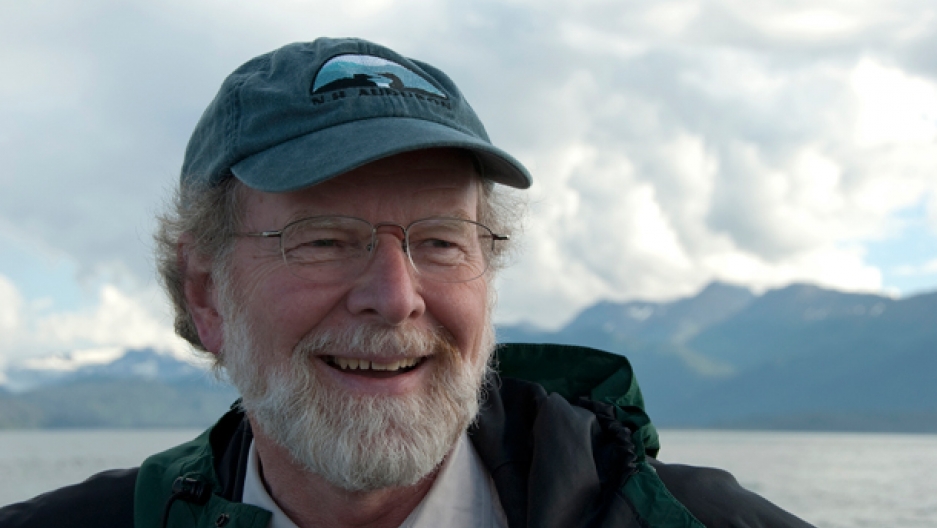
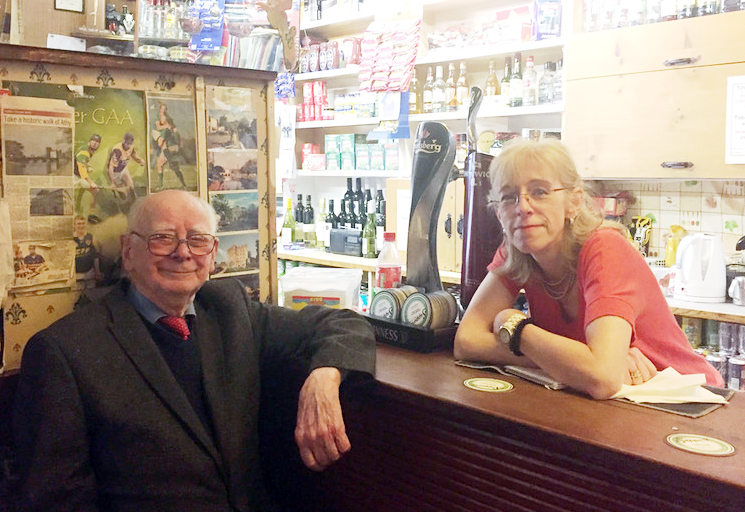
Source: Cameron Treleaven, Aquila Books, Calgary.

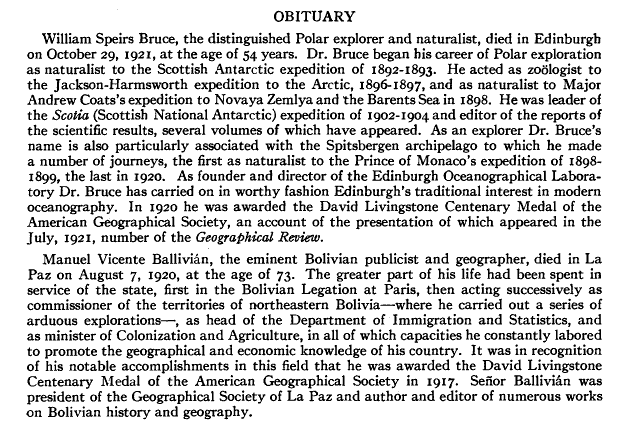 Source: The Geographical Review (American Geographical Society)
By Ted Jones
http://www.sailingscuttlebutt.com
[Contact Peter Webb at webb.3@osu.edu should you desire further information]
—Thanks to John Splettstoesser for sending this on, prepared by Peter Webb.
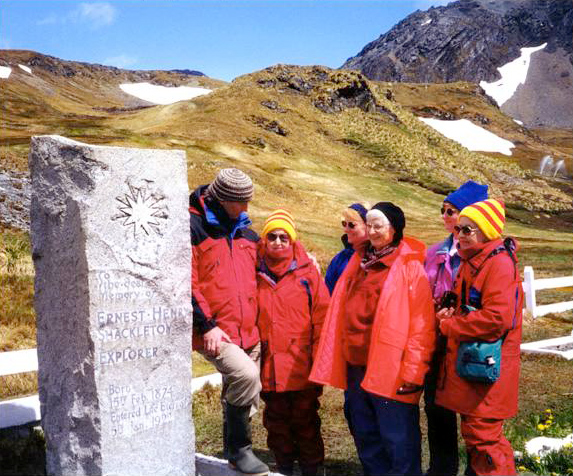
Some Endurance expedition descendants at Shackleton's grave in Grytviken:
Jonathan Shackleton, Adelie (or Toni) Hurley, Elizabeth Bakewell and her two daughters behind, Toni (or Adelie) Hurley.
Date: December 1999. Photo: R. Stephenson.
Source: San Francisco Chronicle, 10 January 2010. Thanks to Jeff Rubin.
Source: New York Times, October 11, 2009. Thanks to John Splettstoesser.
I had two very pleasant involvements with John: The first was assisting and encouraging him to donate a Union flag that was taken by Shackleton to within 97 miles of the Pole during the Nimrod expedition to the Scott Polar Research Institute where it hangs today in the Shackleton Library. The second was attending the auction of his polar collection at Swann Galleries and speaking the night before on collecting Antarcticana. He and Mrs Levinson were gracious hosts to me and other Antarcticans at the Lotus Club following the successful sale. See http://www.antarctic-circle.org/auctions.htm#27
(2 August 2012)
Dear Friends,
It is with profound sadness that I write to tell you that my beloved mother, Edith Maslin Ronne, best known as "Jackie" Ronne, died on Sunday, June 14, 2009, at 5:50 a.m. at Carriage Hill Nursing Home in Bethesda, Maryland. She was 89.
In recent months, Jackie had suffered a compressed spine fracture from slipping off of her living room chair. The pain led to two hospitalizations, the second of which lasted most of April and in to May. During that time, she developed all sorts of complications, including numerous infections. In the course of testing, they surprisingly discovered that she had an aggressive cancerous tumor in her lymph system by her neck. At the age of 89, she was not a candidate for any aggressive treatment. During this time of hospitalization and hospice care, her Alzheimer's disease accelerated and her mental state declined quickly; it was heartbreaking. She was unhappy and in pain at the end, so it is a blessing that she is no longer suffering.
Al and I, having been encouraged by the nursing home staff, decided to proceed with our 30th anniversary trip to Hawaii for three weeks, but now we have cut that short. However, son Michael with his fiance, Amanda, just arrived, so we are staying for a few days to enjoy Maui, returning home on Sunday.
About Jackie:
As many of you know, my mother, Jackie, was a pioneer in Antarctic history and known as "Antarctica's First Lady," also the title of her book. At the last minute, she went along with my father/her husband, Captain Finn Ronne, on his private expedition. On the Ronne Antarctic Research Expedition of 1946 - 1948, she became the 1st American woman to set foot in Antarctica, and with the wife of the expedition's chief pilot, became the first women to overwinter in Antarctica. She was the expedition's recorder/historian. They spent 15 months together with 21 other members of the expedition in a small station they had set up on Stonington Island in Marguerite Bay. She is the namesake of the Ronne Ice Shelf, (second largest on Earth) which was previously called Edith Ronne Land. Her husband, Finn, who discovered and mapped that previously unknown territory during his Expedition, named it in her honor.
Jackie returned several times to Antarctica, including on a Navy-sponsored flight to the South Pole in 1971 (she was the seventh woman at the pole), a 1995 trip back to her former base at Stonington Island as guest lecturer on the expedition cruise ship /Explorer/ and continued lecturing on cruises for a number of years. She made a total of 15 trips to the Antarctic. She also made a trip to Spitzbergen in the Arctic with her husband Finn, daughter Karen, and nephew Jahn. She loved to travel.
Jackie was a fellow of The Explorer's Club, a past president of the Society of Woman Geographers, honorary board member of The Antarctican Society as well as The American Polar Society, and active in other organizations, including The National Society of Arts and Letters and ARCS. She will be missed by many people, but especially her family - daughter Karen, son-in-law Al, grandson Michael, and granddaughter Jaclyn.
I have created an extensive webpage about her, with photos, etc. It is at: http://www.ronneantarcticexplorers.com/Edith_Jackie_Ronne.htm
The funeral service and celebration of Jackie Ronne's life will be as follows:
Wednesday, June 24
St. Dunstan's Episcopal Church
5450 Massachusetts Avenue
Bethesda, Maryland
(Located at the entrance to Sumner, one mile outside the MD/DC line)
http://www.stdunstansbethesda.org/
5:00 - 6:30 p.m. Viewing/Wake/Family Visiting - if you want to stop by and say "hello" but can't make the funeral, which follows at:
6:30 p.m. Funeral Service and Celebration of Life -
The service will be officiated by The Reverend Jeffery MacKnight with special music by friend and singer Mack Bailey (The Limeliters), whom my mother adored.
In lieu of flowers, memorial contributions may be made to either:
The Finn and Edith Ronne Polar Exploration Award (already established but renamed)
or
c/o The Explorers Club
46 East 70th Street
New York, New York 10021
The Edith Ronne Fellowship Fund (which is established by her will)
c/o The Society of Woman Geographers
415 East Capitol Street SE
Washington, DC 20003
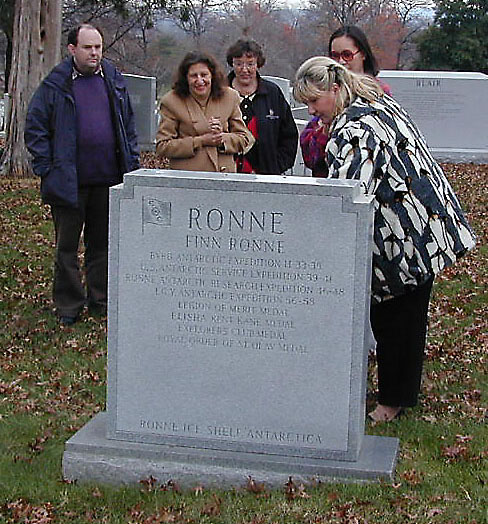
Finn Ronne's gravesite at Arlington National Cemetery.
David Wilson (grand-nephew of Dr Wilson), Myrna Fawcett, Jackie Ronne, Karen Ronne in her penguin coat
and, in the back right, Brenda Clough (writer on Oates). (Date: 2 Dec 2001. Photo: R. Stephenson.)
Sir Edmund Hillary, KG, ONZ, KBE, mountaineer and author, was born on July 20, 1919. He died on January 11, 2008, aged 88
"Hillary's success on Everest established him overnight as an acknowledged leader in the competitive field of high-altitude mountaineering. In 1954 he led a New Zealand Alpine Club expedition to the Barun Valley east of Everest. His gallant rescue of a comrade left him with broken ribs and an acute attack of pneumonia, but he was soon fit enough again to take part in the Commonwealth Trans-Antarctic Expedition (1955-58) led by Dr (later Sir) Vivian Fuchs.
This first overland traverse of Antarctica was combined with a strenuous scientific programme. Starting from Shackleton Base on the Weddell Sea, the main party under Fuchs was to cross the continent (about 2,500 miles) by way of the American station at the South Pole, to Scott Base on the Ross Sea in the New Zealand sector of the Antarctic. Hillarys task was to enlist New Zealand support for the project, to establish Scott Base, and to organise supply depots inland for the use of the crossing party on the second, longer lap of their journey. The entire success of the venture is part of polar history but it was not achieved quite as planned.
Instead of the main party's punctual arrival at the South Pole, while Hillary waited at the first depot on the home run, the New Zealanders, the first overlanders since Amundsen, drove their ramshackle Ferguson farm tractors into the American base two weeks before Fuchs rolled up in his stately purpose-built Sno-cats.
Hillary's dash to the pole, driving the last 70 miles non-stop and with only 12 miles of petrol in hand, is one of the classics of polar adventure. But the charge that he risked the success of the whole project by going ahead with so little safety margin has never been entirely refuted."
Source: http://www.timesonline.co.uk/tol/comment/obituaries/article3169991.ece
Friday June 15, 2007
The Guardian
Sir Wally Herbert, who has died aged 72, was one of the last explorers of the polar regions who was able to make major contributions to geographical discovery and research. From a family background of travel, and an early education in Africa, he spent time travelling throughout the Americas and Europe. His passion for polar regions began in the Antarctic and later extended to the Arctic, where he made the first crossing of the frozen ocean. As time went on, he made a gentle transition to become a writer and artist of the scenes he knew so well.
Wally was born in England into an army family, and went with his family to Egypt aged three, and then to South Africa for nine years. After finishing school, he joined the army, where he studied at the Royal School of Military Survey. Subsequently, he spent 18 months surveying in Egypt and Cyprus. From there he began a slow journey back to Britain through Turkey and Greece, drawing portraits for his board and lodging.
In 1955, he obtained a post in the Antarctic with the Falkland Islands Dependencies Survey (which became the British Antarctic Survey in 1961). He was based at Hope Bay station, near the northern end of the Antarctic Peninsula, where much of his work involved surveying which included glaciological studies. Field work was an essential component of this and most of his extensive traverses were made by dog sled; he became an expert in the care and running of husky dogs.
His longest journey was along the mountainous spine of the Antarctic Peninsula from Hope Bay (62°23'S) to Portal Point (64°33'S). This included transits of the notoriously narrow "Catwalk" and the "Waist", where the Herbert Plateau narrows abruptly. During these two years, he sledged some 5,000km. This was when, as with several of his contemporaries, he developed a persistent passion for the polar regions.
Wally's experience with dog sledding led him to a job with the New Zealand Antarctic programme, where his first commission was to go to the west coast of Greenland to purchase dogs for the Antarctic. During this time, he learned much of the Inuit methods of dog driving and developed an enduring interest in their way of life. He continued to the Antarctic to join the New Zealanders with his selected team of 13 dogs.
As leader of the 1961-62 southern exploration party, he surveyed a large area of the Queen Maud range, where he ascended the route up the Beardmore glacier, discovered by Ernest Shackleton in 1908 and followed by Captain Scott in 1911. A request to continue to the south pole was not sanctioned, so his programme was exploration of new territory southwards along the Transantarctic mountains. At the head of the Axel Heiberg Glacier, his party ascended Mount Nansen and descended by a similar route to that taken by Roald Amundsen in 1911, during which he found one of Amundsen's survey cairns. This was the first retracing of these historical traverses first accomplished during the heroic age of exploration. Wally returned to Britain in 1962 and wrote his first book about his experiences, A World of Men.
In 1963, he conceived an idea for a major Arctic expedition and began careful planning, including living with the Inuit in the far north-west. The following spring, he set out with three dog teams and four Inuit to trace the routes described by Otto Sverdrup (1898-1902) and Frederick Cook (1908-09). This led from Greenland to Ellesmere Island and proved a difficult test, largely across pack-ice, for men and equipment.
Wally's best known polar journey was as leader of the British Trans-Arctic Expedition (1968-69), with Allan Gill, Roy Koerner and Kenneth Hedges. Their equipment included four sleds and 40 dogs. The journey began from a base at Point Barrow, Alaska, where the first difficulty to be overcome was access from the shore to the constantly drifting Arctic ice fields. It was planned to make the traverse in three travelling periods, interrupted by the Arctic winter and the summer melt period, when travel over the pack becomes impossible.
After crossing some 1,900km of rough drifting ice, they established a summer camp, in July 1968, at 81°22'N 165°29'W, which became known as "Meltville". Unfortunately, they were not able to reach a position where the drift of the trans-Arctic ice-stream was in their favour (they were drifting around the north pole rather than towards it). This necessitated the expedition camping there for the winter, during which they continued to drift anti-clockwise but not much closer to the pole.
After midwinter, the floe on which they had camped broke in two and, in February, shattered. However, they had to remain until the sunlight returned before continuing the journey which passed the northern pole of inaccessibility. The geographic north pole was attained on April 6 1969. Wally and the other three were unquestionably the first men to have reached this point over the ice surface. From the pole, over difficult ice, they continued to Vesle Tavloya, the most northerly island of the Svalbard archipelago, which was reached on May 29 1969, 464 days from Point Barrow. Other than receiving air-drops, contact with the rest of the world was by radio only.
For this achievement, the first surface traverse of the Arctic, the longest traverse across the Arctic Ocean, reaching the northern pole of inaccessibility and north geographic pole, 6,700km over the pack-ice, Wally was awarded an Arctic bar to his Polar medal and received awards from the Royal Geographical Society and other institutions. His book of the expedition, Across the Top of the World, was published in 1969.
Shortly after his return, he married Marie McGaughey, and within two years they lived, with their baby daughter, Kari, on an island off north-west Greenland making a film about the Inuit hunters.
Greenland was again Wally's polar base when, between 1977 and 1979, he, with Allan Gill, attempted to circumnavigate the island by dog sled and umiak (traditional boat), beginning and ending at Thule. It was estimated that the journey would take 16 months and cover 13,000km. Difficult ice and weather conditions, however, made it impossible. On midsummer day in 1978, they were near Loch Fyne (East Greenland); Wally wrote: "We were forced to take to the land and haul the sledges across steaming tundra and rock bare of snow, swollen rivers, baked mud flats, sand-dunes, swamps and stagnant pools. We were blasted by duststorms and eaten alive by mosquitoes." Mesters Vig was ultimately reached, but the circumnavigation was abandoned, and has yet to be accomplished. Subsequently, he led filming expeditions to north-west Greenland, Ellesmere Island and the north pole for a second time (but by aircraft).
From this period, Wally's literary and artistic career began to dominate. He also lectured extensively. He made a specialised study of the north pole controversy (the problems of Frederick Cook in 1908 and Robert Peary in 1909), and although his analysis effectively resolved rival claims, The Noose of Laurels (1989) was not able to quench many of the passionate opinions. He also worked on his autobiography, The Third Pole, and on a book of his paintings, The Polar World (2007). He was knighted in 2000.
Wally is commemorated in the Antarctic by names of a mountain range and a plateau, and, in the Arctic, the most northern mountain of Svalbard also bears his name. He is survived by Marie, and their elder daughter, Kari, who has also developed a passion for the polar regions. Their younger daughter Pascale predeceased him.
• William Herbert, explorer, born October 24 1934; died June 12 2007
Source: The Guardian, 15 June 2007. http://www.guardian.co.uk/obituaries/story/0,,2103675,00.html
Note: There is an extensive obituary of Sir Wally Herbert by Charles Swithinbank in the December 2007 (Vol 174, No 4) issue of the Geographical Journal.
"When Peter Skellerup passed away in May, the City of Christchurch and the
Antarctic community, lost one of its most loyal supporters. A past member of
the New Zealand Antarctic Society and a Fellow (International) of the Explorers'
Club New York, Peter valued his Antarctic as-sociation.
(9 December 2006)
Director, Scott Polar Research Institute (1992-97)
"John Heap, who has died aged 74, was a scientist turned diplomat whose leadership and vision made a fundamental difference to the governance of the Antarctic and its conservation for future generations. His urbane manner, command of English and fund of good stories made his diplomacy seem effortless, but his understanding of procedural detail and determination to succeed made him a formidable opponent in negotiation.
(9 December 2006)
A Great Man Passes. We are saddened by the passing of a great man today, on the 23rd December 2005, Norman Vaughan passed away peacefully in Anchorage, Alaska; he was 100 years old.
Born in 1905, when Teddy Roosevelt was president and polar exploration was in its heyday, Norman was weaned on tales of Robert Peary, Roald Amundsen, and Sir Robert Falcon Scott. In 1925 he left Harvard to join one of his heroes, Sir Wilfred Grenfell in Newfoundland, bringing medical supplies by dog sled to isolated villages. He left school again three years later to go to Antarctica with Admiral Byrd - a bold move that changed his life.
The following appeared in the 24 December 2005 edition of the Boston Globe:
Norman's travel biography from the 2002 edition of the Harvard Travellers Club:
Guatemala, Central America, 1925; Newfoundland and Labrador (Dr. Grenfell's Mission), 1925, 1926; Little America, Antarctica, Byrd Antarctic Expedition, 1928-30; Labrador, Greenland, Baffin Island, 1941; Iceland, England, Scotland, Ireland, 1942; Belgium, France, Italy, Africa, 1944; Saudi Arabia, India, Thailand, Philippines, 1945; Egypt, Jerusalem, France, Ireland, 1947; Peru, Chile, Argentina, Brazil, West Indies, 1948; Japan, Philippines, Thailand, India, Pakistan, Saudi Arabia, Greece, Italy, Germany, Denmark, Norway, 1953; France, Algeria, Italy, England, Azores, Bermuda, 1954; Alaska, 1952 and twelve times since; Drove a snowmobile from Fort Yukon, Alaska (above Arctic Circle), to Boston, a distance of 5,700 miles in 40 days and nights (a world's record for longest single trip on a snowmobile), 1968; Went to Iran, as manager and coach of U.S. Polo Team, to celebrate 2,500th Anniversary of monarchy; was umpire in the games, of which the Iranians won three and the U.S. two, 1972. Moved to Alaska in 1973 for permanent residency. Stood on South Pole, November 27, 1979, to celebrate the 50th anniversary of Admiral Richard E. Byrd's flight over the South Pole. Have entered the 1,151-mile Iditarod sled dog race 13 times. Have gone to Greenland each year (except one) since 1981 to search for, excavate and salvage eight U.S. Air Force airplanes which were forced down without fuel in July, 1942. Found B-17 at 256 feet below surface of Greenland Ice Cap, but it was so damaged we didn't try to recover it. However, in 1990 we melted a shaft down to a P-38, took it apart, recovered it, and it is being reassembled in Kentucky. This plane will fly again. It was 266 feet below the surface. Residual from snow each year at this location is 5 to 6 feet. Visited Sweden, 1983 and 1984. Drove dog-team in the inaugural parades of Presidents Carter and Reagan and drove His Holiness John Paul II on his only dogsled ride. Spent two years preparing the Mount Vaughan Antarctic Expedition for austral summer 1993-94. Left October 26th with twenty sled dogs and thirteen people. DC-6 leased for trip crashed in Antarctica on first of seven scheduled flights. Will return to climb Mount Vaughan. Goal is to climb the 10,302-foot unclimbed mountain and summit on December 19, 1994, my 89th birthday.
Librarian of the Scott Polar collection, who eventually visited Antarctica
and gave his name to a glacier
(25 May 2004)
The voice of Dick Barton, Special Agent, who was also a highly respected
polar explorer
(25 May 2004)
Tuesday February 24, 2004
The Guardian, London
Virginia "Ginny" Fiennes, who has died of cancer aged 56, was highly respected in polar circles around the world. In 1985, she became the first woman ever to be invited to join the hallowed ranks of the Antarctic Club, and, two years later, the first to receive the Polar medal from the Queen. This was in recognition of her research work, especially into VLF radio propagation, for the British Antarctic Survey and Sheffield University.
Ginny's husband, the polar explorer Sir Ranulph "Ran" Fiennes, led many expeditions, in hot deserts and cold regions, through the last three decades of the 20th century. But it was his wife, whom he idolised, who originated and inspired the planning, had the final say in choosing the teams, organised the routes and schedules, was base leader in Africa, Arabia and the polar regions for many years, and specialised in communications.
She was not impressed by bureaucracy, never took "No" for an answer and, though slightly built, could make big men quake in their boots with a flash of her bright blue eyes.
Ginny was born Virginia Frances Pepper near Lodsworth, West Sussex, the third of the four children of Tom and Janet Pepper, whose family had, for 300 years, owned and worked the Amberley chalk quarries on the South Downs, now an industrial museum. She was only nine when she met Ran, then an unruly 12-year-old just arrived in a neighbouring village from South Africa; they married in 1970.
After school, Ginny took up deep-sea diving, but was recruited to work for two years in Wester Ross for the Scottish National Trust. She spent many months in the 1960s researching for Ran's travel books on Arabia, Africa and the Rocky mountains.
In 1968, she organised the first navigation of the Nile, the world's longest river, by prototype hovercraft, and, in 1971, the first transnavigation of British Columbia entirely by river, a four-month journey filmed by the BBC for the World About Us series. One night, awaiting the arrival of boats bringing up petrol and food, she was startled by a bear and shot through her own boot by mistake.
In 1972, Ginny was commissioned by Woman's Own magazine to live for two months with an Omani sheikh in a Jebel Akhdar village - the idea was that she should act as his third wife, though with a strict understanding that no carnal activities were involved. She grew to love her Omani family, lived entirely as they did, and decided not to submit any article out of respect for their privacy.
This episode was the start of Ginny's lifelong love of Oman, and she organised four expeditions with Ran to locate the lost frankincense city of Ubar, in Dhofar. This quest was finally successful in the early 1990s, two decades after their search began.
In 1972, Ginny suggested an attempt to circumnavigate the world along its polar axis. Ten years later, her dream finally succeeded, and the Transglobe expedition team became the first to reach both north and south poles, having crossed Antarctica, and the Arctic ocean through the North-West Passage, a journey altogether of 35,000 miles lasting three years. The band of expedition colleagues from those days remained Ginny's close friends, among them Anton Bowring, Charlie Burton and myself. Prince Charles, patron to the expeditions for 15 years, also became a friend.
To become Britain's most experienced polar radio operator, Ginny was trained by expert Jack Willis at Royal Aircraft Establishment (Cove) Farnborough, then took marine radio officer courses and joined the WRAC Territorials. She set up and maintained 80ft radio masts in the Arctic and Antarctic, often in high winds and temperatures of -50C. In Antarctica in 1980, she was instrumental in saving the lives of a group of South African scientists lost to the north of her isolated base.
Ginny was tough, and knew what she wanted. As Ran's fiancée in 1968, she managed to get an interview with Britain's top literary agent, George Greenfield. But she arrived at the meeting with bleeding knees, having slipped down the steel-edged steps at Holborn tube station in her miniskirt and cut her legs. Greenfield was so impressed by this fiery envoy that he agreed to take Ran's first book sight unseen.
On another occasion, while discussing an offer from the Observer for exclusive coverage of her Transglobe expedition, Ginny confronted a committee of 18 senior polar gurus, including Sir Vivian Fuchs. After Greenfield had announced the newspaper's offer - 20% revenue from foreign rights to accrue to the expedition, and 80% for the Observer - Ginny managed singlehandedly to persuade the editor Donald Trelford's executives to switch the figures around and give 80% for the expedition.
Even in bad times, her sense of humour was never far away. When she heard that Ran was to have five fingers amputated because of frostbite, she commented, "Oh damn, now we'll be shorthanded on the farm." And despite her sometimes forceful manner, Ginny was known to her many friends and godchildren for her gentleness, integrity and generosity. A modest and private person, she hated being in the spotlight, and never took credit for her achievements.
She loved all animals, and her Jack Russell terrier Bothie, beloved by a generation of Blue Peter fans, became the first dog to travel to both north and south poles -an achievement recounted in Ginny's bestselling book, Bothie, The Polar Dog (1984). In 1981, Ginny saved a St John's Water Dog puppy from an Inuit annual cull in Tuktoyaktuk, and brought her back to Britain to found a new breed. There are now some 50 descendants, which are much in demand.
In the 1980s, Ginny moved with Ran to Exmoor national park to raise pedigree Aberdeen Angus cattle and a flock of black Welsh Mountain sheep, turning herself into a highly proficient hill-farmer (at 1,400ft, one of the highest working farms in the south-west). Her cattle, traditional but not old-fashioned, are sought after by breeders all over the UK and have won many awards at major cattle shows.
Right up until her death, Ginny was planning new expeditions abroad and new cattle-breeding projects at home. Her cancer was diagnosed last November, on the day after Ran returned from running seven marathons in seven days on seven continents with Dr Mike Stroud, raising funds for the British Heart Foundation four months after Ran himself suffered a massive heart attack and double bypass surgery.
Lady Virginia Twisleton-Wykeham-Fiennes, explorer, born July 9 1947; died February 20 2004
--Sent by Antony Bowring, who with his wife Jill, was a member of the Trans-Globe expedition.
(29 January 2007)
For more on Ginny Fiennes, go to the
Transglobe Expedition website
(25 September 2003)
Appearing in the May 2003 issue of The James Caird Society Newsletter.
(17 November 2002)
Gibbs served on Adm. Richard Byrd's third expedition to the South Pole in 1939, becoming the first African American in Antarctica. He was one of 40 Navy men selected from 2,000 applicants to sail with Byrd on the USS Bear, a rickety, wooden ship that had been made into a museum before it was retrofitted for the South Pole voyage.
After three Antarctic expeditions, he was a World War II gunner in the South Pacific.
Following his naval career, Gibbs graduated from the University of Minnesota, and moved to Rochester in 1963 to work for IBM. After retiring, he managed his own employment agencies.
Gibbs helped organize the Rochester chapter of the NAACP 35 years ago and worked tirelessly for civil rights.
In 1974, Gibbs made national news when the Rochester Elks Club denied him membership. He was the first African-American to apply to the local club, and he helped break the color barrier at service clubs in Rochester."
As my son will shortly be participating in a centenary expedition to
recreate the original expedition plus the last 97 miles to the South
Pole, I have recently been taking renewed interest in my grandfather's
life, including any records on the web.
For your information, "The Mate", as my grandfather was better known,
was born on 6th March 1880 and he died in London on 30th April 1962.
I attach a copy of the address given by his friend Lord Boothby at his
memorial service.
— 17 July 2007
Address given at the Memorial Service on 25th May 1962 for Commander Sir Jameson Adams KCVO, CBE, DSO, RD, RNR at St James' Church, Piccadilly by Lord Boothby KBE, LLD.
"A few weeks ago a familiar figure, in a curled billycock hat and a coat cut to a fashion that no longer exists, came up to me and said: 'I have got some bad news for you, Mate. I have decided that, if they give me a Memorial Service, you are to make the Address.'
Not unnaturally, I was pleased, because it betokened the friendship of a man whose regard I would rather have had than that of anyone else in the world. Nor was I apprehensive, because not for a long time had I seen him look so well, or in better spirits. Little did I realise that the hour of fulfilment would come so soon.
The career of Sir Jameson Adams was astonishing; and, indeed, unparalleled.
He joined the Merchant Navy in 1893 (having run away from school at the age of 13), and the Royal Naval Reserve in 1895. He was one of the last to gain a Master Mariner's Certificate under sail. In 1907 the Captain of HMS Berwick sent for him and said:
'Look here, Adams, put on your frock-coat and sword tomorrow morning. I'm going to take you aboard the Drake to see Prince Louis. Arrangements have been made to give you a permanent commission in the Royal Navy with the requisite seniority, and your career is made.' He went down to the wardroom to celebrate, with - in his own words - 'the greatest joy in the world'.
Minutes later a signal came from Shackleton, whom he had met only once, two years before, but had talked to for several hours, asking him to go as second-in-command of the Nimrod Expedition to the Antarctic. Immediately he went up to the bridge and said to the Captain: 'Sir, I've changed my mind: this is my offer and I'm going to take it.'
For what reason? Little interest in the scientific side, or in the theory of meteorology. He didn't even believe that the records he was to make were of any consequence. 'I had an interest.' he said, 'in trying to see that England got where she should get -- to the South Pole, and first.' They got within ninety miles.
And then: 'I always remember, on the worst part of the journey, when we were camping up for the night, having had a hell of a day, my book of records blew away, and Shackleton said to me: 'You must go after it, Bill; no good going home without the records.' So I had to turn to and skid down the crevasses and get my little logbook with all the records in. He appreciated it very much.' I should think he did!
Bill Adams was by nature something of a hero-worshipper; but he gave it, wholeheartedly, to two men alone.
First to Shackleton. After the return of the Nimrod Expedition, they drifted apart. It was inevitable. Adams went to establish the Labour Exchanges in the North-East of England. Shackleton was lionised by Edwardian Society and wanted to make money, and - as Sir Jameson said - 'went off lecturing all over the place'. This was no good for the Mate, who hated the limelight and avoided it all his life. But the final verdict, given almost half a century later, stands. Shackleton was, in his eyes, 'the greatest leader that ever came on God's earth, bar none.'
Second, to Admiral Hood. He was his Flag Lieutenant when he commanded the Dover Patrol at the beginning of the First World War; and Sir Jameson was rightly convinced that a great injustice had been done to his Chief when he was relieved of his command in 1915. It was, indeed, the only subject on which I ever heard him speak with bitterness.
Amends were later made to Admiral Hood by the Admiralty, when he was appointed to the command of a Battle-Cruiser Squadron. By this time Sir Jameson had been recalled to do a special job at the Ministry of Munitions; and went on from that to the Naval Siege guns off the Flanders coast, where he won the DSO and Croix de Guerre. (A bad wound necessitated his return home in 1917).
So it turned out that he escaped death, by a narrow margin, on two occasions. If Shackleton had delayed his decision to turn back by more than an hour, they could not have got back. Hood led the Battle Fleet into action at Jutland. If 'The Mate' had still been with him, as he would have wished, he would have gone down in the Invincible, standing by the side of his beloved Admiral.
The rest of the story can, and must, be recounted briefly. After the war he returned to the Ministry of Labour, as Controller of the North-Eastern Division. He cared passionately about the ravages of sustained mass unemployment; and, above all, about its effect on the young generation. He concentrated his energies upon the promotion of emigration to the Colonies, and the Boys Club Movement. His success, achieved by sheer energy and force of personality, was never in doubt. The Duke of Windsor once told me that no-one made him work harder, as Prince of Wales, than Sir Jameson Adams; and that was saying a lot.
In 1935 he was appointed Secretary to King George's Jubilee Trust; and this was yet another success story. I need hardly say that the Second World War found him back with the Royal Navy, in Contraband Control, first at Aden, later in Gibraltar.
We come now to the last phase of his almost incredible life. As Honorary Appeals Secretary to the King Edward VII Hospital -- or, as I prefer to call it, Sister Agnes' -- he raised a sum of money which must have amounted to something in the neighbourhood of half a million pounds. It is today a living and permanent memorial to him, and to his life's work.
'I am not a bad beggar', he once said, and he might just as easily have used another not dissimilar word. It was an under-statement. I wonder if any man has ever raised so much money for charitable purposes, by his own unaided efforts; and taken nothing -- but nothing -- for himself. You and I know how exhausting it is to visit patients in hospital, even when they are our best friends. He did it every day; bringing hope and comfort and cheer to all.
I vividly remember him saying to me, about four or five years ago, when I was ill and felt it: 'You don't look very well, Mate. I think you'd better come back to 'the Dump' (Sister Agnes') for a bit. We'll do our best to stop you killing yourself. And if we fail' - this with a twinkle in his eye - 'the box is always ready.' From that moment I never looked back.
Loving and lovable; courageous and kind; trenchant and humorous; rough and tender; pirate and saint; a life of selfless devotion to to the service of others; and, underlying it all, a heart of pure gold. You can hardly beat that.
We therefore do well to pay tribute to the memory of this extraordinary man, who made no enemies, and countless friends."
But as well as being a man of action and resource, he had an original and independent mind. Nothing pleased those within his intimate circle more than to get him to tell a story. The material always came from some adventure of his own. Yet he always told the story through the mouth of another. It would usually start: "I once knew a man who…" and then would follow a perfect gem: a narrative not merely exciting in terms of action or suspense, but shrewd in psychological situation and reaction. And always it would be told in short, almost staccato, sentences, with the expression of a poker player. He could never be persuaded to write his memoirs though he did, in recent years and most reluctantly, allow notes to be taken at his dictation.
His loyalty to his friends, his gallantry—he served with distinction in both world wars, first with the RFC and then with the RAF—and the unembittered courage with which he continued to meet the difficulties of a world which gave little recognition in peace to men of his mould—leave to us who shared in one way or another his various life the memory of a rich, rewarding and abiding spirit.
He leaves a widow—formerly Lady Joan Chetwynd-Talbot, a sister of the Earl of Shrewsbury—and a small daughter.
Source: The Times, 30 August 1954. Provided by Stephen Haddelsey.
HOME
Темпоральные коды доступа создают одноразовые ссылки для входа. Сгенерировать код можно в https://www.uniaomedica.com.br/. Временный токен действует один час и не требует ввода пароля, что снижает риски перехвата учетных данных.