ANTARCTIC PHOTOGRAPHY and FILM
Launched: 29 November 2002. Last updated: 4 September 2016.
Accessed at least  times since 4 May 2008.
HERBERT PONTING; PICTURING THE GREAT WHITE SOUTH By Maggie Downing, CUNY City College. (2014) Master's Thesis. Paper 328.
Michael Rosove e-mails to say:
"In doing some online searching regarding Ponting's film 90 Degrees South, I came across this outstanding thesis produced in 2014 and made available online by the author and CUNY."
(4 September 2016)
Photography Comes to the Polar Regions—Almost
by Glenn M. Stein, FRGS. ©2007 & 2012.
To reproduce or distribute, visit: http://gmsteinfrgs.icopyright.com
Of all the images of the polar regions throughout time, none have matched the wide-ranging influence produced by the camera's eye. Until now, the story of photography's introduction to frosty climes has never been fully told.
Frenchman Louis-Jacques Mande Daguerre was the first to permanently record and fix an image with an exposure time to make it a commercially viable photographic process. His first daguerreotypes were created as early as 1834, after five years in experimentation with fellow inventor Joseph Nicéphore Niépce (who had died the previous year). Niépce is universally credited with producing the first successful photograph in June/July 1827.
Though Daguerre announced the invention in the Journal des artistes on Sept. 27, 1835, he continued working on the process to perfect details, and it was not until 1838 that his experiments had progressed to the point where he felt comfortable showing examples to selected artists and scientists, hoping to secure investors. In that year there was an attempt to float a company which would buy out the process, and a subscription was opened from March 15 to April 15, the valuation being put at 200,000 francs; but no one came forward to invest.
Daguerre decided to appeal to the government, and succeeded in interesting noted astronomer and politician François Arago, who became a great admirer of the new art form. The invention was publicly announced by Arago on Jan. 7, 1839, and he formally revealed the process at a joint meeting of the Academy of Sciences and Academy of Fine Arts on August 19. King Louis-Philippe signed a law earlier that month granting Daguerre and Niépce's son pensions for life.
To begin with, a silver-coated copper plate was exposed to iodine fumes, inserted into a camera obscura (Latin - dark chamber) and then directed at the intended subject. Depending on lighting conditions, the exposure times for the earliest daguerreotypes ranged from 10 to 20 minutes (references vary widely on this point), thus ruling out the recording of moving objects. Rendering a visible image meant another series of chemical fumes and a solution, before rinsing in hot distilled water. Afterward, the delicate surface of the plate needed to be protected under glass in a wooden frame.
Handling highly toxic chemicals and fragile equipment aboard a cramped sailing ship at sea would have been a challenging thing indeed. What's more, there was a serious drawback to the daguerreotype process. Once you got an image, it was not possible to produce prints: one exposure equalled one image.
It would therefore seem highly unlikely that Jules Dumont d'Urville could have carried a daguerreotype apparatus with him in the Astrolabe and Zéléé (Zealous), during his South Seas and Antarctic Expedition 1837-40. The ships left Toulon on Sept. 7, 1837, and Daguerre did not even start seeking investors for his photographic process until the following year. The Astrolabe and Zélééreturned to Toulon on Nov. 6, 1840.

The Astrolabe and Zéléé are curiosities for Adélie penguins near the coast of Antarctica.
Still, it was worth scanning d'Urville's writings and expedition illustrations for any references to early photography. There are several descriptions of landings to take magnetic observations, in the quest to fix the position of the magnetic pole, but no mentions of taking photographs. Below are detailed sections from larger images, and it is assumed all of the pieces of equipment shown are scientific instruments; in fact the one on the upper left appears to be a surveying compass:

However, it is intriguing to note that daguerreotyping was used in creating lithographic plates of some of the scientific results from the French expedition. The finely detailed 3-D lithographs are some of the earliest uses of photography to present Europeans with a scientific view of a world very different from their own.
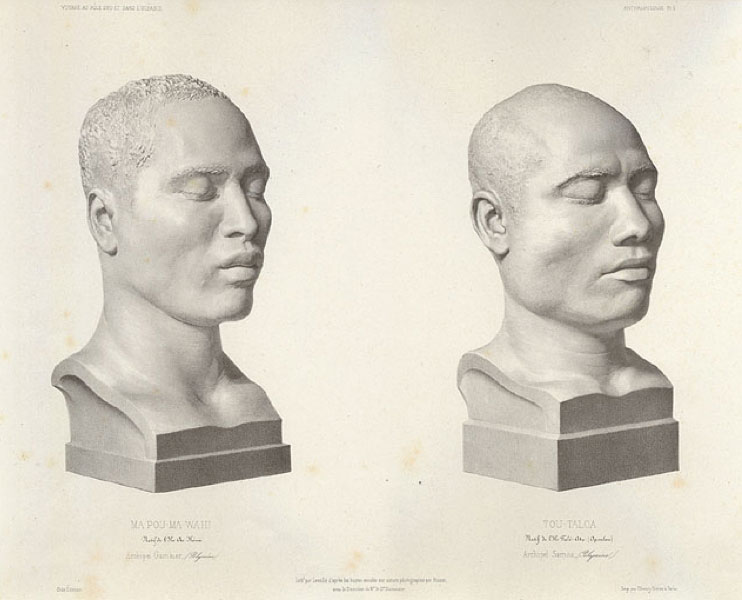
Natives of Samoa and Ao-Kena (1841). Large lithographic plate reproducing two daguerreotypes by Louis-Auguste Bisson (c. 1841) of life-casts of Polynesians from Samoa and Ao-Kena. With printed attribution "Voyage au Pôle Sud & Dans L'Océanie/ Anthropologie, Pl. 16/Gide Èditeur/Lith par Léveillé d'après les bustes moulés sur nature, photographié par Bisson, sous la Direction de Mr. le Dr. Dumoutier/Imp. par Thierry Frères a Paris." The subjects are identified in the image as "Ma-Pou-Ma-Wahi, Natif de l'Ile Ao-Kena, Archipel Gambier (Polynesie)/Tou-Taloa, Natif de l'Ile Fale-Ata (Apoulou), Archipel Samoa (Polynesie)."
Turning to James Clark Ross' narrative of his 1839-43 Antarctic expedition, no photographic outfit appears in its inventory, but one of his medical men later noted just such an apparatus for posterity. Dr. Joseph D. Hooker was lecturing about the historic expedition at the Royal Institution of South Wales in 1846 when he offered these words:
I believe no instruments, however newly invented, was omitted, even down to an apparatus for daguerreotyping and talbotyping, and we left England provided with a register for every known phenomenon of nature, though certainly not qualified to cope with them all.
The responsibility for any photographic equipment fell upon the expedition's medical men. At the time, the practice in the Royal Navy was for medical officers to double as scientists on such voyages, and under the conditions, coping with new inventions was challenging for these gentlemen—HMS Erebus: Surgeon Robert McCormick (zoology and geology); Assistant Surgeon Joseph D. Hooker (botany)—son of botanist Sir William Hooker; HMS Terror: Surgeon John Robertson (zoological and geological research); Assistant Surgeon David Lyall (botanical research).
The Antarctic expedition grew out of the eighth meeting of the British Association for the Advancement of Science in August 1838, when a committee was appointed to represent to the British government a series of resolutions adopted by the Association related to terrestrial magnetism (of central importance to the voyage). One of the committee members was noted astronomer Sir John F.W. Herschel, who made numerous contributions to the development of photography. In fact, it was Herschel who coined the term "photography" in a paper presented to the Royal Society in March 1839; he was also the first to use the terms "positive", "negative" and "snap-shot".
Herschel became an important link in obtaining daguerreotype equipment for the Antarctic expedition. Daguerre's discovery was made known in January 1839, and several Parisians viewed his images, but the technique was still Daguerre's secret. During a visit to Paris in May, Herschel was shown examples of the new process, and this exposure had marked importance for the near future.
Herschel wrote Daguerre on August 1, on behalf of The Royal Society, asking to purchase, "...an apparatus with the proper Camera Obscura and 100 plates properly prepared to receive impressions, and with instructions for its use...If the request appears to you extraordinary, the circumstances of the case will explain it." Herschel continued:
Captain Ross (the discoverer of the Northern Magnetic Pole) is about to proceed on a Voyage of Discovery and circumnavigation of the Antarctic Pole, in command of two Ships, the Terror and Erebus, admirably equipped and every way furnished with instruments of Science and Art. Now the Council of the Royal Society are earnestly desirous that the Expedition should sail provided with the invaluable resources furnished by the Daguerrotype process—for depicting scenes they may visit—and as it will be yet 3 weeks before the sailing of the Ships, and it has been stated that within that time your process will probably be divulged--they consider that the importance of the occasion justifies this direct application to you.
I shall hope for your early reply, and that it will be such as to enable me to announce to the Council that the apparatus and instructions will be forwarded in time (ie to arrive before the 20th August, inst.) Should you wish that the instructions should yet remain for some time secret you may send them sealed and may rely on them not being opened till the Ships have passed the Cape of Good Hope—In that case you will have the goodness expressly to write to that effect.

1) HMS Erebus and Terror in an Antarctic gale
There is no record of Daguerre's reply, but Hooker's statement during his lecture implies the inventor granted Herschel's request. Details of Daguerre's process were made public at a meeting of the French Academy of Sciences in Paris, on August 19, which was around the time Herschel indicated to Daguerre that the Erebus and Terror were to set sail. In fact, they did not finally depart until September 30, so Herschel ended up having a greater window of opportunity to obtain daguerreotype equipment than he indicated to Daguerre.
The possibility also exists that the Antarctic voyagers may have encountered the daguerreotype during the expedition, while visiting far-flung parts of the Empire. The Erebus and Terror spent southern winters in Tasmania, Australia and New Zealand. Ross reached Hobart, Tasmania, on April 7, 1841. He left Hobart on July 7, with the next port of call being Sydney, where the expedition arrived on July 14. The ships sailed from that place for New Zealand on August 5, arriving off the Bay of Islands on the 17th (mooring near the whaling port of Kororarika). The Bay of Islands was the first British settlement in New Zealand, and the Erebus and Terror did not sail south again until November 23.

2) Rossbank Observatory (Hobart, Tasmania)
The date of the earliest daguerreotype outfit in Tasmania is uncertain, but a Hobart printer named Thomas Browne is thought to have been the first resident professional photographer, opening a daguerreotype studio in his shop in 1846.
However, the time and place of the camera's first arrival in Australia is intriguing. The Australasian Chronicle announced on April 13, 1841, that a daguerreotype apparatus had been brought to Sydney by one Captain Lucas (Capt. Augustin Lucas, a French merchant mariner, arrived aboard his brother's ship, the Justine). The same Chronicle article continued on, relating that "...Captain Lucas intends to dispose of the instrument at prime cost...", and this resulted in the earliest documented daguerreotype on the continent being taken in Sydney by mid-May.
Interestingly, the Justine made a stopover at the Bay of Islands before arriving at Sydney on March 29; and there was a later viistor worth just a mention. On October 20, the French corvette Héroine anchored off Kororarika, and her captain visited the Erebus (with Ross returning the compliment the following day). The Frenchman spent only two or three days at the anchorage before sailing off on her mission of protecting French whaling vessels and a related task.
In addition to the daguerreotype, Dr. Hooker spoke of "talbotyping", using the word in the sense of a generic term for photography on paper. Hooker was actually referring to William Henry Fox Talbot's primitive photogenic drawing technique, which was a cameraless process. Small objects, such as leaves, could be placed on sensitized paper and exposed to sunlight. This produced a light image of the object against a dark background—a negative image—but nothing more advanced which would be recognized as a true photograph.
At the same time, Talbot had managed to produce very simple negative images on paper in a camera by extremely long exposures of stationary objects (see Talbot's letter to Ross below). Advancements in the process by the fall of 1840 resulted in what Talbot called calotyping (from the Greek kalos, meaning beautiful), but dubbed talbotyping by the British inventor's friends. Calotyping led directly to modern photography through the chemical development of a latent image in a negative, thus allowing the production of multiple positive prints.
In the summer of 1839, Talbot sent photogenic drawing examples to Hooker. Replying from Glasgow on June 21, the doctor was most pleased with "the imitation of an etching.", and asked, "Can that be made available for Botanical drawing?". Though Hooker further remarked that one image of a flower "was very pretty as to general effect," he pointed out the lack of detail (all-important to a botanist): "it did not express the swelling of the flower, nor the calyx, nor the veins of the leaves distinctly. When this can be accomplished as no doubt it will, it will surely become available for the publication of good figures of plants." Talbot's lifelong interest in botany surely gave him an appreciation of Hooker's comments.

3) Copy of Le Vesconte sketch of Erebus and Terror in 1845
In July, Talbot wrote to Surgeon Robert McCormick (Hooker's immediate superior aboard the Erebus), offering to give both doctors instruction in the photogenic drawing technique. Writing from onboard the Erebus, McCormick responsed glowingly on the last day of the month, "that we shall be most happy to avail ourselves of your friendly aid, in an art which promises to be of incalculable value in delineating the various objects of Natural History, which we may meet with during our voyage to the Antarctic Regions; more particularly in obtaining faithful representations of those evanescent forms, inhabiting the Ocean, which this expeditious and beautiful process is so well fitted to preserve". McCormick further notes that Capt. Ross had given both medical men permission to be away from the ship at the same time on August 5 or thereafter, thus paving the way for instruction in the process.
It is worth noting that even though McCormick enthused to Talbot about his drawing process prior to the expedition, during the voyage, Hooker largely tookover responsibility for his superior's zoology department. Hooker wrote to his father on March 17, 1840, that he and McCormick "are exceedingly good friends", but the good doctor "seems to care too little about Natural History altogether to dream of anything of the kind;... He takes no interest but in bird shooting and rock collecting; as of the former he has hitherto made no collection, I am, nolens volens [whether willing or unwilling], the Naturalist".
On August 22, Talbot wrote to Ross from London:
Dear Sir
Hearing that you had some intention of making drawings in the Southern Regions with the Camera Obscura I would have offered any assistance in my power to you but that I knew you could not possibly spare the time that would be requisite.
I enclose a little sketch made with a camera of my house in the country [Lacock], of which I request your acceptance.
I wrote at some length to Mr Mc Cormick who was desirous of putting in practice my method of [photogenic] drawing, but I have heard nothing from him in reply, I presume therefore that my answers to his inquiries were sufficient, & that he did not want any further information. I only mention this lest my letter to him should have miscarried.
I am dear Sir
yours most truly
H.F. Talbot
with all good wishes for the success of the expedition
The letter is marked "ans. 23d", but Ross' reply is not among the nearly 10,000 letters to and from Talbot handled by The Correspondence of William Henry Fox Talbot Project, and its whereabouts is unknown to the author.
Talbot and Herschel were friends who compared notes as they worked, and it is certainly conceivable that Herschel told Talbot about his letter to Daguerre just three weeks previous, asking to purchase a photographic apparatus for the expedition. In addition, Talbot appears to make reference to a reply to McCormick's July 31 letter, but I am unsure on this point.
In his 1846 lecture, Hooker noted a single apparatus being taken on the expedition for daguerreotyping and tablotyping, but Talbot's August 22 letter to Ross certainly implies the offer of a camera. We do not know Ross' reply the following day, and as the expedition did not sail until September 30, one of Talbot's cameras may have made the voyage after all. As an aside, the National Museum of Photography, Film and Television in Bradford (UK; part of the Science Museum) has a Daguerre camera used by Talbot for his own process, though it lacks the Daguerre label. Daguerre's cameras always had labels with his signature on their sides, but the suspicion is that Talbot removed it from this camera.
Sadly, no known photographic images from Ross' expedition have survived. Despite McCormick's and Hooker's enthusiasm prior to the voyage, perhaps the complex and tedious new processes proved too discouraging on such an arduous voyage. As Hooker commented afterward regarding the many instruments brought on the expedition, "...we left England provided with a register for every known phenomenon of nature, though certainly not qualified to cope with them all." But taking it one step further, a deeper understanding of Hooker's situation puts things into context.
Remembering that Hooker was not a sailor, life aboard a naval vessel was in itself a whole new world for the 22-year-old. He had only just completed his medical exams before the start of the journey, and as an assistant surgeon was subject to naval discipline and had shipboard duties, in addition to his botanical work. He was also a volunteer in the neglected department of marine zoology, and in writing to Dr. Bruce of the Scotia expedition seventy years later, he revealed that, "I was the sole worker of the tow-net, bringing the captures daily to Ross, and helping him with their preservation, as well as drawing a great number of them for him."
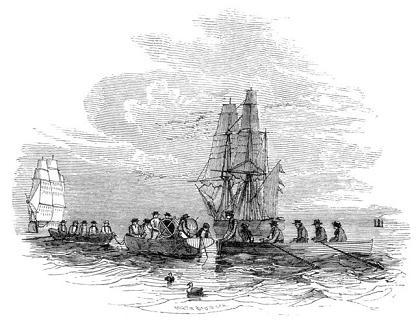
4) Deep sounding with ship's boats
Dr. John Richardson (Arctic explorer, author of many books and reports on exploration and natural history of the Arctic, and a friend of Hooker's father) had warmly encouraged young Hooker in the work; skill with the pencil being a special qualification in dealing with sea creatures which could not be preserved. "To add to our knowledge of the structure of animals," he insisted, "is the most certain way of attaining a scientific reputation; to be the first to discover or name a new species is a very secondary matter."
In writing his father on March 17, 1840, one can appreciate young Joseph's line of thinking:
Since leaving St. Helena, my time has been employed exactly as before; the net is constantly overboard, and catching enough to keep me three-quarters of the day employed drawing; the dissections of the little marine animals generally take some time, as they are almost universally microscopic. Though I never intend to make anything but Botany a study, I do not think I can do better than I am doing; it gives me a facility in drawing which I feel comes much much easier to me; it pleases the Captain beyond anything to see me at work, and, further, it is a new field which none but an artist can prosecute at sea ...
My collection amounts to about 200 drawings done from nature under the microscope. ... As I am learning to use my left eye to the microscope, I do not find my eyesight affected even by candlelight.
Thus, perfecting his drawing skills was essential to Hooker's future career as a scientist, and this had to be weighed against experimenting with new photographic processes. Joseph Dalton Hooker became the most important British botanist of the 19th century and lived until 1911. He was one of Charles Darwin's closest friends and eventually succeeded his father as director of Britain's Royal Botanic Gardens at Kew in 1865.
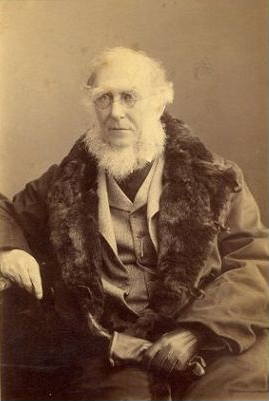
5) Joseph D. Hooker in 1896 (courtesy of Dr. Daniel Weinstock)
Artistic ability was hardly confined to men like Hooker and the other doctor-scientists. Second Master John E. Davis on the Terror was not only responsible for drawing the fair charts from the surveys, but his renderings of Antarctic scenes were used to illustrate most of Ross' narrative. Hooker considered Mate Joseph Dayman (Erebus) to be the best artist on either ship; Dayman also contributed a few illustrations to the narrative, as did Hooker. In the fall of 1840, Dayman was appointed an assistant at the observatory in Hobart, and did not return home from that place until 1844, thus missing all of the Antarctic journeys. One wonders if Davis and Dayman pondered their artistic skills versus the camera's possibilites?
In the end, the Antarctic expedition left a "photographic" mark on Antarctica when Ross christened Mount Herschel in 1841 (3,335 metres/10,942 feet), never realizing the irony between the mountain's namesake and a missed opportunity to possibly capture the first photographs of the Subantarctic and Antarctica. Nearly 120 years later, the UK Antarctic Place-Names Committee honored other notables in 1960 by naming Daguerre Glacier, Niépce Glacier and Talbot Glacier. Joseph Niépce was a photography pioneer who is universally credited with producing the first successful photograph in June/July 1827. Partnering with Daguerre in 1829, Niépce died only four years later.
Fewer than two years after returning from service in southern climes, the Erebus and Terror set out from England in May 1845 on a North-West Passage expedition under Sir John Franklin—allowing photography another opportunity to make polar history.
At Franklin's request, a complete daguerreotype apparatus was supplied by Richard Beard, a popular London photographer. It was Lady Jane Franklin's desire that Beard produce two images each of Sir John Franklin and his officers, taken on the Erebus prior to the voyage. One set was presented to Lady Franklin, while Beard kept the other; the former resides in the Scott Polar Research Institute, while the latter rests with the Derbyshire Record Office, Matlock. Commander Francis R.M. Crozier was second-in-command and onboard the Terror during Ross' Antarctic expedition; while he was in the south, Crozier was promoted to Captain.
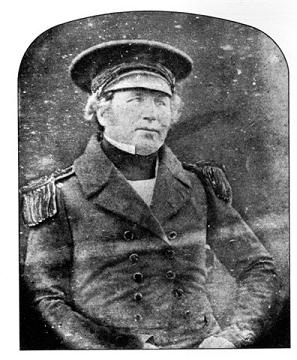
6) Capt. Francis R.M. Crozier (HMS Terror)
The ships arrived at the Whalefish Islands, Greenland, on July 4 and departed on the 12th of that month, and a copy of an obscure sketch connected to this stopover was spied by the author early in 2006. Originally rendered by an officer of the Erebus, it is titled H.M. Ships 'Erebus' and 'Terror', Franklin Expedition. by Lt. Henry Thomas Dundas Le Vesconte, R.N., one of the above expedition. Taken at Boat Creek, Whale Island [Whalefish Islands], July 12th. 1845. At first glance, there is nothing remarkable about the drawing of two ships at anchor in a small harbor, but on closer inspection of an outcropping of rocks, one's curiosity is barely suppressed. On the rocks there is a man slightly bent down behind a tripod with something atop, evidently oriented toward the ships—a camera? Maybe.
In Franklin's last dispatch to the Admiralty (dated July 12, from the Whalefish Islands), he wrote, "The magnetic instruments were landed the same morning [July 4]; so also were the other instruments requisite for ascertaining the position of the observatory...". Commander James Fitzjames, in a July 6 letter wrote that, "Levescomte (sic) and I on the island since six in the morning, surveying.", so it may also be a surveyor's transit in the sketch. According to Le Vesconte's caption, he drew it on the day the expedition departed the islands, so the question is: Would there have been surveying up until the day of departure? Alternately, in the center of the picture, there is a man standing by a ship's boat at water's edge, so perhaps the man on the rocky outcropping was brought ashore to take a photograph before the expedition departed?
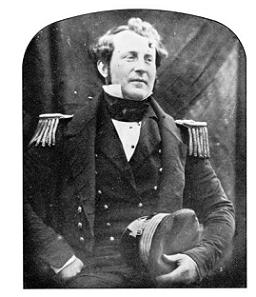
7) Commander James Fitzjames (HMS Erebus)
However, the sad reality of the expedition's disappearance blinded any hope of ever seeing historic photographs. In the end, though detailed portraits of the Queen's explorers put a human face on the Franklin Expedition, they represent the only photographs connected to the voyage. Among the many varied relics and bones recovered over the years by searchers, no part of the daguerreotype apparatus, or any plates, were ever found.
During the vain search for Franklin and his comrades, polar photographs finally materialized, painting in black and white the stark realism of northern climes, native peoples—and European intruders.
Acknowledgements
Dr. Dominique Dirou
Dr. Jim Endersby
Royal Botanic Gardens, Kew
Dr. Daniel Weinstock
Wellcome Library for the History of Medicine
Mr. Derek Wood
Sources
Arthur, Jean. 1974. La Famille Le Vesconte. (Jersey, Channel Islands: Société Jersiaise Bulletin).
Barr, William & Wamsley, Douglas. 1996. Early Photographers of the Arctic. (Cambridge: The Polar Record).
The Browne Family (http://members.pcug.org.au/~mos/browne.htm; information on Thomas Browne from The Dictionary of Australian artists: painters, sketchers, photographers and engravers to 1870, edited by Joan Kerr (Melbourne: Oxford University Press, 1992).
Christopher Wahren Fine Photographs.
http://cwfp.biz/cgi-bin/gallery/tm.pl?itm&ha16.03&7_Daguerreotype.
The Correspondence of William Henry Fox Talbot. (http://foxtalbot.dmu.ac.uk/index.html).
Cyriax, Richard. 1939. Sir John Franklin's Last Expedition.
(London: Methuen & Co. Ltd.).
Daniel, Malcolm. 2004. "Daguerre (1787-1851) and the Invention of Photography". In Heilbrunn Timeline of Art History. (New York: The Metropolitan Museum of Art, 2000).
http://www.metmuseum.org/toah/hd/dagu/hd_dagu.htm.
De Marliave, Gérard J. et C. 1997. L'Aventure Polaire Française des baleiniers aux expéditions de Paul-Emile Victor. (Paris: Arthaud)
Dumont d'Urville, Jules S-C. 1987. (translated from the French and edited by Helen Rosenman).
An Account in Two Volumes of Two Voyages to the South Seas, etc. (Honolulu: University of Hawaii Press).
Endersby, Jim. 2007. The Joseph D. Hooker Website (www.jdhooker.org.uk/).
Exploring Photography (The Victoria and Albert Museum; www.vam.ac.uk/vastatic/microsites/photography/index.php).
Fogg, G.E. 2005. A History of Antarctic Science. (Cambridge: Cambridge University Press).
Hannavy, John (editor). 2007. Encyclopedia of Nineteenth-Century Photography (Vol. 1). (Oxford: Taylor & Francis Group Ltd.)
Herschel to Daguerre. Aug. 1, 1839. (Wellcome Library for the History of Medicine, London).
Hooker, Jospeh D. 1846. Manuscript of a lecture by J.D. Hooker given at Swansea, June 17, 1846. (J.D. Hooker Papers; Archives of the Royal Botanic Gardens, Kew).
Leggat, Robert. 1995. A History of Photography from its beginnings till the 1920s (www.rleggat.com/photohistory/).
Lehane, Brendan & Editors of Time-Life Books. 1981. The Seafarers: The Northwest Passage. (Alexandria: Time-Life Books).
Lienhard, John. H. 2003. William Henry Fox Talbot. (The Engines of Our Ingenuity; www.uh.edu/engines/epi1839.htm).
McGonigal, David. 2008. Antarctica: Secrets of the Southern Continent. (Buffalo: Firefly Books Inc.).
The Nautical Magazine. 1852.
Poulsom, Lieut. Col N.W. and Rear Adm. J.A.L. Myres. 2000. British Polar Exploration and Reseach: A Historical and Medallic Record with Biographies 1818-1999. (London: Savannah Publications).
Ross, Capt. Sir J.C. 1847. A Voyage of Discovery and Research in the Southern and Antarctic Regions During the Years 1839-43. (Volume 1) (London: John Murray; reprint by Augustus M. Kelley, New York, 1969).
Ross, M.J. 1982. Ross in the Antarctic: The Voyages of James Clark Ross in Her Majesty's Ships Erebus & Terror 1839-1843. (Whitby: Caedmon of Whitby).
The Royal Photographic Society (www.rps.org/history/Collection).
Stewart, John. 1990. Antarctica: An Encyclopedia (2 volumes). (Jefferson: McFarland & Company, Inc.).
Tennant, John. A. (editor). "Who Discovered Photography?" The Photo-Miniature: A Magazine of Photographic Information (March 1904, Vol. 5, No. 60).
http://books.google.com/books?id=PFILAQAAIAAJ&pg=PA552&lpg=PA552&dq=daguerre+1838&source=bl&ots=2U-Sq_dBZe&sig=_eFWThQK_KGS8fhIE_ePiHnI8yc&hl=en&sa=X&ei=dQVWUMq7DZKy8QTZioCgAQ&ved= 0CGMQ6AEwCQ#v=onepage&q=daguerre%201838&f=false
Thomas Browne. (Prints and Print Making; www.printsandprintmaking.gov.au/).
Wood, Derek. 1980. The Daguerreotype Patent, The British Government, and The Royal Society. (London: History of Photography). Note: Three unpublished Addenda were added later; see www.midleykent.fsnet.co.uk/HomePage.htm.
Wood, Derek. 2006. The Voyage of Captain Lucas and the Daguerreotype to Sydney. (www.midley.co.uk/articles/LUCAS.htm).
A QUERY FROM AUSTRALIA
Peter Howard e-mails to ask:
"I am putting the finishing touches to our annual Longest Night Film Festival which takes place here in Hobart, Tasmania in June as part of this State's Antarctic Midwinter Festival.
The film festival was devised originally four years ago to showcase works about the Antarctic region but owing to the lack of material the brief is now a little more diverse. Having said that I would still welcome suggestions for Antarctic films that have been made recently that might have been overlooked in the past to enhance this year's, or future years', programs.
Perhaps readers have suggestions. Peter's e-mail is Peter.Howard@development.tas.gov.au
(22 May 2005)
SPRI BUYS PONTING PHOTOGRAPHS
The original negatives of more than 1,000 images of the Antarctic have been bought by the University of Cambridge.
The photographs by Herbert Ponting, depict Captain Robert Scott's 1910-1912 expedition and will be shown in 2005.
"Ponting's photographs of Antarctica remain among the most evocative images ever taken of the continent", said Professor Julian Dowdeswell.
The university's Scott Polar Research Institute purchased the images with a £533,000 Heritage Lottery Fund grant.
The photographs capture the splendour of the landscape, but also chronicle the scientific work and day-to-day life of the expedition.
The archive consists of the original glass-plate negatives of the photographs, stored in the original wooden boxes that Herbert Ponting used to carry them back from the expedition.
Robyn Greenblatt, regional manager for the Heritage Lottery Fund, said: "The images create an iconic link to one of the best known expeditions in British history, and will be a great asset for local people and visitors alike."
NOTE: Story from BBC NEWS:
http://news.bbc.co.uk/go/pr/fr/-/2/hi/uk_news/england/cambridgeshire/4110751.stm
Published: 2004/12/20 10:31:23 GMT
(23 December 2004)
(Thanks to David Wilson)
DOCUMENTARY FILM ON FRANK HURLEY UNDERWAY
Simon Nasht e-mailed recently:
"I'd be pleased if you would let the Circle know that I'm in the midst of a big documentary film about Frank Hurley. I'm originally Australian so the interest is obvious. My last film was about the sadly overlooked Sir Hubert Wilkins (see www.voyageofthenautilus.com). My crew and I have recently returned from a visit to Commonwealth Bay, site of Hurley's first Antarctic expedition with Mawson and we'll be following Hurley's life in New Guinea, the Middle East, Europe and of course, his native Australia.
I'd be very pleased to hear from anyone with an interest in Hurley, particularly any anecdotes or stories about the various photographs he made--and where they may be now (apart from the obvious of course!)"
Simon may be reached at: Real Pictures, 92a Stapleton Hall Road, London N44QA UK (Tel: +44 208 3478151. E-mail: simon@nasht.com)
(29 November 2002)
UPDATE: Simon Nasht e-mails to say:
"My film on Frank Hurley [Frank Hurley: The Man Who Made History] is finally ready. It will show first on the BBC, BBC 4 August 23, 9 pm later this month and will then be broadcast in Australia, Netherlands, Germany, Canada and New Zealand, with other countries to follow. I will try and update broadcast dates as they are finalised."
(8 August 2004)
SHANE MURPHY'S LATEST
Shane Murphy, the leading expert on the Antarctic work of Frank Hurley, has been developing a CD entitled List of Known Images - Imperial Trans-Antarctic Expedition 12 October, 1914 - 26 April, 1917. It's just what the title suggests: an illustrated database of all known images of Shackleton's Endurance expedition. It's not generally available yet but may be in time; for the moment, it's mainly a resource directed to polar archives and libraries. (Page 2 gives a price of $100 for printed copies and $45 for the CD. Go to www.frankhurley.com to contact Shane.) The List is an Adobe Acrobat .pdf document consisting of 114 pages. Each page in the main section includes 5 numbered thumbnail images accompanaied by short telegraphic descriptions and information on the collections the images are in and in some cases additional information. Here's what Shane has to say in his introduction:
"The ENDURANCE LIST is an attempt to locate and name all known photographs of Sir Ernest Shackleton's Imperial Trans-Antarctic Expedition (ITAE) Weddell Sea Party, 12 October, 1914 - 26 April, 1917. This list is incomplete because, of course, no final tally is possible. Something I've come to believe is that there's always another Endurance photo out there that hasn't seen the light of say since, say, 1962, and probably well before that.
What's presented here has been a long-standing dream of mine, with origins in my first reading of Alfred Lansing's Endurance -- I wanted to see every photo of the expedition. I never quite got around to it until I was asked to write captions written for a book, (South With Endurance; Simon &Schuster, 2001) at which time both the necessity and opportunity presented themselves. Going into the book, my idea was to cross-categorize the RGS and SPRI archives while referencing other photos like the Paget plates, with an eye toward including all of the images in the book. However, the book was not 'mine' and the 'entire record' was not wanted. As a result, my methodology changed as I investigated further. In time, the list grew to its present ordinal form, beginning with the RGS-SPRI contrast and continuing through all of the other sources I am aware of.
Whether an image comes from a glass or plastic negative, album, lantern slide or newspaper, does not matter. Only singular images are counted. It is believed duplicate images have been omitted. Likewise with composites except when they show original material.
Nearly every photo in this collection bears Frank Hurley's name.There is no question that Hurley did expose, develop, print, transport, preserve and protect the overwhelming majority of these images. The LIST also reveals a
significant interweaving between some archives suggesting, at least to me, that Hurley did not capriciously dismiss glass plates when deliberately destroying them on the ice 9 November, 1915. It also shows a rich assortment of
privately held images not found in institutional settings.
Unique here are the 32 Paget Colour plates, some of the only survivors of the medium. Still more interesting is Hurley's diary notation for 26 April, 1917 mentioning "...hundred colour [plates secured here at South Georgia
during the last month]" in what appears to be a draft for a cable to Ernest Perris in London. Fourteen South Georgia Island Paget plates are held at Mitchell Library. Where are the remaining images? What happened to them?
Hurley's 'Blue' albums commissioned in late 1916 (London;"Raines & Coy") are quite similar in overall format, images, block-lettered notations and presentation. 'Non-Blue' albums are vastly different from each other and the
above. While various albums are noted here, few of their contents are referenced.
As a separate matter,throughout his life Frank Hurley produced post cards. These products include his before Endurance work with Henry Cave and others (c1906 -1910) and Australasian Expedition images (1911-14). After Endurance, Hurley offered New Guinea cards. WW I post cards were produced by the military (without credit to Hurley); Hurley's 'across Australia' series of 'cards' was popular for two decades. One Endurance postcard is found in an archival vault. Others have been auctioned at Christie's. More are available for the finding.
I should add the following: I've been looking at this information for way too long.Inaccuracies surely exist here but they are certainly not intended."
(29 November 2002)
UPDATE: Shane e-mails to say: "List of Images has taken a great leap forward. It now has 9 new files, most of them large, high quality thumbnails, detailing the institutions, call numbers etc."
(29 November 2002)
HOME