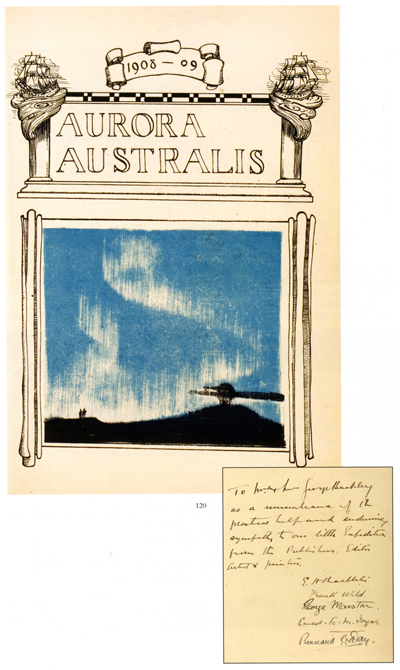
AURORA AUSTRALIS
Auctions—Entries for Aurora Australis in American Book Prices CurrentBookseller Catalogues—
Entries for Aurora Australis in Book Auction Records Individual Sales: (arranged chronologically, earliest first) Sotheby's, London, February 6, 1912 (307)
Hodgson & Co., London, March 20, 1912 (292)
Sotheby's, London, March 28, 1912 (312)
Sotheby's, London, June 27, 1912 (313)
Puttick & Simpson, London, July 26, 1912 (298)
Sotheby's, London, February 5, 1913 (278)
Sotheby's, London, July 20, 1922 (279)
Hodgson & Co., London, May 11, 1928 (293)
Sotheby's, London, October 13, 1942 (280)
Sotheby's, London, January 24, 1949 (281)
Sotheby's, London, February 24, 1953 (282)
Sotheby's, London, May 11, 1953 (283)
Sotheby's, London, April 9, 1957 (284)
Sotheby's, London, July 3, 1967 (285)
Sotheby's, London, May 20, 1969 (286)
Parke-Bernet Galleries, New York, October 21-22, 1969 (Streeter Sale) (250)
Sotheby's, London, November 18, 1969 (287)
Sotheby's, London, July 14, 1970 (288)
Sotheby's, London, November 17, 1970 (289)
Sotheby's, London, November 17, 1970 (290)
Sotheby's, London, June 12, 1972 (314)
Sotheby's Chancery Lane, London, December 12, 1975 (294)
Sotheby's Chancery Lane, London, June 25, 1976 (267)
Phillips, Son & Neale, London, May 17, 1977 (299)
Christie's, London, July 27, 1977 (301)
Sotheby's Chancery Lane, London, June 9, 1978 (296)
Christie's, Sydney, April 23, 1979 (300)
Sotheby's Chancery Lane, London, December 13, 1979 (260)
Christie’s & Edmiston’s, Glasgow, Scottish country house sale, September 20, 1982 (252)
Christie's, London, April 16, 1986 (295)
Sotheby's, London, September 22-October 7, 1986
Sotheby's, London, November 18, 1986 (275) (Same copy as 304)
Gaston Renard-Leonard Joel Auction, Melbourne, Australia, August 30, 1988 (305)
Sotheby's, London, June 27, 1990 (274)
Sotheby's, London, November 29, 1990 (273)
Christie's, London, May 1, 1991 (306)
Sotheby Parke Bernet Galleries, New York, October 11, 1991 (Manney Sale) (304) (Same copy as 275)
Peter Webb Galleries, Auckland, New Zealand, December 10, 1992 (309)
Bloomsbury Book Auctions, London, February 24, 1994 (308)
Gaston Renard-Leonard Joel Auction, Melbourne, Australia, November 16, 1994 (#1) (254)
Gaston Renard-Leonard Joel Auction, Melbourne, Australia, November 16, 1994 (#2) (255)
Sotheby's, London, June 22, 1995 (276)
Christie's King Street London, October 25, 1995 (277)
Christie's King Street London, September 27, 1996 (256)
High Latitude, Bainbridge Island, Washington, September 30, 1996 (Priester Sale) (257)
Christie's King Street London, September 26, 1997 (258)
High Latitude, Bainbridge Island, Washington, September 29, 1999 (Starr Sale) (259)
Christie's King Street London, April 18, 2000 (297)
Bloomsbury Book Auctions, London, September 26, 2000 (261)
Christie's King Street London, September 25, 2001 (Shackleton Collection #1) (262)
Christie's King Street London, September 25, 2001 (Shackleton Collection #2)(263)
Christie's King Street London, May 9, 2002 (Züst Sale) (264)
Christie's King Street London, September 25, 2002 (Silverman Sale #1) (265)
Christie's King Street London, September 25, 2002 (Silverman Sale #2) (266)
Bloomsbury Book Auctions, London, October 16, 2003. (268)
Discovery Book Auctions, Calgary, September 14, 2005 (302)
Christie's King Street London, September 21, 2005 (303)
Anderson & Garland, Newcastle upon Tyne, March 21, 2006. (269)
Christie's King Street London, September 27, 2006 (270)
Swann Galleries, New York, May 24, 2007 (Levinson Sale) (271)
Bonhams, London, June 26, 2007 (272)
Sotheby's, London, September 30, 2015 (Brooke-Hitching Sale, Part 4) (315)
Sotheby's, London, April 28, 2016 (316)
Sotheby's, London, May 22, 2022 (328)Blackwells, Oxford, Catalogue 895, 1970 (311)
Blackwells, Oxford, Catalogue 916, 1971 (310)
Francis Edwards, London, Catalogue 1055, July 1978 (251)
Bob Finch, Torrance, California, Catalogue 16, November 1982 (253)
• Sotheby's, July 3, 1967. (285) Lot 198. [Maggs] £260.1970-1975. None listed
• Sotheby's, May 20, 1969. (286) Lot 378. [Blackwell] £550. (Joints defective. Contents of the Library of Dropmore, Burnham, Buckinghamshire.)
• Sotheby's, November 18, 1969. (287) Lot 367. [Blackwell] £500.
• Sotheby's, July 14, 1970. (288) Lot 541. £380 [Mrs. Standon]. Bdg loose, spine detached. (Probably consigned by "Miss J. Wild" who is listed as one of the consignors in the sale.)
1975-1980. Seven listed:
• Hodgson's (Chancery Lane), December 12, 1975. (294) Lot 226. [Maggs] £740. (Spine rubbed and torn; some leaves detached at perforations.) (Only consignor listed for that sale is "Mrs R. Hardings Francis")1980-1985. One listed:
• Hodgson's (Chancery Lane), June 25, 1976. (267) Lot 408. [Porter] £850. (Only consignors listed for that sale are "Ceylon Assoc.," "L. Dearden," "Charles Hadfield," "George Handelman," and "Anthony Heal")
• Phillips, Son & Neale, May 17, 1977. (314) Lot 30A. [F. Edwards] £500. "orig half lea; worn."
• Christie's, July 27, 1977. (301) Lot 7. [Quaritch] £560. (Signed by Shackleton and Marston.)
• Hodgson's (Chancery Lane), June 9, 1978. (296) Lot 301. [Cavendish] £1,300. (Re-backed.)
• Christie's (Sydney), April 23, 1979. Lot 46. (300) AU$2,900.
• Hodgson's Rooms, December 13, 1979. (297) Lot 193A. £1,000 [Way] (Inscribed by Shackleton to Ernest Perris.)
• Christie's & Edmiston's, Glasgow, September 20, 1982. (252) £1,890 (With front endpaper autographed by Shackleton, Day, Marston, Murray, Mackay and Wild and with related autographed material.) (Only consignor listed for that sale is "Mr & Mrs D.S. Bowser")1985-1990. Three listed:
• Christie's, April 16, 1986. (295) Lot 139. £6,500 [Isles] Rebacked preserving original spine. (Only consignor listed for that sale is "L.A. Mayer Memorial Foundation")1990-1995. Six listed:
• Sotheby's, November 18, 1986. (275) Lot 1223. £7,500 [Quaritch] Rubbed, joint slightly split, loose. Inscribed by the printer Ernest E. Joyce, 1911. (Only consignors listed for that sale are "E.M.M. Besterman" "deLancy Foundation" "Spike Milligan"
• Gaston Renard & Leonard Joel, August 30, 1988. (305) Lot 820. A$40,000. New leather backstrip with orignal harness leather backstrip mounted therein. Without the leaf A Giant Tick was investigating the Carcase.
• Sotheby's, November 29, 1990. (273) Lot 348. £3,500 [R. Waterhouse] Lacking backstrip, loose. One leaf carelessly opened. Inscribed by Shackleton to G. Wyatt Truscott, Lord Mayor of London. (Only consignors listed for that sale are "Sir William Curtis" "Edward Faridany" "Duke of Wellington")1995-2000. Two listed:
• Christie's, May 1, 1991. (306) Lot 93. £22,000 [Lascaux] Inscribed by Shackleton.
• Sotheby's, June 27, 1991. (274) Lot 457. £19,000 [Simper] Inscribed by Shackleton to Mrs Lysaght.] (Only consignors listed for that sale are "Franklin H. Kissner" "Teddy Kollek")
• Sotheby Parke Bernet, Richard Manney Library. October 11, 1991. (304) Lot 274. $24,000. Joints repaired. Inscribed by the printer. Manney copy.
• Bloomsbury Book Auctions, February 24, 1994. (308) Lot 453. £16,000 [Bob Finch] Backstrip detached. One leaf detached. Inscribed by Shackleton and 4 other members of expedition. (Only consignors listed for that sale are "Duncan Carse" "Louis C. Baume". [Baume was the proprietor of the Gastons Alpine Books and was surely the consignor although Carse had Antarctic--South Georgia--connections.])
• Gaston Renard & Leonard Joel, November 15, 1994. (254) Lot 1435. A$25,000. Signed by Shackleton and George Marston.
• Gaston Renard & Leonard Joel. November 16, 1994. (255) Lot 1436. A$20,000. Variant minus 1 plate.
• Sotheby's. June 22, 1995. Lot 188 (276) £7,500 [Antipodean] Restored, soiled. Inscribed by Frank Wild's brother to his grandson, 1970.2000-2004. Two listed:
• Christie's, September 26, 1997. (258) Lot 136. £18,000. Spine present but damaged and covered with protective paper. Inscribed by Shackleton to Sir Thomas Shaughnessy, June 1910.
• Christie's, April 18, 2000. (260) Lot 153. £32,000. (Inscribed by Shackleton to Ernest Perris)
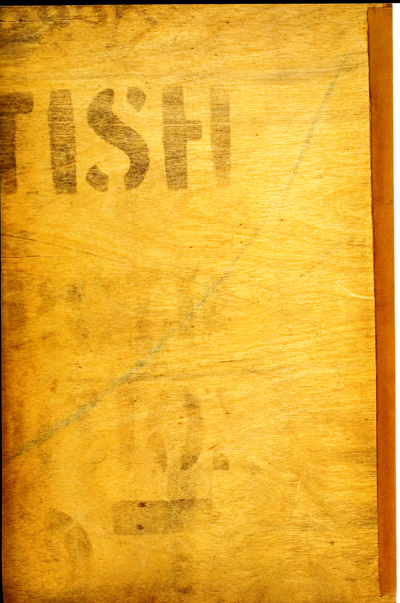
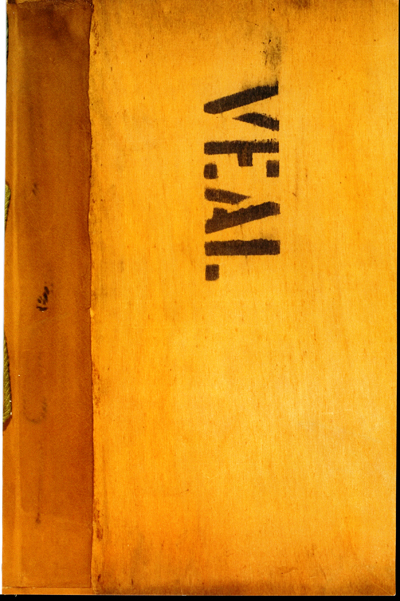
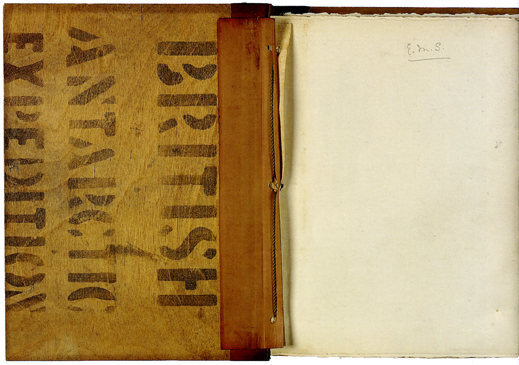
• Bloomsbury Book Auctions, September 26, 2000. (261) Lot 300. [Kossow] £42,000. (Upper cover verso: ID BRITISH ANTA[rctic] EXPEDITION. Lower cover verso: BUTTER. Lith title and 11 plates.)
• Sotheby's, Feb 6, 1912. (307) Lot 526. £8 5s. [Johnston]Vol 10, 1912-13 One listed:
• Hodgson and Company, March 20, 1912. (292) Lot 216. £4 4s.
• Sotheby's, March 28, 1912. (312) Lot 218. £10 5s. [Maylin] "only 90 were printed."
• Sotheby's, June 27, 1912. 313 Lot 180. £5 7/6 [F. Edwards] Recorded by John Millard but not found.
• Sotheby's, Feb 5, 1912. (278) Lot 811. £4. [B.F. Stevens]Vol 11, 1913-14. None listed
• Sotheby's, June 20, 1922. (279) Lot 486. £5. [Hope] "signed in the handwriting of the Editor."Vol 20, 1922-23. None listed.
• Hodgson & Company, May 11, 1928. (293) Lot 549. £2 10s. [F. Edwards] "signed."Vol 26, 1928-29. None listed.
• Sotheby's, October 15, 1942. (279) Lot 669. £32. [Maggs] Consignor: "Manuscripts, Printed Books, etc.—the Duke of Gloucester's Red Cross and St. John Fund." "Author's Autog. Pres. inscrip. on title: 'To Rudyard Kipling with Ernest Shackleton's Regards, 1914.' Kipling's bkpl. inside cover." See Copy 12, Dulwich College.Vol 41, 1943-34. None listed.
• Sotheby's, January 24, 1949. (281) Lot 148. £11. [Maggs] "The late Sir Bernard Eckstein, BT., and others."Vol 47, 1949-50. None listed.
• Sotheby's, February 24, 1953. (282) Lot 243. £27. [Patch] Inscribed "to Miss D. Lambton from the Editor & printers, Dec 25th, 1909". "The Rt. Hon. Lord Sandys & others"Vol 51, 1953-54. None listed.
• Sotheby's, May 11, 1953. (283) Lot 128. £19. [Maggs] "Charles Ramsden, Esq., & others"
• Sotheby's, April 9, 1957. (284) Lot 438. £24. [F. Edwards] "The Bishop's Court estate & others"Vol 55, 1957-58. None listed.
• Sotheby's, July 3, 1967. (285) Lot 198. £260. [Maggs] "The Rt. Hon. The Earl of Amherst & others"Vol 65, 1967-68. None listed.
• Sotheby's, May 20, 1969. (286) Lot 378. £550. [Blackwell] "The Most Noble the Marquess of Hertford & others"Vol 67, 1969-70. One listed:
• Sotheby's, July 14, 1970. (288) Lot 541. £380. [Mrs Standon] Col litho view on t-p, 11 full page illust (4 etched, others lithod). Loose in bdg. Spine blind stamped. Spine detached.Vol 68, 1970-71. Two listed:
• Sotheby's, November 17, 1970. (289) Lot 265. £450. [Maggs] Presentation copy inscribed to Henry Nuttall. Cold. litho view, 11 lithos & etchings.
• Sotheby's, November 17, 1970. (290) Lot 266. £350. [Maggs] Presentation copy inscribed to Belle Donaldson.
• Sotheby's, June 12, 1971. (314) Lot 118. £650. [Gaston Alpine Books] Signed by the editor & artist.
• Hodgsons Rooms, December 12, 1975. (294) Lot 226. £740. [Maggs] Signed by Shackleton & Marston. Some leaves detached.Vol 74, 1976-77. One listed:
• Hodgsons Rooms, June 25, 1976. (267) Lot 408. £850. [Porter] Recorded by John Millard.
• Phillips, Son & Neale, May 17, 1977. (314) Lot 30a. £500. [Edwards]Vol 75, 1977-78. Two listed:
• Christie's, July 27, 1978. (301) Lot 7. £560. [Quaritch] Col litho tp.Vol 76, 1978-79. None listed.
• Hodgsons Rooms, June 9, 1978. (296) Lot 301. £1,300. [Cavendish] Wild's copy. TLs from Evans to Stanley Wild. Col litho tp. 11 lithos & etchings. Rebacked.
• Hodgsons Rooms, December 13, 1979. (260) Lot 193A. £1,000. [Way] "inscribed Ernest Perris"Vol 78, 1980-81. None listed.
• Christie's & Edmiston's, September 20, 1982. (252) Lot 336. £1,800. Front e-p signed by Shackleton, Bernard Day, Marston, James Murry [sic], & others. With postcard dated 26 May 1910 &. menu card for Penguin Club dated 26 May 1910, both designed by Marston, with autographs including Bernacchi, J.B. Stenhouse, Stefansson.Vol 81, 1983-84. None listed.
• Christie's, April 16, 1986. (295) Lot 139. £6,500. [Isles] "tp, 4 etched plates plus 6 lithos. Rebacked. Buckram box."Vol 84, 1986-87. One listed:
• Sotheby's, November 18, 1986. (275) Lot 1223. £7,500. [Quaritch] "Litho title, 11 lithos or etchings. Many leaves loose (torn at punchholes), lower right corner of upper cover slightly chipped." "With Best Wishes to Mr. & Mrs. Hill from the printer Ernest E. Joyce August 19th 1911." Also copy 304.Vol 85, 1987-88. None listed.
• Gaston Renard and Leonard Joel, August 30, 1988. (305) Lot 820. AUD40,000. "109 unnumbered leaves incl. 10 full-p plts (6 lithos, 2 mntd., 4 etchings), new leather backstrip with original leather backstrip mntd. on."Vol 87, 1989-90. None listed.
• Sotheby's, November 29, 1990. (273) Lot 348. £3,500. [R. Waterhouse] "Inscribed on flyleaf to G. Wyatt Truscott"Vol 89, 1991-92. One listed:
• Christie's, May 1, 1991. (306) Lot 93. £22,000. [Lascaux] "Stencil top inner part of 'British Antarctic Expedition case 705', front free ep inscribed by editor with 4-line stanza from poem by R. Service & added note initialled EHS."
• Sotheby's, June 27, 1991. (274) Lot 457. £19,000. [J. Simper] "Mrs Lysaght Feb 1910"
• Sotheby Park Bernet, May 1, 1991. (304) Lot 274. $24,000. "t-p coloured. 3 tipped-in illus. 1 sepia 6 b&w 4 etchings. Inscribed by printer on 2nd lf (blank) to Mr and Mrs Hill 19 Aug 1911. Joints restored." Manney copy. Also copy 275.Vol 90, 1992-93. None listed.
• Bloomsbury Book Auctions, February 24, 1994. (308) Lot 453. £16,000. [Bob Finch] "Inscribed to Mr and Mrs Buckley, signed by author, Wild, Marston, Joyce and Day. Membership card of the Antarctic Club. L.C. Baume Liby. Also copy 271.Vols 92, 1994-95. One listed:
• Sotheby's, June 22, 1995. (276) Lot 188. £7,500. [Antipodean] 11 etched or litho plates, small wormholes. Lower right corner restored. Slightly soiled. Front end-lf inscribed "To N.J. Fright 31 Dec 1970 from L.C. Wild."Vols 93, 1995. One listed:
• Christie's, October 25, 1995. (277) Lot 149. £1,600. Col litho t-p. 10 of 11 plates. Inner margins reinforced. Few margins repaired. Resewed. Rebacked by South African library, Cape Town.Vols 94, 1996. One listed:
• Christie's, September 27, 1996. (276) Lot 161. £24,000. Litho t-p. 11 plates. "BISCUIT" on upper cover verso. Joints splitting.Vols 95, 1997. One listed:
• Christie's, September 26, 1997. (258) Lot 136. £10,700 including buyer's premium. 11 plates. OATMEAL on upper cover verso. Spine defective & crudely paper-bkd. Copy of Thos. Geo. Shaunessy [sic], 1st Baron Shaughnessy of Montreal & Ashford with presentation inscription from author on front blank dated Jun 1910.The British Library has no more recent volumes in this series.
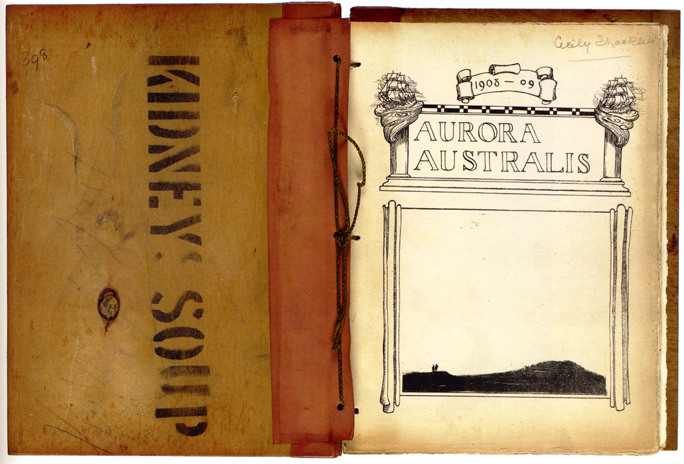
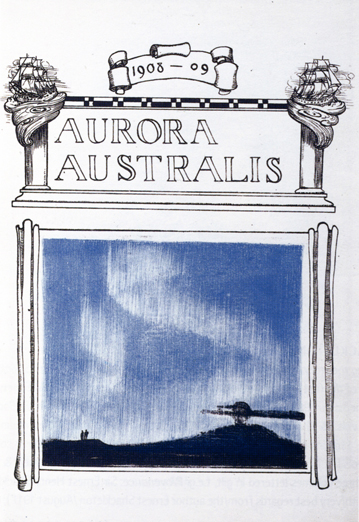
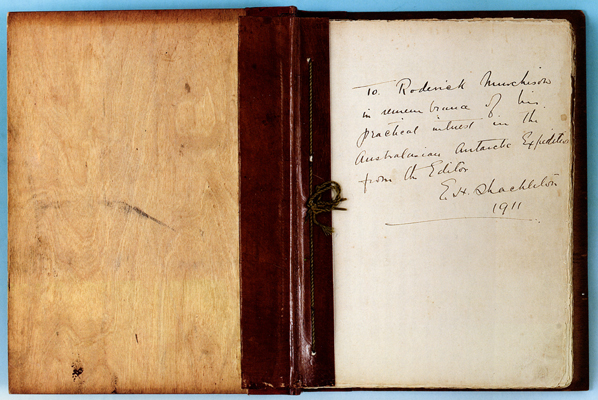
NB: This work was the first book completely printed and produced on the Antarctic Continent. In 1907 Shackleton embarked on an expedition to Antarctica aboard the Nimrod in an attempt to be the first to reach the South Pole. Having already visited the polar regions with Robert Falcon Scott on the Discovery Voyage 1903-04, Shackleton recognised the importance of maintaining moral among crew members during the dark winter months; and so to keep boredom at bay, the expedition took with them a printing press, an etching press, quantities of paper and ink and other materials needed to write, typeset, illustrate and bind a full-length publication. This book was produced under extremely difficult conditions in the cramped hut at Cape Royds on Ross Island - the expedition's base and home to fifteen men. Frank Wild and Ernest Joyce had learned the essentials of printing in England prior to departure, but with outdoor temperatures of minus 50 deg. or less, and indoor temperatures often below freezing, they had to move a candle back and forth under the ink plate to keep the ink from freezing solid. Expedition artist George Marston illustrated the volume with etchings and colour lithographs. Crew biologist James Murray, working on his specimens alongside Marston's etching press, noted "I've seen him during a whole night pull of half a dozen wrong ones for one good print, and he did not use so much language over it as might have been expected". Bernard Day, the expedition's motor mechanic, bound the book using venesta board - an early form of plywood - from packing cases to make book covers. These boards often bear stencilled letters indicating the original contents of the packing cases such as bottled fruit, chocolate, or as in this case, marmalade. They then used old pony harness and seal skin for the spine and hinges which secured with cords.
About 100 copies were produced; the exact figure is unknown as copies were not numbered. Of these it is thought about 25 to 30 were bound as in this example. The contents also differ somewhat from copy to copy.
Although produced mainly for presentation to members, friends and backers of Shackleton's expedition, relatively few copies are in fact signed or inscribed in any way; this copy is dedicated to Viscountess Grey, wife of the fourth Earl and one time Governor General of Canada.
£10000-18000
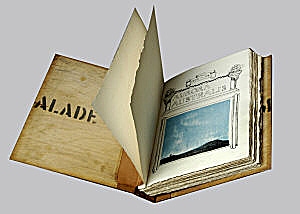
Results: £46,000 which with the buyer's premium took it to £53,000 or ca. $92,000, probably the highest an Aurora has ever sold for at auction. Here's what was said in the local paper:
Polar book is sold off for £53,000
By Tony Henderson, The Journal
A book printed in the Antarctic which ended up in a Northumberland stables yesterday became the most expensive volume to be sold in the North-East.
One of only 100 produced at explorer Ernest Shackleton's overwintering base, it was sold for £53,000 by Newcastle auction house Anderson & Garland.
What is technically the first book printed in the Antarctic had been signed by Shackleton to Lady Grey, the wife of Albert Henry Grey, 4th Earl Grey whose family seat was Howick Hall in Northumberland.
And it will be staying in the North-East as a Northumberland polar enthusiast beat off national and international interest, including bids from New York and Canada.
The book's covers are made from the thin wooden packing of a crate which contained marmalade and pony harness and seal skin were used for the binding. The 1908 British Antarctic Expedition was the second of four to the South Pole by Shackleton.
He took a small printing and etching press to relieve boredom and keep up morale during the long winter months holed up in the expedition base. Team members wrote items, illustrated by lithographs and etchings.
Auction house book specialist John Anderson discovered the book, which was sold by a descendant of Lady Grey, in a tea chest in stables.
He said: "It was a privilege to handle a book which resonates with history. It is an evocative rarity. Not only is the book phenomenally rare, but Shackleton did not sign every book, but he did sign this one to Lady Grey."
The books, never numbered, are known by the stenciled descriptions of what the packing cases contained, such as the chocolate, bottled fruit and coffee editions.
—From The Journal. 23 March 2006
Aurora Australis 1908-09 [comprising Ten Articles and Poems by Members of Shackleton's First Antarctic Expedition with a Preface and Additional Preface by E.H. Shackleton]. Published at the Winter Quarters of the British Antarctic Expedition 1907, during the Winter Months of April, May, June, July, 1908. Illustrated with Lithographs and Etchings; by George Marston. Printed at the Sign of 'The Penguins' ; by Joyce and Wilde. [sic] Latitude 77° ...32' South, Longitude 166° ...12' East, Antarctica [1908].Notes: See 286 261 109 which are the same copies.
[one of 100 copies] illustration in colours on title and 11 other full-page illustrations (10 printed on separate leaves or tipped in), each of the articles preceded by a blank leaf and a sub-title printed in red, 9 of the plates preceded by a leaf with the title printed in red, [168] pp. (not including blanks and separately printed plates).
4to, orig. qtr. leather, backstrip lettered in blind, bevelled wooden boards prepared by Bernard C. Day from the expedition's Venesta provision cases (the inside of the front covered lettered 'British Anta Expedition' and the inside of the back cover lettered 'Butter'), the wood-lined leather back detached and rubbed, bottom edge of front board chipped, the boards and leaves laced together individually with green twine, edges untrimmed. £825
'Joyce, Wild, Marston and Day during the winter months spent much time in the production of the "Aurora Australis" the first book ever written, printed, illustrated and bound in the Antarctic.' Shackleton: Heart of the Antarctic (1909), I. 216-7.
'A hundred copies were printed, but none for sale, and the work is already a rarity for bibliophiles'. Mill: Life of Sir Ernest Shackleton (1923), p.180.

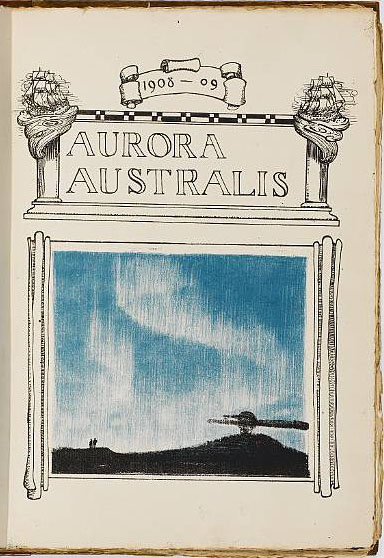
"The fifth Aurora Australis went with Wild to South Africa and somehow it was acquired by POB Frost and eventually found its way to Brian Frost in Cape Town.Results: £1,600
In 1992 Brian Frost, who was thinking of selling the book, contacted Spink & Son who advised him that it was worth approximately £10,000.00…
Brian Frost eventually sold the book through Christies on the 25th October 1995 for an unusually low price of £1,600 to a buyer in the USA. The inside front cover revealed the letters GRIFFITHS, McALIS… EXPORT PROVISION M... LIVERPO[ool]' with pencilled note BAKES BEANS, below that similarly stencilled BLAC[k]... BOTTLE. The book had been restored by the conservators of the South African library in Cape Town for the sum of R800 which resulted in obscuring the original stitching holes in the inner margins. The book had its own leather-lined cloth solander box, again restored, which also contained a portion of the original spine and a length of the green twine used in the original binding.
Christie’s informed Brian Frost that when cataloguing the book they discovered the sketch 'Under the shadow of Erebus' by Marston was missing and with the book incomplete its original estimated value of £5,000 - £8,000 had depreciated to £1,500/£2,000…The buyer is unknown."
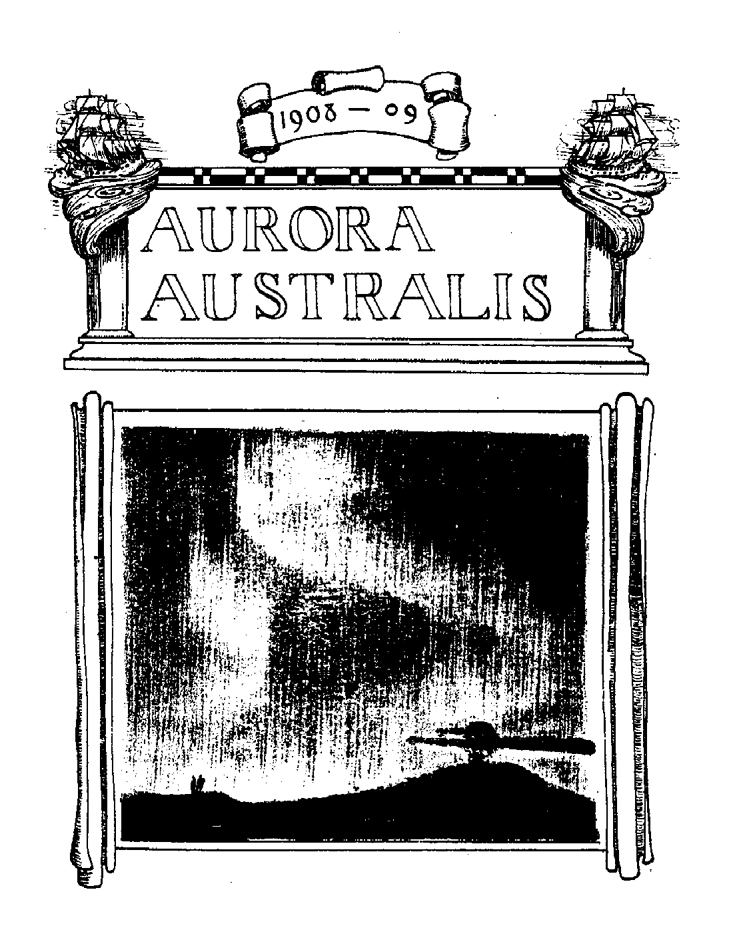
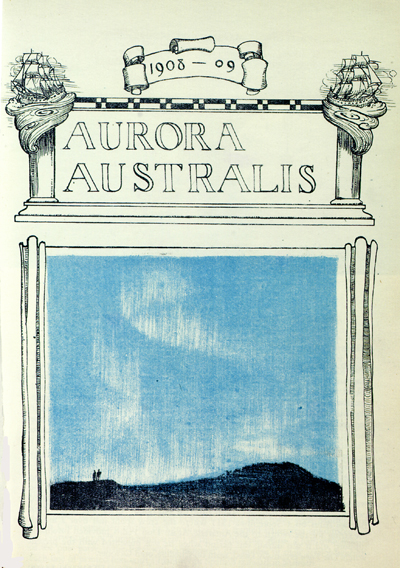

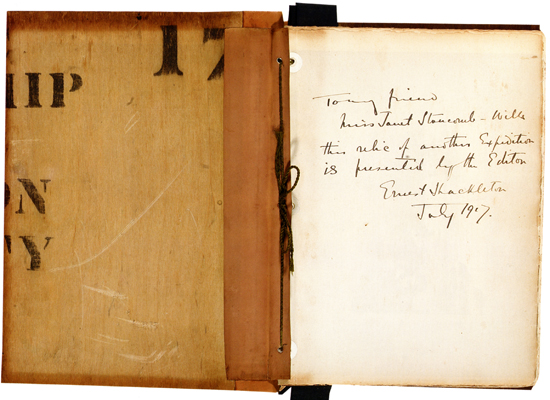
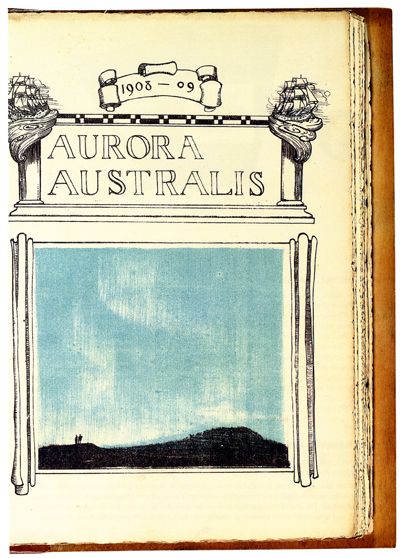
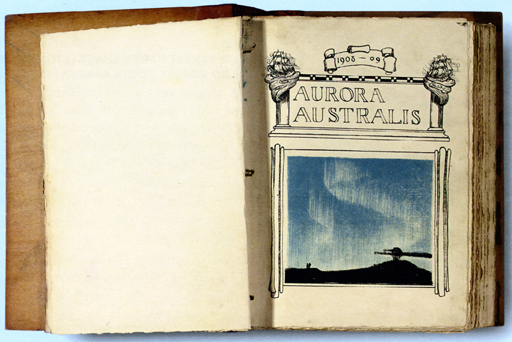

A fine copy of the first book printed in Antarctica. The flyleaf is inscribed "To Mrs. Lysaght from the Editor E.H. Shackleton with best wishes Feb. 1910", and with a postal cover addressed to Mrs. Lysaght in Shackleton's hand neatly tipped in bearing stamps of New Zealand overprinted "King Edward VII Land", one bearing the expeditionary postmark, the other with "British Antarctic Expedition 1907" printed in blue below.(Only consignors listed for that sale are "Franklin H. Kissner" "Teddy Kollek")
Gerald Lysaght was a steelmaker from Scunthorpe who first met Shackleton in 1899 when the latter was an officer on the Union Castle liner Tantallon Castle. He was a signficant sponsor of both the Nimrod and 1907 expeditions [sic].
This work was printed at Cape Royds during the Antarctic winter months of 1908. The wooden boards for binding were taken from the expedition's packing cases and frequently, as here, exhibit stencilling. The method of binding devised by the mechanic Day involved punching holes in the inner margins to be secured by a cord, whilst the leather spine was made from old harness. Neither the 'sewing' nor the 'binding' were practical for reasonable use and have failed to some degree in almost surviving copies. This copy is in an unusually fine state the only defect mentionable being a few leaves slightly strained at the cords. The boards are in remarkably fresh condition. £10,000-12,000
The first book printed in Antarctica.Estimate: £8,000-10,000
This copy bears the inscription: "To my grandson Nicholas J. Fright on his 21st. Birthday 31 December 1970. To keep in memory of his great-uncle Frank Wild, who made this book in the Antarctic. With best wishes, Laurence C. Wild." Laurence C. Wild was a brother of Frank Wild.
This work was printed at Cape Royds during the Antarctic winter months of April-July 1908. The wooden boards used for binding were taken from the expedition's packing cases and frequently exhibit stencilling, as here: BRITISH ANT / SHIP NIM / LYTT on the inside of the upper board. The method of binding devised by the mechanic day involved punching holes in the inner margins to be secured by a cord, while the spine was made from harness leather. Neither the 'sewing' nor the 'binding' was practical for reasonable use and have failed to some degree in almost all surviving copies.